Table of Contents
The conference room smells like stale coffee and desperation. A manager sits alone at 7 PM, staring at a spreadsheet that refuses to make sense. Three departments want different things. The deadline moved up. Again. Someone on the team just quit.
This is when the chess masters speak loudest.
Not because chess and management are identical. They’re not. But because both require something most people forget: the ability to think several moves ahead while everything around you is falling apart. Chess grandmasters spent centuries figuring out how humans make decisions under pressure. Managers are still trying to catch up.
Here are ten quotes from the chessboard that belong on every manager’s desk. Not as motivational fluff, but as operating principles for when things get real.
1. “The hardest game to win is a won game.” – Emanuel Lasker
Emanuel Lasker held the world chess championship for 27 years, longer than anyone in history. He understood something that destroys more managers than any competitor ever could: success makes people stupid.
A product team finally ships the feature everyone wanted. Six months later, that same team is buried in technical debt and missing every deadline. What happened? They won, then stopped playing carefully.
Lasker watched players dominate for 30 moves, build overwhelming advantages, then collapse. The psychological shift is predictable. When you’re ahead, you stop calculating. You start assuming. Every move feels easy because you’re winning. Then one careless decision, and the advantage evaporates.
Management works the same way. A company lands a major client and immediately starts acting like that client will never leave. A team completes a successful project and assumes the next one will be just as smooth. The sales pipeline looks healthy, so hiring decisions get sloppy.
The hardest part isn’t getting ahead. It’s staying focused when everything feels safe. When the pressure drops, so does performance. The best managers treat success like Lasker treated a winning position: as something fragile that requires even more attention than when things were difficult.
2. “Even a poor plan is better than no plan at all.” – Mikhail Chigorin
Chigorin never became world champion, but he revolutionized chess thinking in the late 1800s. His quote gets misused constantly. People think he’s saying any plan works. He’s not.
He’s saying that having a bad plan forces you to think. No plan means you’re just reacting. Reaction feels productive. It’s not.
A manager without a plan spends the entire day responding to whoever yells loudest. Email. Slack. The fire in production. The upset client. By 6 PM, they’ve been busy for ten hours and accomplished nothing that matters.
A manager with even a rough plan has a filter. When someone asks for time, there’s a question to answer: does this serve the plan? If not, it waits. The plan might be wrong. That’s fine. Wrong plans reveal themselves quickly. No plan just keeps you busy until you burn out.
Chigorin knew something else: a mediocre plan you actually follow beats a perfect plan you abandon. Managers love making elaborate strategies they never execute. They’d be better off with three simple priorities they check every morning.
The plan doesn’t need to be brilliant. It needs to exist.
3. “Tactics is knowing what to do when there is something to do. Strategy is knowing what to do when there is nothing to do.” – Savielly Tartakower
Tartakower was a grandmaster who understood that most people have this backwards. They think strategy is the hard part. It’s not.
When something breaks, most managers are excellent. A crisis focuses the mind. The server crashes, and everyone knows what to do. Fix it. The client threatens to leave, and the response is clear. Save the account.
Strategy is harder because nothing is on fire. The company is stable. Revenue is okay. The team seems fine. What do you do? Most managers do nothing and call it “steady state.” Then six months later, everything falls apart at once and they wonder why.
Tartakower saw this in chess. When the position gets complicated, players calculate brilliantly. But in quiet positions, they drift. They make meaningless moves. They wait for something to happen instead of making something happen.
The best managers are dangerous during boring times. That’s when they reorganize team structures before problems emerge. When they invest in tools that won’t pay off for a year. When they have difficult conversations that aren’t urgent yet.
Anyone can manage a crisis. Professionals manage the silence.
4. “When you see a good move, look for a better one.” – Emanuel Lasker
Lasker appears twice on this list because he understood human nature better than most psychologists. This quote sounds like perfectionism. It’s the opposite.
It’s about checking your impulses.
A manager gets excited about a solution. It makes sense. It feels right. Every instinct says to move forward. That’s exactly when Lasker says to pause.
Not because the first idea is always wrong, but because the first idea is always easy. The brain stops searching the moment it finds something acceptable. This is efficient for survival and terrible for complex decisions.
A team needs to hit a deadline. The obvious solution is to work weekends. It would work. But is there a better move? Could you cut scope? Delay something else? Add a contractor for two weeks? Most managers never ask because they already found an answer.
The better move isn’t always more complicated. Sometimes it’s simpler. But you only find it if you force yourself to keep looking after you think you’re done.
Lasker’s rule creates a habit: when you feel certain, that’s your signal to doubt. Not paralyzing doubt. Productive doubt. The kind that asks “what am I missing?” before you commit.
5. “The blunders are all there on the board, waiting to be made.” – Savielly Tartakower
Tartakower again, with perhaps the most honest thing anyone has said about decision making. The mistakes already exist. You’re going to make them. The question is which ones and when.
This terrifies new managers. They think their job is to never mess up. So they become cautious. They delay decisions. They wait for more data. They form committees. The fear of making the wrong move means they make no move at all.
Senior managers know better. They know some decisions will be wrong. The goal isn’t perfection. The goal is making mistakes you can recover from rather than mistakes that kill you.
A manager hires the wrong person. That’s recoverable if you catch it in three months. It’s not recoverable if you wait a year because you were afraid to admit the mistake. A product feature fails. That’s fine if you killed it after two months of data. It’s not fine if you kept funding it for two years because no one wanted to accept defeat.
The blunders are waiting. Tartakower’s insight is that you get to choose your blunders. Pick the ones you can learn from. Avoid the ones you can’t survive.
6. “Every chess master was once a beginner.” – Irving Chernev
Chernev was a chess writer, not a grandmaster, but he documented thousands of games. He saw the same pattern repeatedly: masters didn’t start as geniuses. They started as people who refused to quit when they were terrible.
This matters in management because everyone forgets it. A new manager watches a VP run a meeting effortlessly and thinks “I could never do that.” They’re comparing their struggle to someone else’s highlight reel. The VP also couldn’t do that at first. They just practiced for ten years where no one was watching.
Competence is mostly just repetition plus feedback. A manager runs their first one on one and it’s awkward. They run fifty one on ones and develop a rhythm. They run five hundred and people think they’re naturally gifted at coaching.
The gap between beginner and master isn’t talent. It’s that masters kept going through the part where they weren’t good yet. Most people quit when they’re beginners because being bad feels terrible. The ones who become experts simply decided that feeling terrible was temporary.
Every manager who looks confident today was confused yesterday. They just didn’t stop.
7. “In life, as in chess, forethought wins.” – Charles Buxton
Buxton wasn’t a chess player. He was a 19th century politician who saw the connection between chess and everything else. Forethought means thinking about what happens after the next thing happens.
A manager approves a project without asking what it means for the team’s capacity next quarter. They hire three people without considering who will train them. They commit to a deadline without thinking through dependencies. Then they act surprised when everything collides.
Chess players learn forethought or they lose. Every move creates a new position. That position creates requirements. If you only think one step ahead, you walk into traps you could see coming.
The same manager who would never make a single move in chess without considering responses will make business decisions based purely on solving the immediate problem. The disconnect is fascinating.
Forethought isn’t about predicting the future. It’s about asking “and then what?” before you act. If we launch this feature, what will customers expect next? If we expand the team, what systems need to change? If we enter this market, what does that mean for our existing business?
Most business disasters aren’t unpredictable. They’re unthought. Forethought is free. The consequences of skipping it are not.
8. “The winner of the game is the player who makes the next to last mistake.” – Tartakower
This is Tartakower’s third appearance because he had a gift for uncomfortable truths. This quote describes most business competition. Companies don’t win because they’re flawless. They win because they screwed up less recently than their competitor.
Look at any industry. The leader usually isn’t the one with the perfect strategy. They’re the one whose competitor made a worse mistake at a worse time. A company dominates social media not because they’re brilliant but because their predecessor became arrogant. A startup wins a market not because their product is perfect but because the incumbent ignored them until it was too late.
This should be liberating for managers. You don’t need to be perfect. You need to be marginally less wrong than the alternative.
But the quote has a darker side. It means you can do everything right and still lose because someone else simply made fewer mistakes. Your product can be better. Your team can be stronger. Your strategy can be smarter. And you can still get beaten by whoever messed up less.
This is why paranoia keeps companies alive. The moment you think you’ve figured it out is the moment before you make the next to last mistake. Staying ahead means staying worried.
9. “I always prefer to sacrifice my opponent’s pieces.” – Savielly Tartakower
Tartakower with the darkest joke on this list. In chess, sacrifice means giving up your own pieces for an advantage. Tartakower is saying he’d rather not give up anything at all.
Obviously.
But managers forget this constantly. They think leadership means sacrifice. Making hard choices. Taking one for the team. Sometimes it does. But often it means they’re solving the wrong problem.
A manager needs to cut costs. They immediately think about what to sacrifice from their team. Budget, headcount, projects. Sometimes they need to. But the best managers first ask if there’s a way to make someone else’s team handle the burden. Not out of cruelty, but out of strategy.
Your team has limited resources. Every sacrifice you make voluntarily is a resource you can’t use later. The question isn’t whether you’re willing to sacrifice. The question is whether you’ve exhausted every option that doesn’t require it.
This isn’t about avoiding hard decisions. It’s about not making them harder than necessary. When a choice seems binary, when sacrifice seems inevitable, that’s when managers should think like Tartakower. Is there a third option where you keep your pieces and still solve the problem?
Usually, there is.
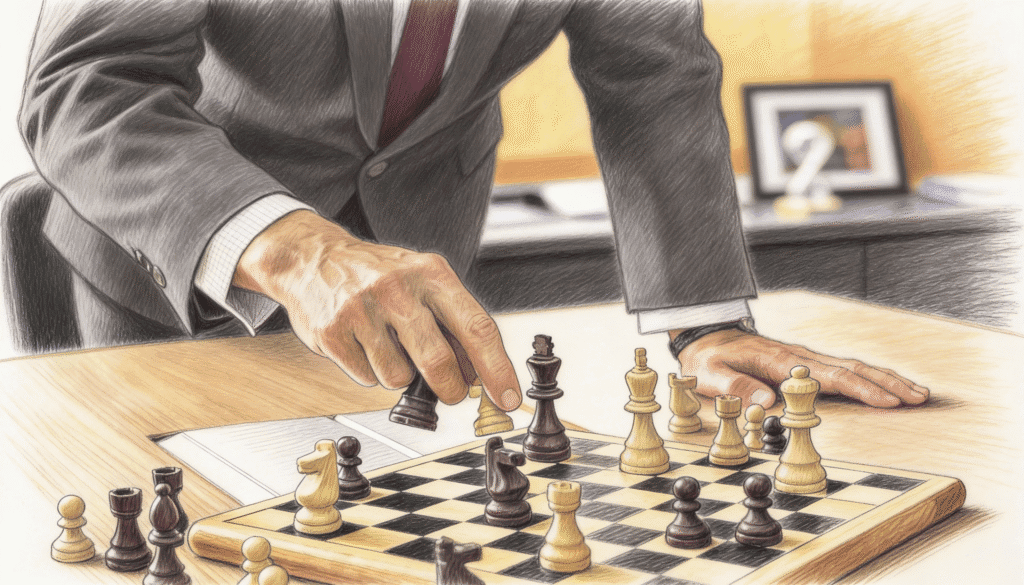
10. “Avoid the crowd. Do your own thinking independently. Be the chess player, not the chess piece.” – Ralph Charell
Charell captures the fundamental split in any organization. Some people move the pieces. Others get moved. Most managers think they’re players. They’re pieces.
The difference is simple. Players decide strategy based on the whole board. Pieces execute someone else’s plan. Players ask why. Pieces ask how.
A manager gets told to implement a new process. The piece implements it and hopes it works. The player asks what problem they’re solving and whether this process actually solves it. Not to be difficult. To avoid wasting time on something that doesn’t matter.
Organizations need both. But they don’t need managers who think like pieces. They need managers who understand the full board, question bad strategies, and make independent judgments about what serves the goal.
This creates tension. Companies say they want independent thinking, then punish people who think differently. The real test of whether you’re playing chess or being played is simple: do you make moves based on what you see, or based on what you’re told?
Being the chess player means accepting responsibility for your moves. It means you can’t blame the plan when things fail because you should have seen the problem. It means you get questioned constantly because you’re making decisions others don’t understand yet.
Most managers prefer being pieces. It’s safer. The truly good ones refuse.
These quotes won’t fix a broken strategy. They won’t make hard conversations easier. They won’t turn a bad team into a good one.
What they will do is create better reflexes. When you see a decision looming, one of these quotes will whisper. The next time you’re tempted to relax because things are going well, Lasker reminds you that’s when the danger starts. When you’re stuck choosing between bad options, Tartakower tells you to look for the one you can recover from.
The chess masters spent their lives studying how people make choices under pressure. They left behind patterns that work. Managers who ignore those patterns spend years relearning lessons that were already solved.
Print these quotes. Actually tape them to your desk. Not as inspiration, but as interrupts. Let them stop you before you make the obvious mistake. Let them push you to think one move deeper than feels necessary.
Because the hardest game to win is still a won game. And the board is still covered in blunders waiting to be made. The only question is whether you’ll be the player or the piece.