Table of Contents
Picture a mail ship cutting through the Irish Sea in 1824. The waves crash against the hull. The steam engine churns below deck. And in the captain’s quarters, a Welsh seafarer hunches over a chessboard, working out an idea that would shake the chess world for the next two centuries as Evans Gambit.
Captain William Davies Evans was born on January 27, 1790, at a farm in Pembrokeshire, Wales. He was not born into chess royalty. He was not a child prodigy who learned the game at five. In fact, Evans came to chess relatively late. He learned to move the pieces at around twenty eight years old. By that age, most chess masters have already established their reputations. Evans was just beginning.
But timing, as it turns out, matters less than vision.
The Sailor Who Joined Too Young
At fourteen, Evans made his first sacrifice by joining the Royal Navy. This was during the age of Nelson, when Britain ruled the waves and Napoleon threatened Europe. Evans fought in the Napoleonic Wars until 1815. When the wars ended, he transitioned to the merchant service. By 1819, he became captain of a postal ship called ‘The Auckland.’
The life of a mail packet captain meant regular routes between ports. Evans commanded vessels sailing between Milford Haven in Wales and Waterford in Ireland. These were not long voyages to exotic lands. They were routine trips across the Irish Sea. The kind of trips where a man had time to think.
And think Evans did.
He played chess with Lieutenant Harry Wilson, a naval officer with some reputation in the game. The two men battled over the board countless times. Evans started out receiving heavy odds. He began by accepting a full rook handicap from Wilson. But gradually, through practice and correspondence with chess writers like William Lewis and George Walker, Evans improved. Eventually, he played Wilson on equal terms and won.
The Birth of the Gambit
Sometime around 1824, while captaining his steam postal packet between Milford and Waterford, Evans invented the opening that would bear his name. The ship’s passages were perfect for chess study. The route was familiar. The crew knew their work. Evans had hours to explore chess positions.
The question that consumed him was this: How do you break through in the Italian opening when both sides develop normally? How do you turn a quiet position into something explosive?
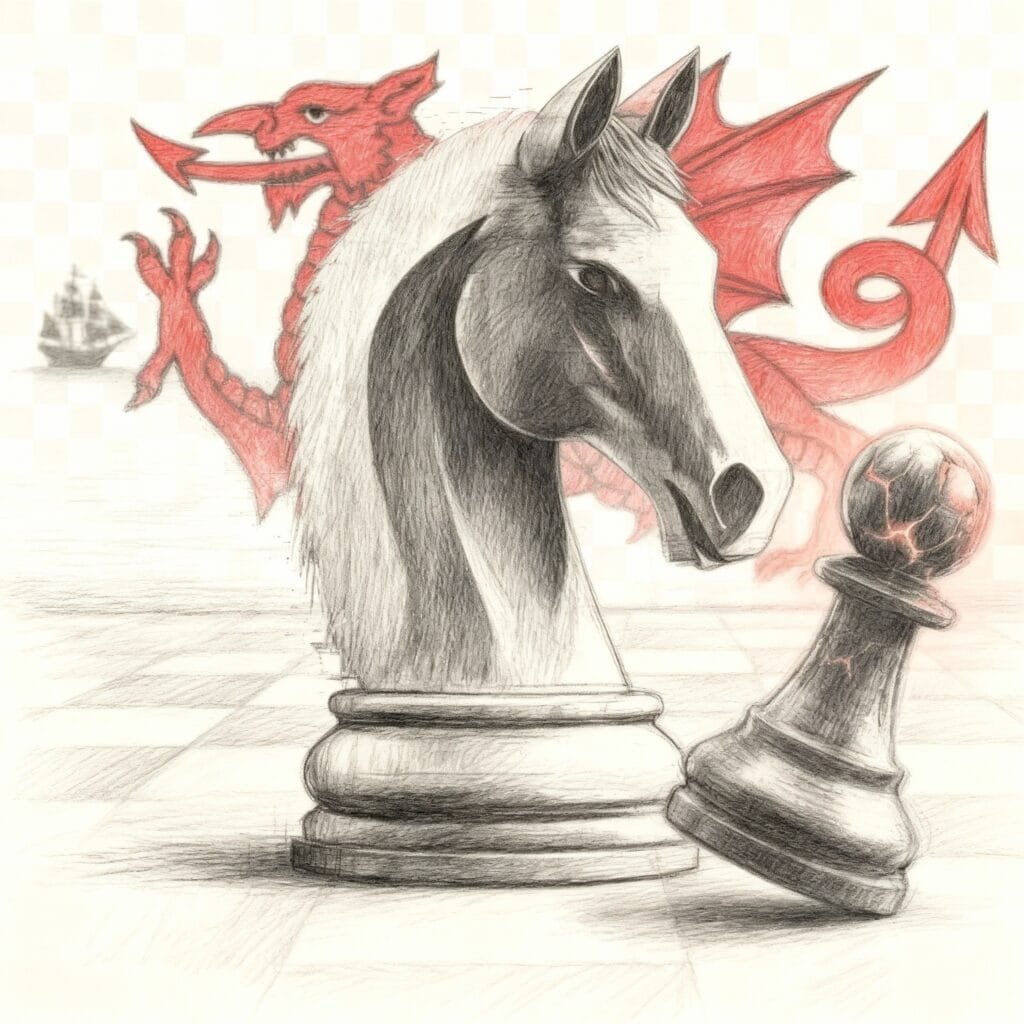
His answer was radical for its time. Give up material. Deliberately. Not because of a miscalculation, but as a calculated investment. Offer a pawn not to regain it immediately, but to buy something more valuable. Time. Space. Initiative.
The idea was to sacrifice a pawn to divert the opponent’s bishop and rapidly control the center. While the opponent collected material, Evans would collect everything else: development, open lines, attacking chances.
It was, in many ways, a sailor’s philosophy applied to chess. Trade the cargo, but keep control of the ship.
The London Debut
In 1826 or 1827, Evans was on shore leave in London. This was his chance. London was the chess center of the British world. And playing in London was Alexander McDonnell, one of the strongest players anywhere. McDonnell was considered the strongest player Ireland ever produced.
The unknown sea captain sat down against the chess master. And then Evans unveiled his idea.
The game was not perfect. Later analysis would find improvements for both sides. But the concept was sound, and more importantly, it worked. Evans introduced his sacrificial concept, and it made an immediate impact. A few years later, he would play McDonnell again with a refined version of the gambit and win decisively.
Andrew Soltis later commented that Evans was “the first player to be widely honored for an opening we know he played.” Before Evans, openings were named after places or general themes. The Spanish. The Italian. The French. Evans put a person’s name on the chess map.
The Philosophy Behind the Sacrifice
To understand why Evans sacrificed, you must understand the chess of his time. The 1820s and 1830s represented what historians call the Romantic era of chess. This was before the age of deep theory. Before computers. Before books analyzing every variation to move thirty.
Chess in the Romantic era valued brilliance over safety. Attack over defense. Beauty over points. Players sought immortal games, not draws with optimal play.
The Evans Gambit reflected this spirit perfectly, prioritizing concepts like initiative and tempo over material. Evans understood something fundamental: a pawn is worth less than you think when your pieces are paralyzed. Conversely, active pieces are worth more than you think, even if you’re down material.
By sacrificing the pawn, White gains time to rapidly develop pieces and seize control of the center. The opponent accepts the pawn but then must waste moves retreating the bishop. Meanwhile, White pushes pawns forward, opens lines, and coordinates an attack.
Think of it as a transaction. Evans was buying time with material. And in the opening stages of chess, time is currency.
The Gambit Goes Viral
The gambit became extremely popular and was played multiple times in the famous 1834 match between McDonnell and Louis de Labourdonnais. This was the “Match of the 19th Century,” a legendary series of games between two titans. Both players used the Evans Gambit. Both as White and as Black. They were testing it, exploring it, spreading it.
In those days, there were no chess databases, no opening books to speak of. But in the small world of chess, opening ideas were infectious. Evans had transmitted his gambit to McDonnell. McDonnell shared it with Labourdonnais. Labourdonnais brought it to Paris. The gambit spread through games, through chess clubs, through word of mouth.
Soon, every strong player was trying it. Adolf Anderssen used it to create the famous “Evergreen Game.” Paul Morphy, the American genius, employed it in his legendary matches. Mikhail Chigorin, the Russian romantic, made it part of his arsenal.
The Evans Gambit became the weapon of choice for players who wanted to attack. It embodied the spirit of the age: bold, aggressive, uncompromising.
The Strategic Framework
What made the Evans Gambit work? Why did strong players fall for it again and again?
The answer lies in what chess teachers call “the initiative.” By sacrificing a pawn, White gains initiative and dictates the flow of the game, forcing the opponent to react.
When Black accepts the gambit, Black gains material but loses the right to dictate the game’s direction. Black must respond to threats. Black must solve problems. Black is always playing defense, at least in the critical early phase.
The gambit opens lines for White’s pieces, particularly the bishops and queen. These pieces find natural squares. They aim at weak points in Black’s position. Everything coordinates toward attack.
Black, meanwhile, faces a dilemma. Keep the extra pawn and suffer under pressure? Or return the pawn and reach a balanced position? Both choices require precision. Both require knowledge. And in the Romantic era, few players had adequate defensive technique.
The beauty of Evans’s creation was its simplicity. The ideas were clear. Push the center. Develop quickly. Attack weak squares. No complicated theory was required. Just understanding of basic principles applied with maximum energy.
The Man Behind the Opening
Evans was more than just a chess player. He invented a system of tricolored lights for ships to prevent collisions at night. This invention was adopted by navies around the world. The British government awarded him £1,500 for this invention, and the Tsar of Russia gave him a gold chronometer valued at £160 plus a donation of £200.
Think about that. Evans’s maritime safety invention earned him far more than his chess contributions ever did financially. In today’s money, that £1,500 would be roughly $200,000. Yet his chess opening made him immortal.
There’s irony here. Evans created lights to help ships avoid collisions. But in chess, he created an opening designed to force collisions. To drive pieces into contact. To create the very chaos he worked to prevent at sea.
In January 1840, Evans retired on a pension. He spent his remaining years in chess clubs, particularly in London, playing and watching others play his gambit. One charming story survives. An elderly Evans once raised his hat whenever he saw someone playing his gambit, saying “I am Captain Evans, and whenever I see anyone playing my gambit I always acknowledge the compliment by taking off my hat.”
Picture that scene. An old sea captain, long retired, tipping his hat to strangers who were using his idea. No ego. No demands for recognition. Just quiet pride in seeing his contribution to the game live on.
The Rise and Fall and Rise Again
The Evans Gambit dominated chess for decades. But nothing lasts forever.
Emanuel Lasker, the second world chess champion, dealt the opening a heavy blow with a modern defensive idea: returning the pawn under favorable circumstances. Lasker, who started as a romantic player himself, developed theories about a scientific basis for chess. He showed that Black could weather the storm, give back the pawn at the right moment, and reach a safe position.
The opening fell out of favor for much of the 20th century. As chess theory advanced, as defensive technique improved, the Evans Gambit seemed like a relic. A beautiful relic, perhaps, but outdated.
Except it wasn’t really refuted. It was just sleeping.
In the 1990s, Garry Kasparov used it in several games, notably a famous 25 move win against Viswanathan Anand in Riga in 1995. This sparked a brief revival. Suddenly, players were dusting off the old opening. Computer analysis showed it had more venom than people thought.
The gambit has proven resilient under modern analysis, with no clear refutation.
Today, the Evans Gambit remains a weapon. Not at the highest levels, perhaps, but in club chess, in rapid games, in online battles. It still catches people by surprise. It still leads to tactical fireworks. It still wins games.
The Legacy of Captain Evans
Evans died on August 3, 1872, in Ostend, Belgium. His gravestone reads: “To the sacred memory of William Davies Evans, formerly Commander in the Post Office and Oriental Steam Services; Superintendent in the Royal Mail Steam Company, and inventor of the system of tricolored light for shipping. Also well known in the Chess World as the author of the Evans’ Gambit.”
Notice the order. His maritime work is listed first. The chess contribution comes last. Yet today, few people remember his lights. Everyone in chess knows his gambit.
Evans represents something larger than one opening. He represents the amateur spirit in chess. He was not a professional. He learned the game late. He had no formal training. Yet he created something that survives nearly two hundred years later.
His gambit teaches us that chess rewards courage. It rewards those willing to sacrifice for a higher purpose. Material is important, but it’s not everything. Position matters. Dynamics matter. Initiative matters.
Why He Sacrificed
So why did Captain Evans sacrifice that pawn?
The simple answer is: because it worked. Because it gave him winning chances. Because it turned quiet positions into battles.
The deeper answer is more interesting. Evans sacrificed because he understood that chess is not just about material calculation. It’s about understanding position, about sensing opportunity, about being willing to take risks for the chance at glory.
He sacrificed because he was a Romantic at heart. Because he believed that bold play deserved rewards. Because he thought chess should be a fight, not a technical exercise.
He sacrificed because he was a sailor who understood that sometimes you have to brave the storm to reach port.
The Evans Gambit is more than an opening. It’s a philosophy. It says that material is negotiable. That time and space and activity can be worth more than pawns. That the player who seizes initiative and forces the action has an advantage that computer evaluations don’t always capture.
Modern chess has moved beyond the Romantic era. We have engines now. We have theory. We know that many of the old gambits are technically questionable if Black defends perfectly.
But “if Black defends perfectly” is doing a lot of work in that sentence. Because humans are not perfect. And in the chaos of an Evans Gambit, with time ticking down and threats mounting, even strong players make mistakes. Even strong players like Anand have lost in under 30 moves to this gambit, as Kasparov demonstrated.
Captain Evans understood this truth before chess theory was formalized. He understood that practical play differs from theoretical perfection. He understood that creating problems for your opponent is more important than playing the objectively best move. That’s why he sacrificed. And that’s why his gambit still works today, two centuries after a Welsh sea captain worked out the idea on a mail ship crossing the Irish Sea.
The next time you push that pawn forward and offer it to your opponent, remember Captain Evans. Remember the man who gave up material to gain everything else. Remember the amateur who created something immortal. Remember the sailor who brought the storm to the chessboard.
That pawn sacrifice is his legacy. And in a way, it’s the legacy of chess itself: sometimes you have to risk something to gain everything.