Table of Contents
The board comes alive in the middle game. Pieces maneuver for position—pawns building chains, knights seeking strong squares. Then a subtle transformation: one player slides a rook down an open file where another already stands. The doubled rooks create sudden pressure, stacked like artillery.
The opponent’s posture changes. The casual lean becomes an upright stance. Eyes widen slightly. A hand reaches for a piece, then withdraws. The confident player from ten moves ago now double checks every square. Something primal has awakened in the position. The doubled rooks have created more than a tactical threat. They have planted a seed of fear.
The Weight of Potential Energy
Doubling rooks feels different from other chess maneuvers. When a knight jumps to a strong square, the threat is local. When a bishop aims down a long diagonal, the danger is linear. But when two rooks stack up on a file or rank, something else emerges. The position suddenly contains massive potential energy.
This potential energy exists in the opponent’s mind as much as on the board. The doubled rooks do not need to deliver an immediate threat. Their mere presence changes the entire calculation. Every defensive move must now account for the possibility that this battery might activate. Every plan must include contingencies for when those rooks decide to invade.
Chess players spend years learning to evaluate positions. They learn that a knight on the rim is dim. They learn that bishops love open diagonals. But the doubled rook evaluation runs deeper than pattern recognition. It touches something more fundamental about chess. Control of space. The initiative. The ability to dictate terms.
Why the Human Brain Rebels
The human brain excels at many tasks. Pattern recognition. Language. Social dynamics. But calculating multiple future possibilities simultaneously? That creates cognitive strain. When facing doubled rooks, a player must suddenly track many potential futures at once.
Will the rooks invade on the seventh rank? Will they penetrate on the eighth? Will they swing to another file? Will they support a pawn break? Will they coordinate with the queen? Each possibility branches into more possibilities. The calculation tree grows exponentially.
Strong players can handle this. They have seen thousands of positions. Their intuition guides them through the complexity. The battery creates what psychologists call cognitive load. The brain must work harder to maintain the same level of play.
Weaker players often crack under this pressure. They see the battery and immediately assume the worst. Their imagination runs wild with devastating combinations that might not even exist. This fear becomes self fulfilling. They make inferior moves trying to prevent phantoms. Their position collapses not because the battery executed a brilliant tactic, but because they defeated themselves.
The Anatomy of Intimidation
Intimidation in chess works differently than in other competitions. You cannot stare down your opponent. You cannot trash talk. The intimidation must come purely from the position. Doubled rooks excel at this silent psychological warfare.
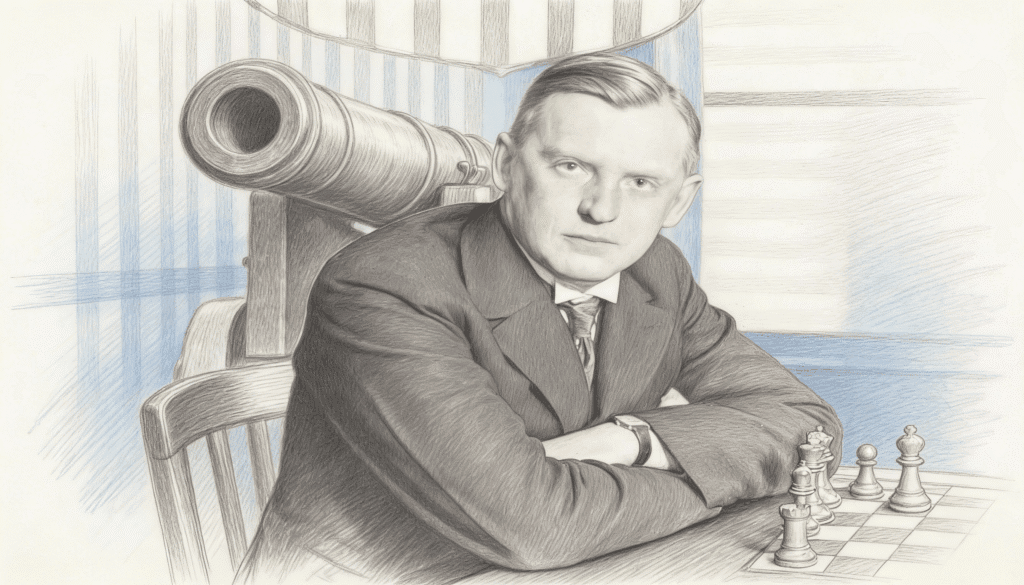
The intimidation starts with visibility. Unlike minor pieces tucked away on their starting squares, doubled rooks announce their presence. They stand tall on an open file. They point toward enemy territory like artillery aimed at a fortress. The opponent cannot ignore them. Every glance at the board reinforces their presence.
Then comes the flexibility. A doubled rook battery can shift purposes instantly. They can switch from defense to offense. They can abandon one target for another. This flexibility means the opponent cannot simply defend one square and relax. The threat remains fluid and adaptive.
The intimidation deepens with coordination. Two rooks working together multiply their effectiveness. They do not just double the power. They create new tactical themes that single rooks cannot. Breakthrough sacrifices become possible. Back rank weaknesses become acute. The whole position restructures around their potential.
The Open File Phenomenon
Open files in chess are like highways through enemy territory. They provide direct routes to important squares. Controlling an open file gives a player freedom of movement. Dominating an open file with doubled rooks takes this control to another level.
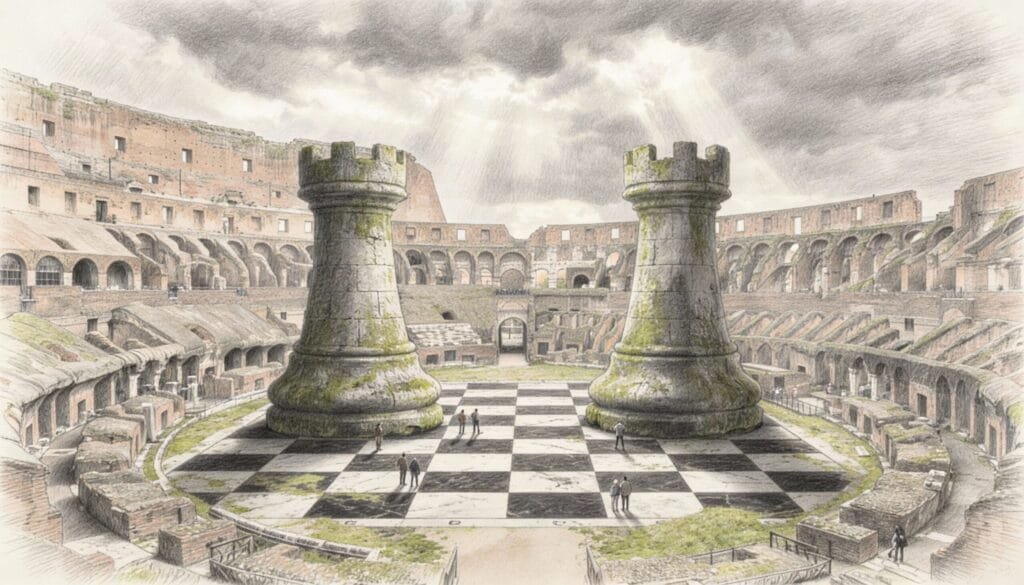
Consider how armies fight for strategic positions. Hills. Bridges. Mountain passes. Control of these chokepoints determines campaign success. Open files work the same way in chess. They are the natural invasion routes. The player who controls them controls the flow of the game. When rooks double on an open file, they do not just control it. They own it. The opponent cannot contest it without risking material.
The Seventh Rank Dream
Chess teachers love to talk about the seventh rank. “Pigs on the seventh” they call it when rooks reach this promised land. The seventh rank sits in enemy territory, right in front of the opponent’s back rank. Doubled rooks on the seventh rank create a nightmare scenario for the defender.
Why does the seventh rank matter so much? Geometry. The seventh rank attacks pawns that have not moved. These pawns usually shield the king. They form the foundation of the defensive structure. When rooks invade the seventh rank, they strike at this foundation.
The psychological impact multiplies when both rooks reach the seventh. Suddenly the defender faces threats on multiple fronts. One rook attacks from the left. The other attacks from the right. The king sits trapped on the eighth rank, unable to find shelter. Pawns fall. The position crumbles.
Even the threat of reaching the seventh rank shapes the game. The defender must constantly ask: Can my opponent double rooks and invade? This question influences every decision. Pawn moves. Piece placement. Timing of exchanges. The mere possibility of doubled rooks reaching the seventh rank acts like gravity, pulling the position in certain directions.
The Initiative Amplifier
Chess players talk about the initiative the way sailors talk about the wind. Having the initiative means making threats. Forcing the opponent to respond. Dictating the pace and direction of the game. Doubled rooks amplify the initiative like a megaphone amplifies voice.
When you have doubled rooks, your threats carry more weight. Your opponent must take them seriously. They cannot afford to ignore your plans and pursue their own. This forces them into a reactive mindset. They respond to your moves instead of creating their own threats.
This reactive mindset compounds over time. Each response to your battery’s threats puts them further behind. They spend tempos defending. You spend tempos improving your position. The gap widens. What started as a slight advantage becomes a winning position.
The amplified initiative also affects decision making. Your opponent faces constant pressure. They must solve problem after problem. Eventually, they make a mistake. Maybe they miscalculate a variation. Maybe they crack under the pressure and play too passively. Maybe they overreact and create new weaknesses. The battery punishes all these errors.
When Batteries Backfire
Doubled rooks are not magic. They can fail. They can become passive. They can even become liabilities.
The most common failure happens when the file closes. Imagine doubling rooks on an open file, only to watch the opponent block it with a piece or pawn. The battery loses its point. The rooks stare at a wall. They become clumsy and slow, unable to find productive squares.
Another failure mode involves timing. Doubling rooks takes time. You must maneuver both rooks into position. If your opponent uses this time to create their own threats, the battery may arrive too late. Their attack crashes through before your rooks accomplish anything.
Batteries also fail when they lack support. Rooks are powerful, but they need help. They need pawns to advance and clear space. They need pieces to create additional threats. A battery without supporting cast becomes isolated and ineffective.
These failures highlight what makes successful batteries work. They require open lines. They require good timing. They require coordination with other pieces. When these elements align, the battery becomes a devastating weapon. When they do not, the battery becomes a slow motion disaster.
The Defensive Dilemma
Defending against doubled rooks creates impossible choices. Every defensive setup has weaknesses. Every plan to neutralize the battery creates new problems.
Block the file? Now your piece becomes passive, chained to defense. Exchange a rook? Now your opponent can activate their remaining pieces. Abandon the file? Now your position gets invaded. Create counterplay? Your attack may be too slow.
This dilemma is what makes the battery so psychologically effective. The defender knows they face problems. They can see the issues. But the solution remains unclear. They sit there calculating, trying to find the least bad option.
Time pressure makes this worse. As the clock ticks, the dilemma intensifies. Should the defender spend time finding the best defense? Or should they move quickly and hope for the best? Either choice carries risk. The battery creates this damned if you do, damned if you do not situation.
Converting Advantage to Victory
Having doubled rooks does not automatically win games. The advantage must be converted. This conversion requires technique and understanding.
The first step involves maximizing the battery’s pressure. This means keeping threats alive. Creating multiple problems. Forcing the opponent to defend on different fronts. The battery should not focus on one square. It should threaten several possibilities.
The second step involves preventing counterplay. The opponent will try to create their own threats. They will look for tactics. They will probe for weaknesses. The player with the battery must balance aggression with safety. Push forward, but not recklessly.
The third step involves simplification. As the position clarifies, the advantage becomes easier to realize. Trading pieces can help, but only the right pieces. Keep the battery. Keep pieces that support it. Trade defenders that contest it.
The final step involves technique. Doubled rooks excel in endgames. They dominate open positions. They convert advantages efficiently. When the position simplifies to a rook endgame with active, doubled rooks against passive defenders, the win becomes mechanical.
The Greater Lesson
The fear that doubled rooks inspire teaches something larger about chess. The game operates on multiple levels. There is the objective level of material and position. There is the calculating level of tactics and variations. But there is also the psychological level of fear and confidence.
The best players master all three levels. They understand when material matters. They calculate accurately. And they recognize when psychology tilts the game. They know how to create pressure. They know how to handle pressure. They know that chess is a human game, played by minds that can panic.
Doubled rooks crystallize this psychological dimension. They are not inherently winning. Strong defenders can hold against them. But they create pressure that leads to mistakes. They plant doubt. They force errors. They transform small advantages into decisive ones.
Learning to Love the Battery
For players looking to improve, learning to double rooks effectively provides immediate benefits. It teaches planning. It teaches patience. It teaches how to build pressure systematically.
Start by recognizing when files might open. Look for pawn structures that create potential open files. Position rooks behind pawns that might advance or trade. Think several moves ahead about how to create open lines.
Practice patience in building the battery. Do not force it. Wait for natural opportunities. Develop other pieces first. Improve the king position. Only then maneuver the rooks into battery formation.
Study how strong players use doubled rooks. Watch how they time the invasion. Notice how they combine the battery with other threats. Observe how they handle defensive tries. This pattern recognition builds intuition.
Most importantly, pay attention to your opponent’s reactions. Watch for signs of discomfort. Notice when they start thinking longer. Recognize when their moves become passive. These psychological tells indicate that your battery is working not just on the board, but in their mind.
The Enduring Power
Doubled rooks have terrorized chess players for centuries. From casual club games to world championship matches, the battery remains one of chess’s most potent weapons. This endurance speaks to something fundamental about the pattern.
The tactic combines multiple powerful elements. Material strength. Geometric advantage. Flexibility. Timing. Pressure. Psychology. When these elements unite, they create something greater than their parts. They create a force that opponents struggle to resist.
As chess evolves, as computers reveal new truths, as preparation reaches new depths, the doubled rook battery endures. It remains a tool that every player must understand. A weapon that every player must respect. And a fear that every player must overcome.
The next time you face doubled rooks pointed at your position, remember this. Your opponent has not won yet. The battery creates potential, not certainty. Stay calm. Calculate accurately. Find the defensive resources. The fear is the real opponent. Master the fear, and you master the position.
And the next time you create a rook battery, savor the moment. Watch your opponent’s body language shift. Feel the psychological weight transfer from their side to yours. You are not just playing chess. You are playing chess where calculation meets psychology, where strategy meets fear, where two minds battle across 64 squares for something that transcends the game itself.