Table of Contents
Every chess teacher delivers the same commandment. Doubled pawns are bad. Doubled pawns are weak. Doubled pawns are something your opponent inflicts upon you like a punishment for poor play. The lesson gets drilled in so deeply that club players will go to absurd lengths to avoid them, twisting their position into knots just to keep their pawn structure pristine.
But here’s the uncomfortable truth that might make your coach twitch: this dogma about doubled pawns is only half the story. And teaching half the story is sometimes worse than teaching nothing at all.
The traditional advice treats chess like it’s played on a scorecard where you win by checking boxes. Avoid doubled pawns. Check. Control the center. Check. Develop pieces. Check. But chess isn’t a checklist. It’s a living, breathing battle where context crushes rules every single time.
The Great Pawn Structure Myth
Somewhere along the line, chess instruction became obsessed with pawn structure as if the pawns themselves were the point of the game. Students learn that isolated pawns are weak, backward pawns are targets, and doubled pawns are structural defects to be ashamed of. The entire framework treats pawn formations like architectural flaws in a building.
But buildings don’t move. Buildings don’t attack. And buildings certainly don’t checkmate enemy kings.
Chess pieces do all of these things, and that’s where the conventional wisdom falls apart. When a coach warns about doubled pawns without discussing what you gain in exchange, they’re teaching chess the way someone might teach swimming by only talking about the dangers of water. Yes, water can be dangerous. But that’s missing the entire point.
What Doubled Pawns Actually Do
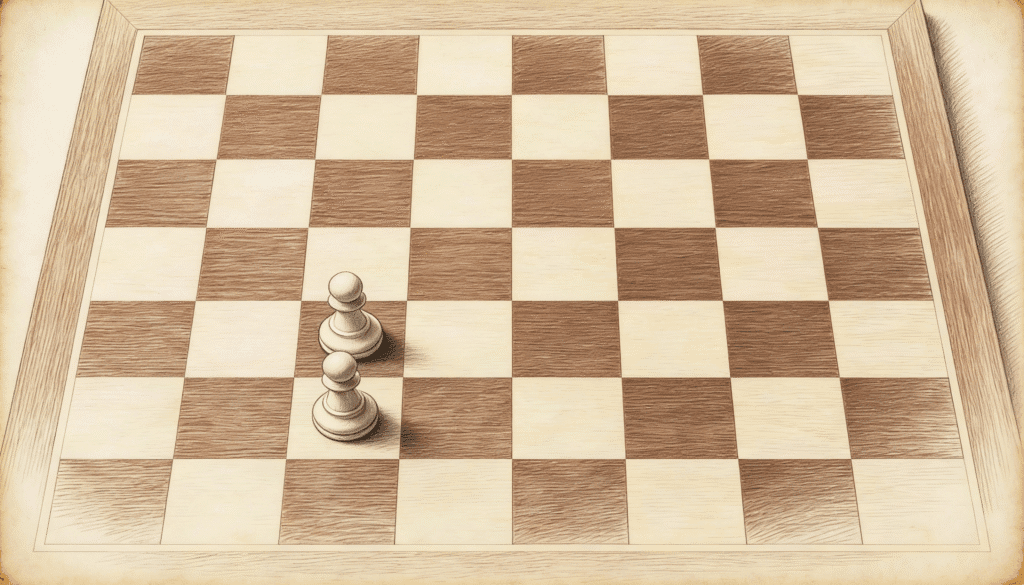
Before challenging the dogma, it helps to understand what actually happens when pawns get doubled. Usually this occurs when a piece captures on a square occupied by a pawn, pulling a neighboring pawn out of its file. The result is two pawns on the same file, one behind the other.
The traditional critique goes like this: doubled pawns are weak because they cannot defend each other. A normal pawn chain allows pawns to protect their neighbors diagonally. Doubled pawns stack vertically, making them unable to provide mutual support. The front pawn becomes a potential target, and the rear pawn becomes a spectator in its own game.
This analysis is technically correct. It’s also strategically useless because it ignores everything else happening on the board.
The Exchange Rate Nobody Talks About
Here’s what coaches often skip over: you don’t get doubled pawns by accident. Something has to capture on that square. And that something is usually an enemy piece taking one of your pieces. The pawn recaptures, and suddenly you have doubled pawns.
But stop and think about what just happened. A trade occurred. Material got exchanged. And whenever material leaves the board, the character of the position changes completely.
When you recapture with a pawn and accept doubled pawns, you’re often gaining three enormous benefits that traditional teaching completely glosses over. First, you open a file for your rooks. Second, you bring a pawn closer to the center or toward an important square. Third, you eliminate one of your opponent’s pieces from the board, which might have been a key defender or attacker.
That’s a lot of compensation for a structural “weakness” that might never actually matter in the game.
Files: The Highway System Your Coach Forgot
Every chess teacher preaches about open files. Control an open file with your rook, and you have a highway deep into enemy territory. But then those same teachers tell you to avoid doubled pawns, which are often the fastest way to blast open a file.
The contradiction is stunning. Players get taught that open files are gold, but the mechanism that creates them most reliably gets labeled as a structural defect. It’s like telling someone that highways are valuable but road construction is bad.
When you accept doubled pawns by recapturing toward the center, you’re often opening the perfect file for your rook. That rook suddenly has a clear path to the seventh rank, where it can terrorize enemy pawns and trap the opposing king. Meanwhile, your opponent sits on a “perfect” pawn structure with all their pieces boxed in behind their own pawns, unable to create any real threats.
Who actually has the better position? The player with prettier pawns, or the player with active pieces and concrete threats?
Pawn structures get described as either good or bad, strong or weak, as if these qualities were permanent and absolute. But chess doesn’t work that way. A pawn structure isn’t good or bad by itself. It’s good or bad for the specific position and plan at hand.
When Weakness Becomes Strength
Take positions where you get doubled pawns on the f file after trading a knight for a bishop. The standard evaluation says this is horrible. You’ve damaged your kingside pawn structure, and those doubled f pawns will be targets all game long.
But look closer at what actually happened. Your opponent’s dark squared bishop disappeared from the board. Suddenly all those dark squares around your opponent’s king become weak. Your remaining bishop or knight can land on those squares without resistance. The open g file might give your rook a perfect attacking channel. And those supposedly weak doubled pawns? They’re actually controlling critical central squares and preventing your opponent’s pieces from finding good posts.
The doubled pawns didn’t weaken your position. They transformed it into something your opponent isn’t prepared to handle.
The Real Question Nobody Asks
When students learn about doubled pawns, they absorb the lesson that these structures are bad and should be avoided. The better question that rarely gets asked is: bad compared to what?
Every move in chess involves tradeoffs. When you prevent doubled pawns by moving a piece to an awkward square, you’ve traded structural purity for piece activity. When you allow an enemy piece to stay on the board just to avoid doubling your pawns, you’ve traded structural purity for material dynamics.
These tradeoffs have consequences that ripple through the entire game. A piece on an awkward square might miss a critical moment five moves later. An enemy piece that should have been traded might become a monster that destroys your position.
The obsession with avoiding doubled pawns often causes players to make these unfavorable trades without even realizing it. They’ve been taught that the pawn structure matters so much that they’ll sacrifice almost anything to maintain it. But pawn structures don’t deliver checkmate. Pieces do.
If there’s one concept that traditional pawn structure teaching undervalues, it’s piece activity. Active pieces create threats. Threats force responses. Forced responses lead to mistakes. Mistakes lead to victory.
Doubled pawns frequently come with a massive increase in piece activity. The opened file gives rooks early agency. The eliminated enemy piece removes a defender. The changed pawn structure creates new squares for your remaining pieces to occupy.
Piece activity should be the foundation, and pawn structure should be evaluated through that lens. When doubled pawns increase your piece activity, they’re not a weakness. They’re an investment.
Learning to Evaluate Properly
The goal isn’t to embrace doubled pawns in every position or to pretend that pawn structure doesn’t matter. The goal is to evaluate positions completely rather than through the narrow lens of structural rules.
When doubled pawns appear in your game, ask better questions than just “is my structure damaged?” Ask what you gained. Ask what files opened. Ask what pieces got traded. Ask how your remaining pieces can use the changed landscape. Ask what threats you can now create.
These questions lead to real evaluation. They force you to look at the whole board, not just the pawn skeleton. They transform chess from a game of memorized rules into a game of concrete calculation and creative possibility.
Watch how strong players handle positions with doubled pawns. They don’t apologize for them or try to immediately repair them. They use them. They exploit the open files. They activate their pieces. They create threats. And if the doubled pawns eventually become weak in the endgame, they’ll deal with that problem when it actually matters, not before.
This is the mindset shift that transforms a player’s understanding. Pawn structure is a factor, not a verdict. Doubled pawns are a feature of the position, not a moral failing. What matters is whether you can use the position to create more threats than your opponent.
The Teaching Gap
Why do coaches persist in teaching that doubled pawns are simply bad? Part of it is tradition. The lesson gets passed down from teacher to student, generation after generation, until it becomes dogma.
Part of it is simplicity. Teaching nuance is harder than teaching rules. Telling beginners “avoid doubled pawns” is easier than explaining the complex tradeoffs involved in every pawn structure decision.
But this simplified teaching creates players who reach a ceiling. They master the basic rules and then wonder why their progress stalls. The answer is often that they’re still playing by rules that work for beginners but fail for intermediate players.
The leap to the next level requires unlearning some of those early lessons. It requires seeing doubled pawns not as mistakes but as opportunities. It requires evaluating positions based on piece activity, king safety, and concrete threats rather than abstract structural principles.
Here’s the practical truth that should replace the old dogma: doubled pawns are often worth accepting if they come with compensation. That compensation might be an open file for your rook. It might be the elimination of a key enemy piece. It might be increased control over central squares. It might be improved piece coordination.
The key word is “compensation.” You’re not doubling your pawns for fun. You’re accepting a changed structure in exchange for concrete benefits. If those benefits outweigh the structural drawback, the decision is good. If they don’t, the decision is bad.
This framework is more complex than “avoid doubled pawns.” But it’s also more accurate. And in chess, accuracy matters more than simplicity.
Moving Forward
The next time a coach or a book or a video tells you that doubled pawns are bad, don’t reject the advice entirely. But don’t accept it blindly either. Ask the follow up questions. What did I gain? What files opened? What threats can I create?
Chess improves through questioning, not through obedience. The rules exist to give a foundation. But that foundation is meant to be built upon, not lived in forever.
Your coach might be wrong about doubled pawns. Or rather, your coach might be teaching you the beginner version of the truth, which works until it doesn’t. The real version is more interesting, more dynamic, and more powerful.
Doubled pawns aren’t the enemy. Rigid thinking is. Break free from the dogma, evaluate positions completely, and watch your chess transform. The pawns were never the point anyway.
They’re just tools in service of the real goal: checkmate.