Table of Contents
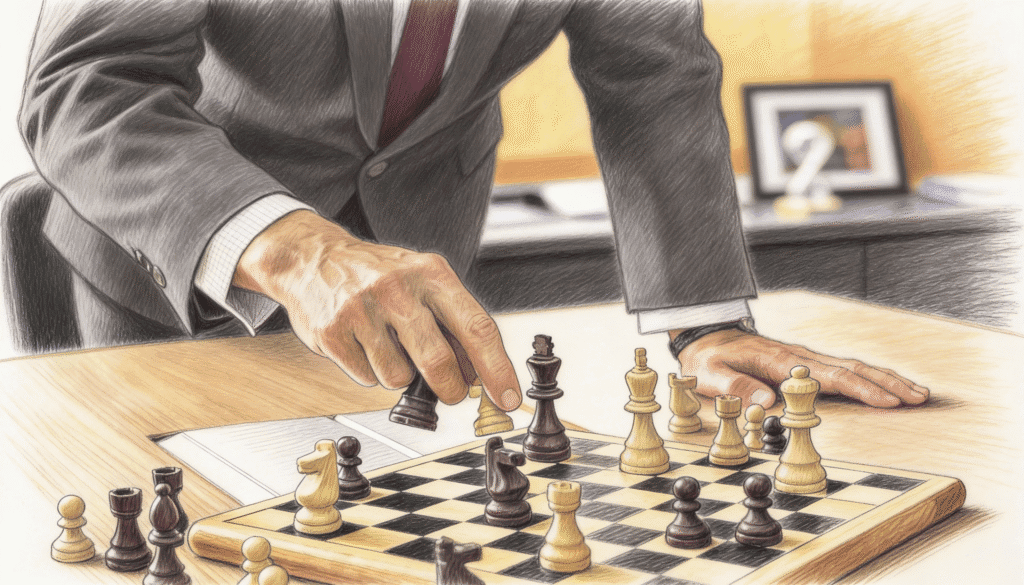
The executive sits in his corner office, staring at a chessboard on his phone. His assistant walks by and sees him studying a position from last night’s online game. She probably thinks he’s procrastinating. She doesn’t know he’s solving the exact problem that’s been plaguing the Q3 marketing campaign.
This is the paradox of chess for working adults. From the outside, it looks like the ultimate time sink. A game that can stretch for hours, offering no immediate return, no clear productivity metric, no line item on a performance review. Yet something curious happens to people who take up chess in their thirties, forties, or beyond. They start finishing projects faster. Making better decisions. Handling pressure with an odd sort of calm.
The world tells us that hobbies should be useful or they’re wasteful. Learn a language that helps your career. Exercise for your health. Network for connections. But chess seems to thumb its nose at this utilitarian framework. You push wood across a board, and when you’re done, everything is exactly as it was. Nothing built, nothing produced.
Except that’s not quite true.
The Slowness That Speeds Everything Up
Modern work culture worships speed. Fast replies, quick decisions, rapid execution. The person who hesitates is lost, or so the saying goes. Then chess shows up and flips the entire script.
A position sits on the board. You see a move that looks brilliant. Your hand reaches for the piece. Then chess training kicks in and whispers: wait. Look longer. What happens after the obvious move? What did you miss?
This forced patience seeps into everything else. The engineer who plays chess stops pushing code the moment it compiles. He runs it through more tests, considers edge cases, catches bugs before they reach production. The project manager playing through positions at lunch starts pausing before committing to timelines. He spots the hidden dependencies, the assumptions that don’t hold, the resource constraints everyone else overlooked.
Chess players develop stronger executive function, the mental capacity that governs planning, attention, and impulse control. The brain doesn’t compartmentalize. When you teach it to slow down and think deeply in one area, it carries that habit everywhere.
The irony cuts deep. Adults feel guilty for “wasting” time on chess, then discover they’re finishing real work faster than before. Not because they’re rushing, but because they’re making fewer mistakes that require fixing later. The slowness at the board creates speed everywhere else.
Decisions Without Perfect Information
Every chess position is a fog of possibilities. You can’t calculate every variation to the end. The combinations branch into thousands of futures, most of which you’ll never see. Yet you must choose. You must move.
This is closer to real life than any business school case study. The manager deciding whether to pivot product strategy has incomplete data. The parent choosing schools for their child can’t preview all outcomes. The investor evaluating opportunities works with educated guesses, not certainties.
Chess teaches a specific kind of confidence in uncertainty. Not the false confidence of people who pretend they know more than they do, but the real confidence of knowing you can make sound decisions even when information is limited. You learn to evaluate positions based on principles and patterns rather than perfect calculation.
The board shows you a position. You don’t know every tactical shot available to your opponent. You can’t see twenty moves deep. But you understand pawn structures. You recognize when your pieces coordinate well. You know whether your king is safe. These frameworks let you decide without paralysis.
Back at work, the chess player approaches ambiguous situations differently. Instead of freezing until more data arrives or rushing into poorly considered action, there’s a third option: apply principles, trust pattern recognition, make the best available decision, then adjust as new information emerges.
The Harvard Business Review has noted that decision-making under uncertainty is one of the most valuable skills in modern business environments. Chess doesn’t eliminate uncertainty. It makes you comfortable operating within it.
The Gift of Losing
Most adult pursuits are designed to make you feel good. Hobbies that guarantee success, entertainment that never challenges, social situations where everyone gets a participation trophy. Then chess walks in and beats you senseless for months.
You lose. You lose again. You lose in ways you didn’t know were possible. The position looked winning, then three moves later you’re getting destroyed. The strategy seemed sound, then the board tells you that you understood nothing.
This is where many people quit. They want a hobby that offers relaxation and escape, not a mirror that reflects every flaw in their thinking. But the people who stick with chess discover something unexpected: losing becomes useful.
Each defeat is a specific lesson. You hung a piece because you lost focus. You missed a defensive resource because you were too committed to your own attack. You played too passively and got squeezed off the board. These aren’t vague failures. They’re precise, correctable errors.
The transfer to regular life is almost laughably direct. The sales director who lost ten games in a row because she ignored her opponent’s threats starts noticing what competitors are doing instead of just pushing her own product. The developer who kept losing positional games from good positions realizes he’s been abandoning projects right before they reach maturity.
Organizational psychologist Carol Dweck’s research on growth mindset shows that people who view abilities as developable rather than fixed handle setbacks more productively. Chess forces this mindset. You can’t maintain the fiction that you’re just “not a chess person” when you see concrete evidence that study and practice improve results. The board doesn’t care about your ego. It shows you exactly where your thinking broke down.
Adults who embrace chess losses develop a resilience that looks like magic to people who avoid discomfort. They fail at the board dozens of times per week, extract lessons, improve, and carry that cycle into their professional lives. The person who “wastes time” on chess becomes the person who bounces back faster from setbacks.
Building Things You Can’t Touch
Modern work often feels abstract. You edit documents that exist nowhere. You join video calls with people you’ve never met. You move money that’s just numbers on screens. The connection between effort and result gets blurry.
Chess brings back something concrete. Not physically, the pieces are often digital now, but conceptually. You build positions the way a craftsman builds furniture. Each move adds to a structure. Place pieces on good squares. Control key areas. Create threats that work together. Watch the position grow from rough opening ideas into a cohesive attacking formation or a solid defensive setup.
This construction happens entirely in strategy and imagination, but it’s no less real. You can point to a position and say, “I built that.” You can see exactly how one decision led to another, how early moves enabled later possibilities, how the whole structure emerged from careful planning and opportunistic adaptation.
The software architect playing chess starts thinking about code similarly. Not just as functions that work, but as structures that have integrity, elegance, relationships between parts. The teacher planning curriculum sees how early lessons build foundations for later concepts. The entrepreneur developing business strategy understands how early market positioning enables future options.
There’s deep satisfaction in building something, even something as impermanent as a chess position that disappears when the game ends. That satisfaction isn’t wasted time. It’s a reminder that careful construction matters, that quality has its own reward, that some things are worth doing well even if they exist only briefly.
The Social Game That Teaches You to Think Alone
Chess looks solitary. Two people sitting across from each other, barely talking, locked in private thought. But the community around chess is vast and generous. Players share games, analyze positions together, discuss ideas. Online forums burst with people helping each other improve.
Here’s what makes this unusual: the social part and the thinking part stay separate. When you’re at the board, facing a position, no one can help you. The decision is yours alone. But before and after the game, you’re part of something larger. You share what you learned. Others share what they discovered. Everyone gets better together, even though each person must ultimately think for themselves.
This balance between independence and community is rare in adult life. Work tends toward one extreme or the other. Either you’re on a team where individual contribution gets lost, or you’re isolated with no support network. Chess shows a middle path: think independently but learn collectively.
The marketing manager who plays chess stops waiting for consensus before forming opinions but becomes better at sharing ideas and absorbing feedback. She knows how to sit with a problem alone, really think it through, develop her own perspective. Then she brings that perspective to the team, where it mixes with other viewpoints and becomes something better.
Chess clubs, whether physical or online, model a kind of community that’s increasingly rare. People of different backgrounds, ages, and skill levels united by shared interest in improvement. No politics, no networking angle, just people helping each other think better. The relationships formed over the board often surprise people with their depth and durability.
Time That Bends Back on Itself
The strangest thing about time spent on chess is how it seems to multiply. You’d think that spending five hours per week on chess means five fewer hours for everything else. Mathematics suggests this should be true.
Except people who take up chess often report having more time, not less. They procrastinate less because they have something specific they want to do with free moments. They waste less time on social media because chess is more engaging. They make decisions faster at work because their thinking is sharper. The hours spent on chess somehow generate hours everywhere else.
Part of this is improved focus. Chess trains concentration in a way few activities match. You can’t play well while distracted. The board punishes a wandering mind immediately and severely. After a few months of regular play, that enhanced focus bleeds into everything. The report that used to take three hours of scattered effort gets done in ninety focused minutes.
Part is better prioritization. Chess teaches you to distinguish between moves that matter and moves that just look busy. You learn to recognize when you’re shuffling pieces aimlessly versus when you’re accomplishing something real. This recognition transfers directly to work tasks. The chess player spots the difference between productive activity and motion that creates an illusion of progress.
The Permission to Think
Perhaps the deepest value chess offers busy adults isn’t tactical or strategic. It’s permission. Permission to sit and think without immediate purpose. Permission to engage with complexity for its own sake. Permission to struggle with difficult problems that have no practical application.
Modern life rarely grants this permission. Every moment should be optimized, every activity justified by measurable outcomes. Thinking for the sake of thinking seems indulgent, almost decadent. Then chess creates a space where thinking is the whole point. Not thinking toward a business goal or personal objective. Just thinking because a position is interesting and you want to understand it.
This matters more than it seems. The executive staring at a chess position isn’t escaping work problems. She’s giving her mind permission to work the way it’s supposed to work, turning over complex ideas without pressure for immediate solutions. That evening spent analyzing a game isn’t stolen from family time. It’s recharging mental batteries that make someone more present and capable when it matters.
Research on creativity and problem solving consistently shows that breakthroughs often come during activities that seem unrelated to the problem. The mind needs space to make connections, try approaches, discard dead ends. Chess provides that space while keeping the mind engaged and active.
The artist needs time to stare at a canvas. The writer needs time to sit with a sentence. The scientist needs time to play with ideas. Adults need time to think without defending that thinking as productive. Chess gives that permission wrapped in a game that happens to make you sharper at everything else.
The Long Game
A chess improvement journey spans years. You don’t study positions for a month and master the game. You work at it over seasons, seeing glacial progress interrupted by sudden breakthroughs and frustrating plateaus. The timeline humbles everyone.
In a culture obsessed with quick results and rapid transformation, chess insists on a different tempo. You get better slowly. Some weeks you seem stuck. Then months later you realize you’re handling positions that would have destroyed you before. The progress is real but not linear, obvious but not fast.
Adults who stick with chess often change their perspective on other goals. The person trying to build a business stops expecting overnight success. The parent working on a difficult relationship with a teenage child finds patience for the slow work of rebuilding trust. The professional developing a new skillset accepts that mastery takes time.
This might be the most valuable thing chess wastes time on: teaching people that important things develop slowly, that consistency matters more than intensity, that showing up repeatedly over months and years produces results that cramming never could.
The chessboard sits waiting, position after position, year after year. The pieces don’t care about productivity metrics or quarterly reviews. They just ask: can you think clearly about what’s in front of you? And in answering that question, game after game, something happens to the person asking it.
They become clearer thinkers, better decision makers, more resilient when facing setbacks.
They waste time on chess. And somehow, everything else gets done better because of it.