Table of Contents
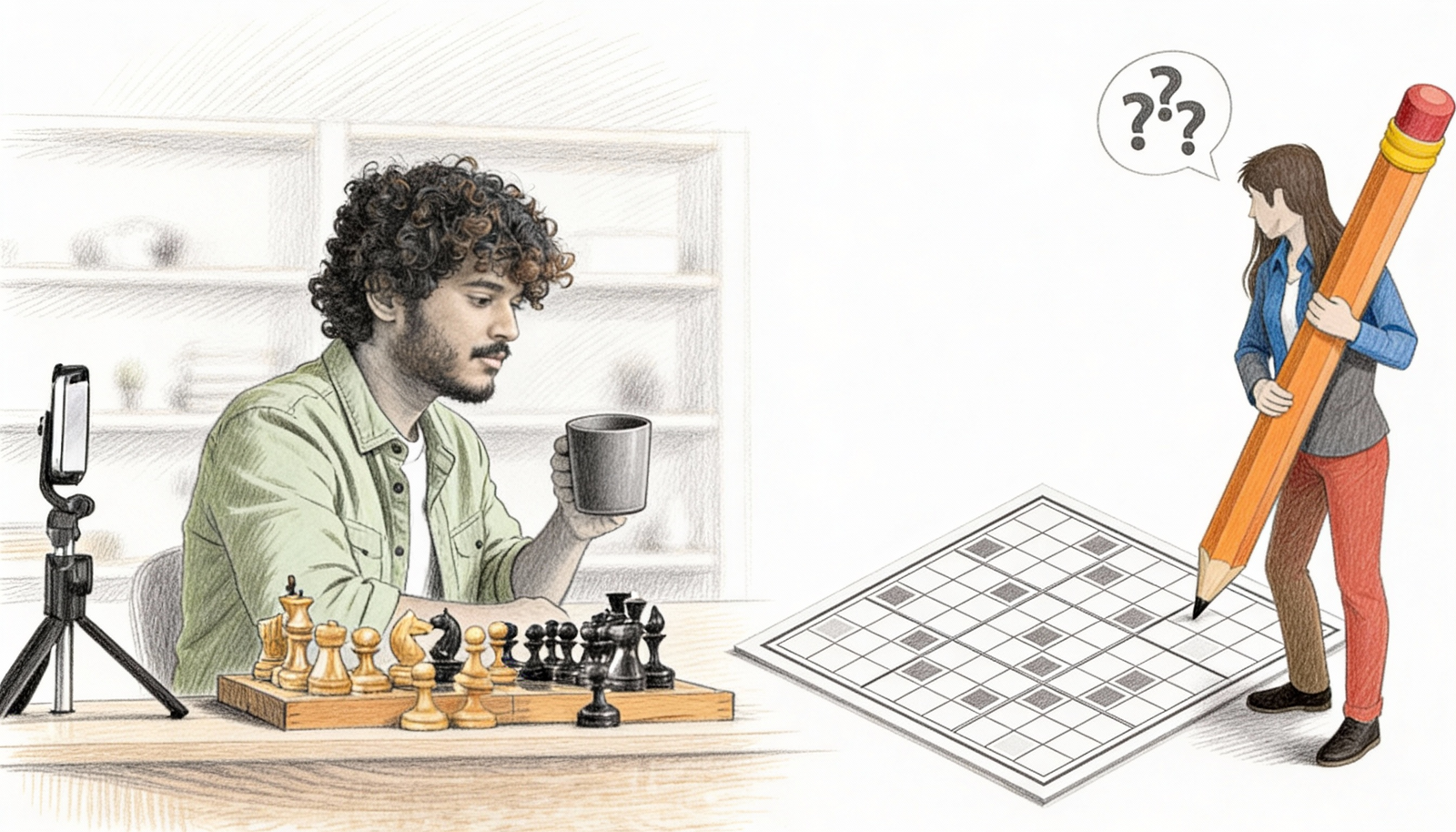
The grandmother sits across from her grandson at the kitchen table, a chessboard between them. She moves her knight with the confidence of someone who has made this particular maneuver a thousand times before. Meanwhile, in the next room, his sister navigates a virtual battlefield, her fingers dancing across the controller as explosions light up the screen. The grandmother shakes her head. One activity, she believes, builds character and intelligence. The other rots the brain.
But what if everything we thought we knew about brain training was incomplete?
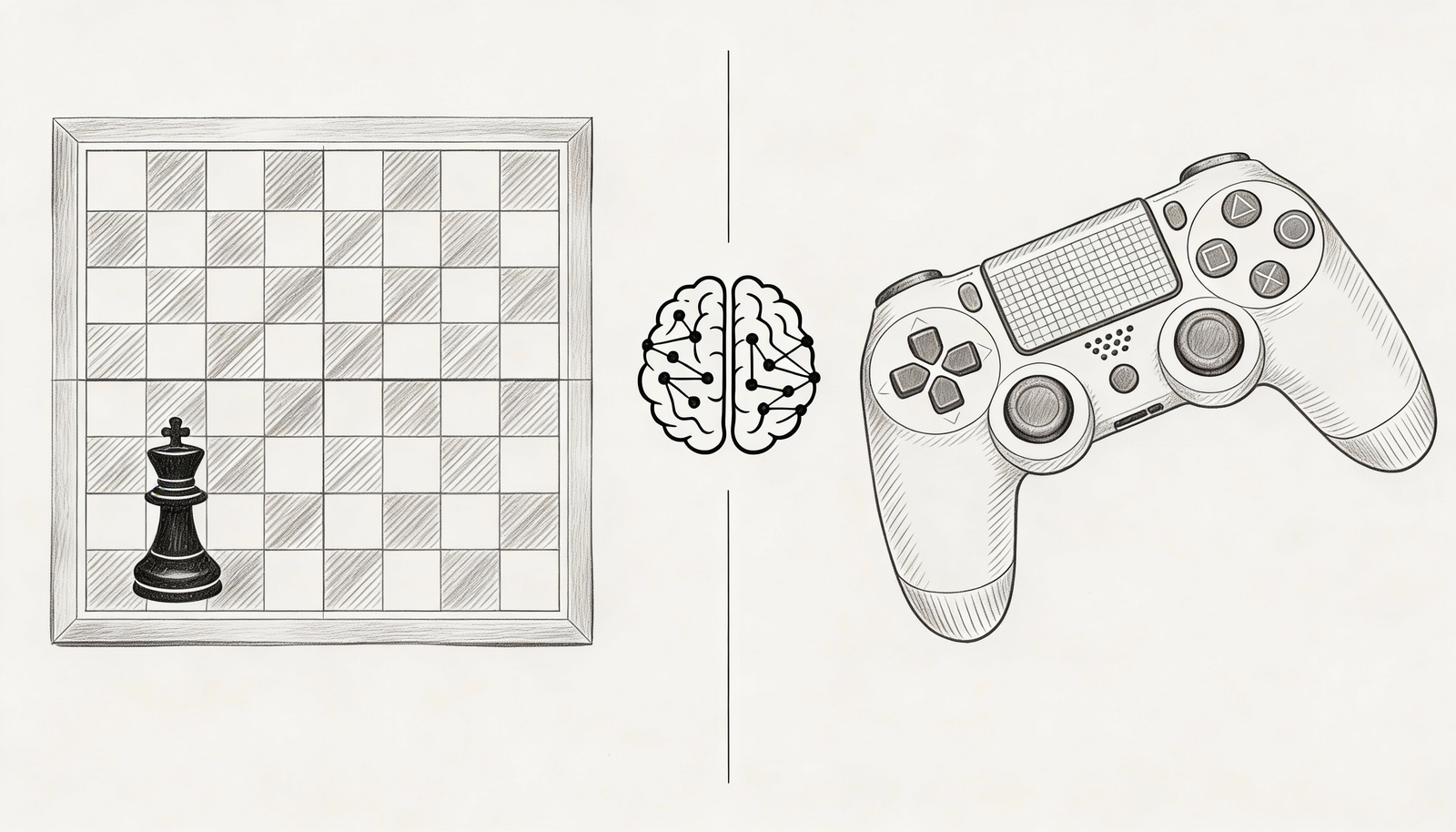
The debate between chess and video games has simmered for years, often framed as old wisdom versus new technology. Yet recent neuroscience research suggests the question itself might be flawed. The real story is far more interesting than picking sides.
The Brain on Chess: More Than Just Strategic Thinking
Chess has enjoyed centuries of respect as the ultimate mind game. Kings studied it. Philosophers praised it. Schools added it to curricula. This reputation turns out to have scientific backing, though perhaps not in the ways people expected.
When researchers examined chess players using brain imaging, they discovered something remarkable. Chess doesn’t just make people better at chess. It appears to reshape how different parts of the brain communicate with each other, creating what scientists call a more stable “cognitive connectome.”
Think of the brain as a vast city. The cognitive connectome represents how neighborhoods connect and work together. In chess players, these connections function with unusual efficiency. The study found that players exhibited tighter connections within specific brain modules while maintaining fewer but more meaningful links between different areas. Picture a well-organized company where each department operates smoothly and knows exactly when to coordinate with others.
A Harvard study examining 10,000 older Australian men over a decade found that frequently playing board games like chess was associated with reduced dementia risk. The key word there is “associated.” Correlation doesn’t prove causation. Chess players might already possess traits that protect against cognitive decline, or the game itself might provide protection. Perhaps both factors play a role.
What chess definitely does is demand sustained attention, planning, and the ability to hold multiple scenarios in mind simultaneously. These mental muscles get exercised every time someone sits down at the board. A 2025 systematic review examining brain imaging studies of chess players found that experts show greater brain activation in areas tied to visual processing and spatial perception. More intriguingly, they exhibit enhanced connectivity in networks underlying cognitive control and decision making.
Video Games: The Unexpected Cognitive Trainer
Now for the plot twist that makes this debate so fascinating.
Video games, long dismissed as mindless entertainment, have undergone their own scientific revolution. The stereotype of gaming as passive consumption crashes against mounting evidence that certain types of games might rival or even exceed traditional brain training activities.
Consider a study from Western University that examined over 1,000 people who completed both lifestyle surveys and cognitive tests. The results surprised even the researchers. Playing video games showed a positive effect on cognition. Not a small effect. A measurable, statistically significant boost in memory, attention, reasoning, and verbal abilities.
But here’s where things get interesting. Not all games deliver the same benefits. The type of game matters enormously.
Action video games, particularly first and third person shooters, place players in chaotic visual environments requiring split-second decisions. Research has consistently found that these games improve visual attention, spatial skills, and the ability to track multiple objects simultaneously. Studies show action gamers outperform non-gamers on tasks requiring rapid decision making and visuospatial reasoning.
Strategy games offer different benefits. Research on StarCraft II players found their brains showed more efficient information processing, with stronger connectivity in areas essential for visual attention and executive function. Managing resources and maneuvering armies in real time apparently trains the same brain networks that handle complex planning and multitasking in daily life.
The neuroscience gets more compelling. A longitudinal study using EEG technology tracked players over 30 weeks, randomly assigning them to action games or strategy card games. Both groups improved across multiple cognitive tasks, but their brains changed in different ways. Action gamers showed increased activity in regions tied to attention and working memory. Strategy players demonstrated different but equally meaningful neural adaptations.
Perhaps most striking, research found that expertise in video gaming was associated with slower brain aging. The brains of experienced gamers appeared an estimated four years younger than their chronological age. The researchers compared gaming to other creative activities like music and art, suggesting these hobbies protect neural connections vulnerable to aging.
An NIH study examining nearly 2,000 children found that those playing video games for three or more hours daily performed faster and more accurately on cognitive tasks than children who never played. Brain imaging revealed higher activity in regions associated with attention and memory. Even more interesting, these children showed more efficient visual processing, suggesting repeated practice had optimized those brain areas.
The Architecture of Mental Training
Here’s where the intellectual angle becomes clear. Both chess and video games succeed for similar underlying reasons, just through different mechanisms.
Chess operates like a structured gymnasium for the mind. Every game follows predictable rules but generates infinite variations. Players must internalize vast patterns, calculate consequences, and maintain emotional control under pressure. The cognitive demands are consistent and accumulating. Each game adds to the player’s mental library of positions and possibilities.
Video games, particularly complex ones, function more like cognitive wilderness training. They throw players into unpredictable scenarios requiring adaptation, rapid learning, and integration of multiple information streams. The brain doesn’t just follow established patterns. It must create new ones in real time.
Researchers have identified what they call the “curse of specificity” that affects most brain training. Skills learned in one narrow context rarely transfer to other domains. The classic example comes from chess itself. Experienced players can remember up to four times as many chess pieces as beginners when arranged in realistic game positions. But place those same pieces randomly on the board and the memory advantage vanishes. The skill is context dependent.
Video games might partially escape this curse because they demand broader cognitive abilities. Action games don’t just improve one thing. They enhance visual processing, attention, decision making, and motor control simultaneously. The skills transfer more readily because they’re more fundamental.
Yet chess offers something video games often lack: deep strategic thinking unconstrained by time pressure. Correspondence chess, where players can ponder moves for days, develops different mental muscles than rapid-fire gaming. The patience to consider deeply, to resist impulsive choices, to trace consequences through long causal chains. These capacities matter beyond the board.
The Uncomfortable Truth About Both
Neither activity qualifies as a magic bullet for brain health. This matters more than which one wins a hypothetical contest.
The research consistently shows that cognitive benefits from both chess and gaming require moderate, sustained engagement. Three hours of either activity daily seems beneficial, but eight hours probably isn’t. The brain needs variety, not obsession.
The dose matters as much as the activity itself. Someone playing chess obsessively for twelve hours daily might experience cognitive fatigue rather than growth. Similarly, marathon gaming sessions can lead to diminished returns. The brain strengthens through cycles of challenge and recovery, not through relentless grinding.
Context shapes outcomes too. Playing chess while distracted or going through the motions provides little benefit. Engaging fully with a video game’s challenges differs dramatically from mindlessly repeating the same level. The quality of attention determines the quality of the cognitive workout.
More importantly, other factors matter just as much or more. Studies show that exercising more than 150 minutes per week significantly improves mental wellbeing, though interestingly it doesn’t boost cognition in the same way gaming does. Sleep quality, social interaction, physical activity, diet. All influence brain health substantially.
Research also reveals a fascinating detail about causation. Do chess and video games make people smarter, or do smarter people gravitate toward these activities? The answer appears to be both. Studies accounting for baseline IQ and family history still find cognitive benefits, suggesting these activities provide genuine training. But people with certain cognitive strengths do tend to stick with challenging mental activities.
What Science Actually Recommends
The evidence points toward a few clear principles that work for both chess and video games.
First, challenge matters more than comfort. Whether moving a rook or navigating a virtual world, growth comes from operating at the edge of current ability. Too easy becomes boring and provides little benefit. Too hard creates frustration and abandonment. The sweet spot lies in that uncomfortable zone where success requires real effort but remains achievable with focus.
This principle explains why playing against stronger opponents or attempting harder game levels drives improvement. The brain grows when forced to stretch, not when cruising through familiar territory. Comfort feels nice but rarely produces cognitive gains.
Second, novelty boosts effectiveness. The brain adapts to repeated challenges by becoming more efficient, which sounds good but can limit further growth. Mixing different types of challenges, different game styles, different opponents keeps the brain working rather than coasting.
A chess player who only studies one opening system or a gamer who only plays one genre eventually hits a plateau. The neural pathways optimize for those specific challenges but stop developing new connections. Variety forces continued adaptation.
Third, moderation beats extremes. Regular engagement provides benefits, while excessive use brings diminishing returns or even negative effects. Balance with other activities, especially physical exercise and social interaction, appears crucial.
The brain isn’t a muscle that grows larger with endless repetition. It’s more like a garden that needs different kinds of attention, rest periods, and varied nutrients. Obsessive focus on any single activity, however beneficial that activity might be, creates imbalance.
Fourth, active engagement trumps passive involvement. Simply playing moves by rote or grinding through video game levels without thought provides minimal benefit. The cognitive value comes from genuine problem solving, adaptation, and strategic thinking.
This distinction separates productive brain training from mere time filling. Someone can spend hours at a chessboard or controller without experiencing cognitive growth if they never truly challenge themselves mentally. The physical act matters far less than the mental effort invested.
The Framework That Matters
Both chess and video games share a fundamental characteristic that explains their effectiveness: they create complex, rule-based systems requiring the player to build mental models and test them repeatedly.
Think of mental training not as filling an empty container but as building a sophisticated prediction machine. The brain constantly tries to anticipate what happens next, whether that’s the opponent’s reply to a chess move or the enemy’s likely position in a video game. Each prediction gets checked against reality. Accurate predictions reinforce the model. Errors force updates.
This cycle of prediction, feedback, and adjustment drives learning across all domains. Chess makes this process deliberate and conscious. Players explicitly consider possibilities and consequences. Video games often make it rapid and intuitive. Players react and adjust without necessarily verbalizing the process.
Neither approach is inherently superior. They develop different but complementary cognitive capacities. The reflective, analytical thinking chess emphasizes complements the rapid, intuitive processing video games encourage.
The Real Question
So which is better for your brain? The honest answer disappoints anyone seeking simple certainty: it depends on what your brain needs.
If attention and rapid visual processing need work, action video games show clear evidence of benefit. If sustained focus and long-term planning could use strengthening, chess provides excellent training. If social connection matters, either activity works well when done with others. If the goal is building cognitive reserve against aging, evidence supports both.
The brain doesn’t care about the medium. It responds to challenge, novelty, and sustained engagement. Whether delivered through ancient board games or modern technology, these elements drive cognitive growth.
The real competition isn’t between chess and video games. It’s between active mental engagement and passive consumption. Between challenging the brain and letting it coast. Between using these tools effectively and mindlessly.
Both chess and video games can train the brain remarkably well. The question isn’t which one wins. It’s whether people engage with either activity in ways that actually deliver cognitive benefits. The answer to that question depends less on what you play and more on how you play it.
So next time someone argues about whether chess or video games are better for the brain, maybe the right response is: yes.