Table of Contents
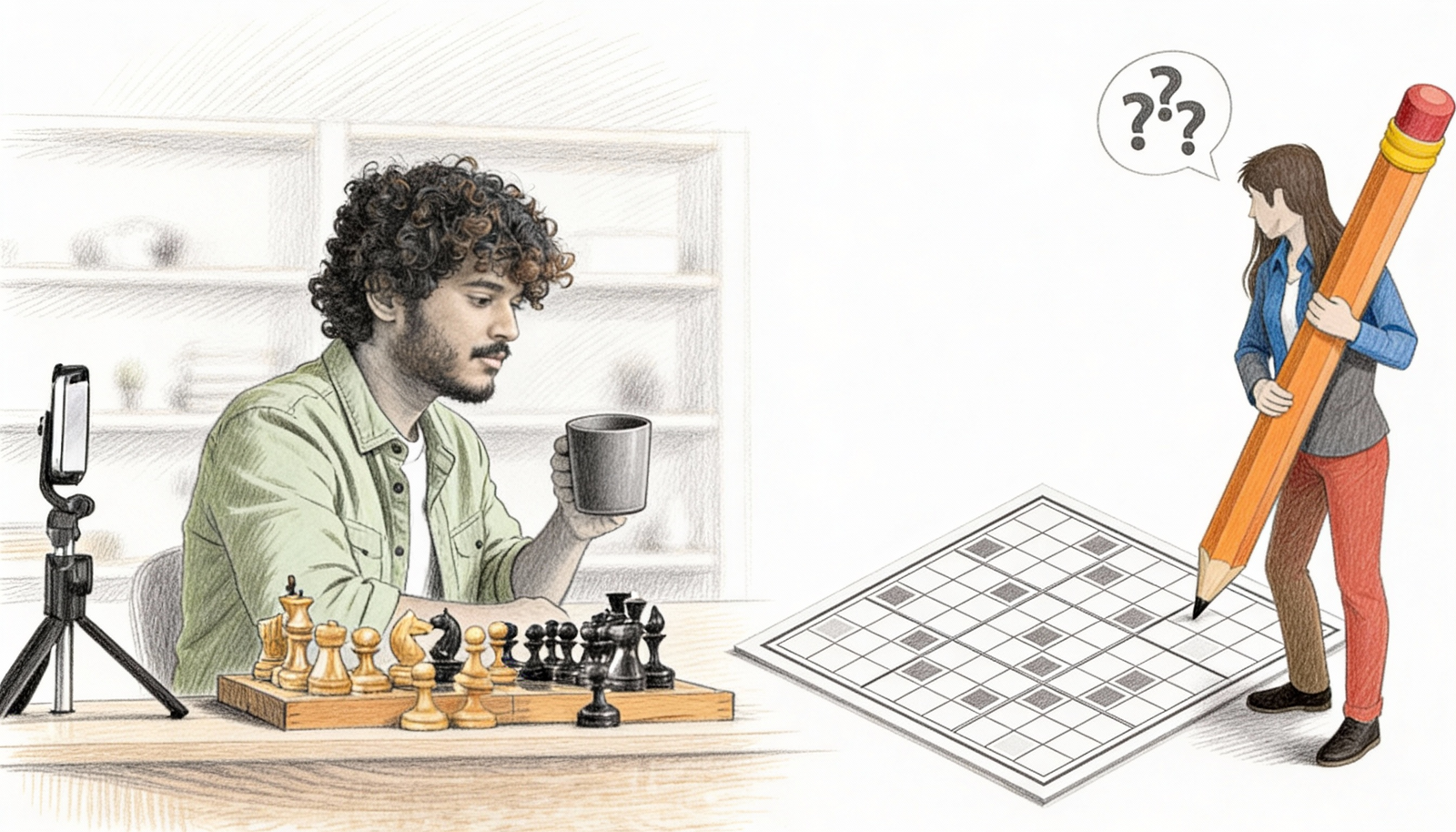
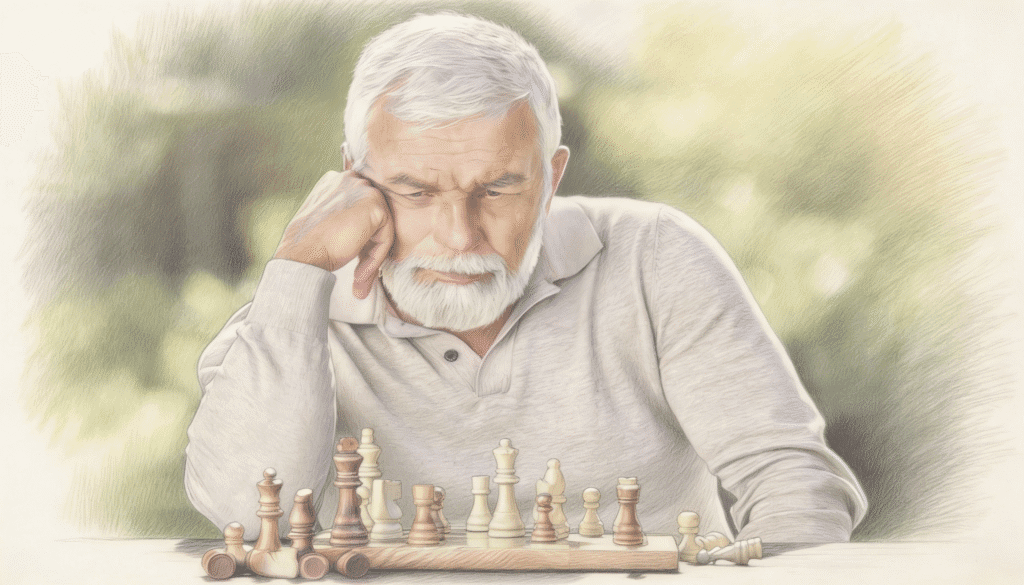
The eighth grader stared at the board for twenty minutes before moving his knight. His opponent, a retired postal worker in his sixties, glanced at the position for perhaps thirty seconds and responded immediately. The game was over twelve moves later. The kid had an IQ of 145. The postal worker barely finished high school.
This scene plays out in chess clubs everywhere, and it reveals something uncomfortable about what most people believe makes someone good at chess. The myth persists that grandmasters possess some kind of superhuman intelligence, that their brains operate on a different frequency than the rest of us. But spend any time around actual titled players and a different picture emerges. Many grandmasters are sharp people, sure. But many are also perfectly ordinary when you remove the chess board. Some struggle with basic math. Others can’t remember where they parked their car.
The truth is stranger and more interesting than the myth. Grandmaster thinking has almost nothing to do with being smart in the way we typically understand intelligence.
The Intelligence Trap
When people watch a grandmaster play, they see someone calculating long sequences of moves, evaluating complex positions, and finding ideas that seem to come from nowhere. It looks like pure computational power. It looks like genius.
What they have is something psychologists call pattern recognition, though that phrase makes it sound simpler than it is. Over thousands of hours at the board, grandmasters build a massive library of positions in their memory. Not individual positions exactly, but types of positions. Structures. Relationships between pieces. When they look at a board, they’re not seeing individual pieces. They’re seeing patterns they’ve encountered hundreds of times before.
A study by Dutch psychologist Adriaan de Groot in the 1940s demonstrated this beautifully. He showed chess positions to players of different strengths for just a few seconds, then asked them to reconstruct the position from memory. Grandmasters could do this almost perfectly. Beginners struggled. But here’s the key finding: when de Groot showed them positions with pieces placed randomly, positions that could never occur in an actual game, the grandmasters performed no better than beginners.
The grandmaster advantage disappeared entirely when pattern recognition couldn’t help them.
The Real Architecture of Mastery
So if grandmaster thinking isn’t about raw intelligence, what is it about? The answer involves three separate but connected systems that have nothing to do with how smart you are.
The first system is recognition. Every chess position contains certain features. Pawn structures, piece placements, king safety issues, open files. A grandmaster has seen thousands of positions with similar features. When they encounter a new position, their brain doesn’t laboriously work through possibilities. It recognizes the pattern and instantly suggests plans that have worked before.
This is why grandmasters can play dozens of games simultaneously while walking from board to board. They’re not calculating. They’re recognizing. The position says “This is that type of situation” and their brain responds with “Then this type of plan makes sense.”
The second system is what you might call constraint awareness. Chess has rules, obviously. But beyond the basic rules of how pieces move, every position contains hidden rules. Things you can’t do because they lose material. Things you should do because of long term factors. Weak squares, bad pieces, exposed kings. A grandmaster doesn’t think through these constraints consciously. They feel them. Certain moves simply don’t register as possibilities because the position’s constraints have eliminated them from consideration.
A club player looks at a position and sees dozens of legal moves. A grandmaster looks at the same position and sees three or four moves worth considering. This isn’t because the grandmaster is smarter. It’s because their brain has learned to filter out irrelevant options automatically.
The third system is evaluation. At some point, you have to judge a position. Is it better for white or black? Should you trade pieces or keep them on the board? These judgments seem magical when a grandmaster makes them. But they’re not based on calculation. They’re based on intuition built from exposure.
Imagine you walk into a restaurant kitchen. If you’re a professional chef, you can immediately sense whether that kitchen runs well or poorly. You notice details others miss. The organization of tools, the cleanliness of surfaces, the way ingredients are stored. You don’t consciously check a list. Your experienced eye knows what matters.
Grandmasters evaluate chess positions the same way. They’ve developed an eye for what matters. And like a chef’s judgment about a kitchen, this has nothing to do with general intelligence. It has to do with exposure and experience.
The Framework Nobody Talks About
Here’s where it gets interesting. The three systems work together to create something that looks like genius but is actually much more mechanical. Grandmasters use what you might call a framework, though they’d never describe it this way because they’re not conscious of using it.
The framework has layers. At the bottom layer sits immediate tactical reality. Can pieces be captured? Are there checks, threats, forced sequences? Grandmasters scan for this automatically. Their brains are trained to spot hanging pieces the way your brain is trained to spot red traffic lights.
The next layer up involves piece activity and coordination. Are the pieces working together or getting in each other’s way? This layer isn’t about specific tactics. It’s about the potential for tactics to exist. A grandmaster feels when pieces are poorly placed the way you feel when you’re wearing clothes that don’t fit right.
Above that sits strategic considerations. Pawn structures, space advantages, piece quality. These factors don’t create immediate threats, but they determine who will have better options as the game progresses. This layer is about trajectory, not position. Where is this game heading?
The top layer involves psychological factors and practical considerations. Time on the clock, opponent’s style, tournament situation. A grandmaster adjusts their decisions based on context. The objectively best move might not be the practically best move.
Most players never develop this layered framework because they focus on the wrong things. They study openings, memorizing moves. They solve tactical puzzles. These help, but they’re not sufficient. The framework develops from playing thousands of games and, crucially, from studying the games of others. From seeing how patterns play out across different contexts.
The Constituencies of Chess Thought
Here’s something non-players rarely understand. Chess isn’t a single skill. It’s a collection of related abilities that all have to work together. You could call these the constituencies of chess thought.
There’s board vision, the ability to see the whole board at once rather than focusing on individual areas. There’s calculation, obviously, though as we’ve established, grandmasters don’t calculate more, they calculate better because they calculate the right things. There’s patience, the willingness to maneuver and improve your position rather than forcing action. There’s aggression, knowing when to commit resources to an attack. There’s defensive skill, sensing danger before it materializes.
Each of these exists on a spectrum. Some grandmasters are brilliant attackers but mediocre defenders. Others are positional wizards who rarely launch successful attacks. The strongest players have developed most of these constituencies to a high level, but few excel at everything.
This is why talented juniors sometimes hit a ceiling. They’ve developed some constituencies naturally but neglected others. The aggressive junior who won games with wild attacks suddenly faces players who defend accurately. The positional player who ground out wins through patience faces opponents who punish slow play with sharp tactics.
Becoming a grandmaster requires consciously developing the weaker constituencies. This has nothing to do with intelligence. It’s about honest self assessment and deliberate practice. A smart person without self awareness stays stuck. A less intelligent person who accurately identifies their weaknesses and works on them improves steadily.
The Uncomfortable Reality
The chess world doesn’t advertise this because it ruins the mystique. If grandmaster thinking is learnable, if it’s not about being special or gifted, then what separates masters from everyone else is simply time and quality of practice. That’s less romantic than the genius narrative.
But it’s also more democratic. The barrier to reaching high levels of chess isn’t your IQ or some innate gift. It’s whether you’re willing to put in thousands of hours of focused study. Not playing blitz online for fun. Not memorizing opening variations. But actual study of complete games, preferably with a strong player explaining the reasoning behind moves.
Consider this perspective. A university professor with a PhD in mathematics started playing chess seriously at age thirty. After ten years, he reached an expert level, roughly 2000 rating. Respectable, but nowhere near master level. Meanwhile, a teenager who dropped out of school at sixteen to focus on chess reached grandmaster level by twenty five. The professor was demonstrably smarter by conventional measures. The dropout had invested more focused hours.
The Hidden Value
So if grandmaster thinking isn’t about being smart, why should anyone care about understanding it? Because the process of developing it teaches something valuable.
Grandmaster thinking demonstrates how human expertise actually works in any domain. The pattern recognition, the constraint awareness, the intuitive evaluation. These same systems operate in every field where people develop mastery. A skilled carpenter looks at a piece of wood and immediately knows how to work with its grain. A jazz musician hears a chord progression and instantly knows which scales and approaches will work. A programmer glances at code and spots the bug.
The lesson isn’t that chess makes you smarter. The lesson is that expertise looks like magic from the outside but is actually built from thousands of small recognitions and adjustments. That the path to mastery in anything involves building up a library of patterns, developing intuition through exposure, and learning to automatically filter out irrelevant information.
The chess world just makes this visible because the entire activity takes place on a sixty four square board where everything can be documented and analyzed. You can track exactly how a player’s thinking develops over time. You can see the moment when pattern recognition kicks in and calculation becomes less important.
The Paradox at the Heart
There’s a paradox here that’s worth sitting with. Grandmaster thinking isn’t about being smart, yet grandmasters make decisions that seem impossibly intelligent. They find moves that computers, with their raw calculating power, agree are best. They sense danger in positions that look safe to everyone else. They conjure up plans that seem to come from nowhere.
The resolution to this paradox changes how you think about intelligence itself. Maybe intelligence isn’t one thing. Maybe what we call smart is actually a collection of different cognitive abilities, and different domains reward different combinations.
Chess rewards pattern recognition, focus, and the ability to build mental models through repetition. It doesn’t particularly reward quick thinking or creativity or social intelligence or mathematical ability. Someone can be brilliant at chess and quite average at everything else. This doesn’t make them less intelligent. It means intelligence is more plural and context dependent than we typically admit.
The grandmaster isn’t smarter than you. They’ve simply invested thousands of hours building a specific cognitive architecture that serves chess extremely well. They’ve trained their brain to recognize patterns you don’t see, to feel constraints you don’t notice, to evaluate positions with intuition you haven’t developed.
You could build the same architecture if you invested the time. That’s not inspiring in a conventional way. Nobody wants to hear that greatness requires thousands of hours of focused practice. But it’s true, and it’s actually the more interesting truth. Grandmaster thinking isn’t a gift. It’s a skill. And like any skill, it’s available to anyone willing to do the work.
The eighth grader with the high IQ eventually quit chess. The postal worker kept playing and kept improving. Last anyone heard, he’d earned his master title. He still can’t do calculus. But sit him at a chess board, and his mind becomes something different. Not smarter exactly. Just more thoroughly trained.