Table of Contents
The board doesn’t care about your excuses.
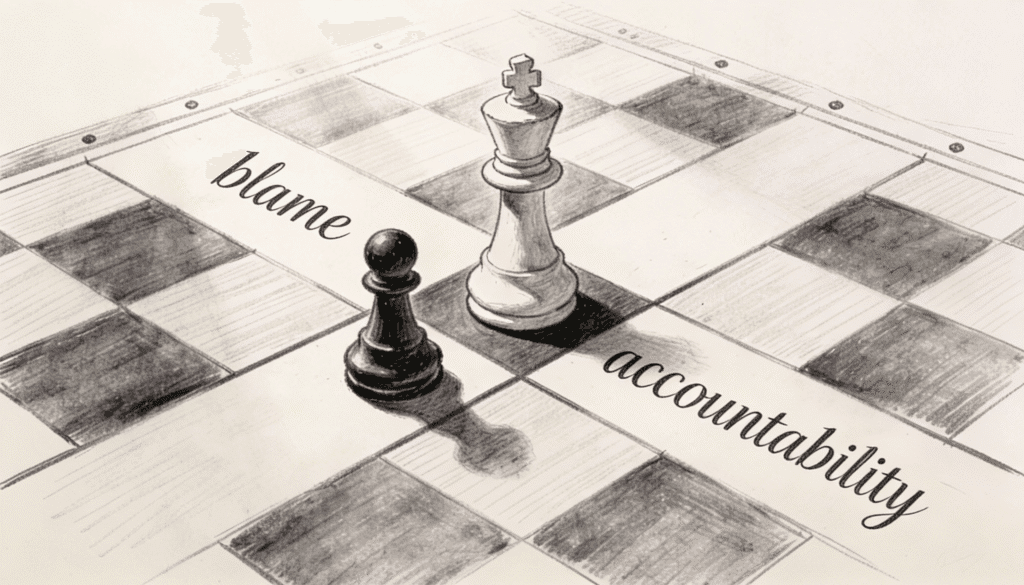
When a chess player loses their queen to a fork, there’s no sympathetic referee to call. No replay booth to overturn the blunder. The piece is gone, and the player must reckon with what remains. This brutal simplicity makes chess one of life’s most effective teachers of personal accountability.
Consider the player who sits down after a devastating loss, face flushed, mentally scrolling through explanations. The opening wasn’t familiar. The opponent played too quickly. The lighting was harsh. The chair was uncomfortable. These defenses arrive unbidden, automatic as breathing, because admitting “I made the wrong decision” burns more than any tactical defeat.
But chess, unlike almost every other competitive arena, strips these excuses bare. There was no bad call from an official. No teammate missed their assignment. No equipment malfunctioned. Every piece that moved did so because the player commanded it. The loss exists in its purest form, uncontaminated by external variables.
This is where the transformation begins.
The Illusion of Control Meets Reality
Most people navigate life with a comfortable blend of agency and excuse making. Something goes wrong at work, and the mind immediately files through possible external causes. The economy. Corporate politics. That one coworker. These explanations feel true because they often contain fragments of truth. But they also serve as shields, protecting the ego from uncomfortable questions about personal choice.
Chess doesn’t allow this luxury. A player might face an opponent who plays an unusual opening, something outside the standard theory. This is legitimately unexpected. But the game continues, and within a dozen moves, the player must adapt or face consequences. Complaining about the surprise doesn’t move pieces. Wishing for a different scenario doesn’t prevent checkmate.
The board teaches through consequence. Fall into the same trap repeatedly, and the lesson arrives with mathematical certainty. Blame the trap all you want, but walking into it was a choice. Recognition of this pattern, painful as it might be, marks the first step toward improvement.
When Blame Stops Working
Psychologists have long studied the locus of control, the degree to which people believe they have control over outcomes in their lives. An external locus means attributing results primarily to outside forces. An internal locus means seeing personal choices as the primary driver. Research consistently links an internal locus of control with better mental health, higher achievement, and greater resilience.
Chess is perhaps the purest training ground for developing internal locus of control because it makes external attribution impossible to sustain. Play a hundred games while blaming bad luck, and the rating system will deliver its verdict without emotion. The player who learns to ask “What could I have done differently?” after each loss gains exponentially faster than the one who catalogs grievances.
This accountability doesn’t mean ignoring legitimate challenges. A player might genuinely face a stronger opponent with years more experience. But even in this lopsided match, the player controls their response. They can study the game afterward, identifying moments where a better move existed. They can recognize patterns in how they fell behind. They can extract lessons that apply to future games against players at their own level.
The victim mentality crumbles here because it provides no actionable intelligence.
The Paradox of Powerlessness
Here’s where chess reveals something counterintuitive. Embracing accountability, admitting that every loss traces back to your decisions, should feel crushing. Total responsibility for failure sounds like a recipe for despair. Yet experienced chess players report the opposite experience.
Knowing that improvement depends entirely on personal growth feels liberating. There’s no waiting for circumstances to change or for others to behave differently. The path forward exists clearly: study more effectively, analyze games honestly, identify recurring mistakes. Progress becomes a matter of commitment rather than luck.
The Scorecard Never Lies
Modern chess platforms track every game, every rating point, every opening played. This data creates an undeniable record. A player cannot claim they’re improving while their rating steadily drops. They cannot insist they’re good at endgames while the statistics show repeated losses in that phase.
This transparency forces confrontation with reality. The player who insists they lose because opponents get lucky must explain why this “luck” persists across hundreds of games. The one who blames time pressure must reckon with why they consistently reach critical positions with insufficient time remaining.
The data doesn’t judge, but it also doesn’t lie. It reflects choices accumulated over time. Players who embrace this feedback mechanism grow. Those who resist it stagnate, trapped in narratives that protect the ego while sabotaging progress.
From Blame to Agency
The shift from victim thinking to accountability mindset follows a predictable pattern in chess. Early players blame pieces, as if the knights conspire against them. Intermediate players blame opponents for playing “annoying” styles or “cheap” tactics. Advanced players blame themselves, but often in vague, unproductive ways.
Master level players do something different. They blame specific decisions they made, identifying the exact moment where a different choice would have altered the outcome. This precision matters because vague self blame (“I played badly”) changes nothing. Specific accountability (“I should have activated my rook on move 15 instead of pushing the pawn”) creates a clear correction for next time.
This evolution mirrors healthy personal growth in any domain. Moving from “Why does this always happen to me?” to “What did I do to contribute to this outcome?” to “Next time I’ll handle that moment differently” represents maturation. Chess compresses this journey because consequences arrive quickly and clearly.
The Social Dimension
Chess communities online and in clubs develop interesting cultural norms around accountability. Beginners who complain about luck in post game analysis receive gentle correction. The experienced player might say, “Yes, their move surprised you. Now let’s look at how to handle that surprise better.” This redirection teaches crucial lessons about where to focus energy.
Over time, players internalize these norms. They start analyzing their own games with the same dispassionate honesty they’d apply to someone else’s. The emotional sting of loss remains, but it no longer blocks clear analysis. “I lost” becomes “I lost because I failed to prevent their central breakthrough” which becomes “Next time I face this pawn structure, I need to control those squares earlier.”
Watch strong players review games, and you’ll rarely hear excuses. You’ll hear detailed analysis of decision points, discussion of alternatives, and honest assessment of calculation errors. This culture of accountability becomes self reinforcing. Players see that improvement comes from owning mistakes, so they own mistakes, so they improve.
Beyond the Board
The habits chess builds transfer surprisingly well to other areas of life. The player who learns to analyze losses objectively begins asking similar questions about career setbacks or relationship problems. Not “Why did this happen to me?” but “What did I miss? What could I have done differently?”
This doesn’t mean accepting blame for things genuinely outside personal control. It means expanding the circle of responsibility to include responses and choices that initially seem automatic. The person who learns they control their reaction to an opponent’s unexpected opening may realize they also control their reaction to a colleague’s criticism or a partner’s mood.
The chess mindset recognizes that while you can’t control what happens to you, you almost always control what happens next. Your move. Your choice. Your responsibility.
The board doesn’t care about your excuses because it doesn’t need to. It offers something better: clarity. Every game provides perfect information about the consequences of your choices. Use that information honestly, and improvement becomes inevitable. Hide behind excuses, and stagnation feels mysteriously permanent.
Chess doesn’t cure victim mentality through inspiration or philosophy. It does so through sheer mechanical reality. Make better choices and win more games. Make worse choices and lose. The connection remains visible, undeniable, and ultimately liberating.
The board is waiting. Your move.