Table of Contents
The conference room falls silent. Sarah glances at her phone under the table, sneaking in one more move before the quarterly review begins. A coworker catches her eye and smirks, ready to rat her out. But when the screen lights up, it’s not Candy Crush. It’s chess. The smirk vanishes. Sarah’s boss walks in, notices the board, and actually leans over to see the position. “Interesting game,” he says.
This scene plays out in offices everywhere, and it reveals something curious about how we view games in professional spaces. Play anything else during work hours and you’re goofing off. Play chess and you’re sharpening your mind.
The question is worth exploring: What makes chess the singular exception to workplace gaming taboos? The answer goes deeper than simple tradition or cultural quirks. Chess has managed to position itself not as a distraction from work, but as a parallel to it.
The Mental Gym Nobody Questions
When someone says they’re going to the gym during lunch, nobody blinks. Physical fitness is universally accepted as worthwhile. Chess has achieved the same status for mental fitness, except with one advantage: you can do it at your desk.
The game offers something rarely found in actual work: pure problem solving stripped of office politics, unclear objectives, and ambiguous success metrics. Every position is a puzzle with real solutions. Every move either improves your situation or worsens it. The feedback is immediate and honest in ways corporate life never is.
The Language of Strategic Thinking
Walk into any executive meeting and listen to how people talk. They speak about positioning. About long term planning. About sacrificing short term gains for strategic advantage. About reading the competition. About protecting key assets while applying pressure.
This is chess vocabulary that escaped the board and colonized business schools.
When a manager sees someone playing chess, they don’t see escapism. They see someone practicing the exact framework that business strategy is built on. The game becomes a Rorschach test where bosses project their own concerns about markets, competition, and resource allocation.
The connection isn’t coincidental. Many management theories explicitly draw from chess concepts. The idea of strategic planning itself, with multiple moves plotted in advance, mirrors how chess players think. The notion of forcing moves, where you give your opponent no good options, appears in negotiation seminars. Even the concept of zugzwang, where any move worsens your position, has found its way into business analysis, particularly around topics like market timing and competitive response.
The Performance of Seriousness
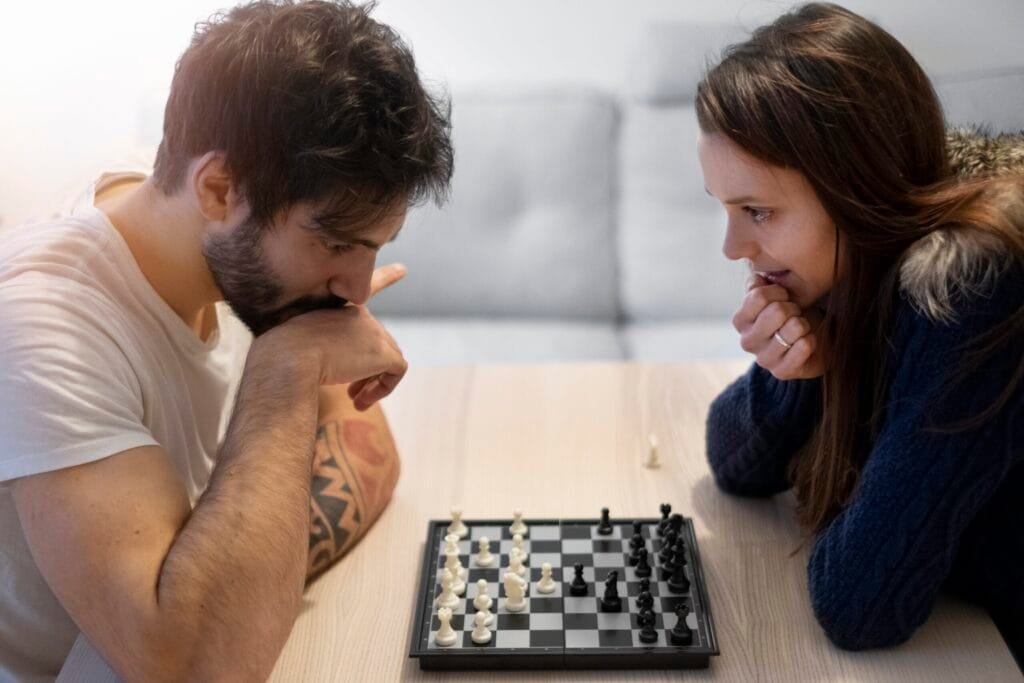
There’s a theatrical element at play too. Chess looks intellectual. The furrowed brow. The hand on chin. The long pause before moving. The game comes with built-in props that signal deep thought.
Compare this to the optics of almost any other game. Mobile puzzle games make people look distracted. Card games seem frivolous. Even complex strategy video games, which might require as much thinking as chess, carry the aesthetic of entertainment rather than exercise.
Chess benefits from centuries of cultural positioning as the game of kings, generals, and thinkers. It appears in paintings of royal courts. When someone plays chess, they’re borrowing that accumulated gravitas.
The seriousness is somewhat ironic given that chess is, objectively, as much a game as poker or checkers. But perception shapes reality in workplace culture. Looking like you’re thinking hard is sometimes indistinguishable from actually thinking hard, and chess provides that cover better than any alternative.
Failure as a Feature
Most workplace activities obscure failure. Projects have many contributors, so individual mistakes blur into collective outcomes. Meetings produce vague action items rather than clear winners and losers. Performance reviews happen once or twice a year and rely on subjective assessments.
Chess is brutally different. You lose, and you know exactly why. The board doesn’t lie. There’s no blaming market conditions or other departments or bad luck beyond the occasional opening surprise.
This clarity of feedback creates an unusual dynamic. People who play chess regularly are essentially volunteering for repeated, definitive losses. They’re signing up to have their mistakes laid bare.
Counterintuitively, this makes chess players seem more resilient to management. The game trains people to analyze failures objectively rather than defensively. When you lose thirty games learning an opening, you develop a thick skin about being wrong. You learn to treat errors as data rather than identity threats.
Bosses appreciate this because workplace success depends heavily on learning from mistakes without spiraling into blame cycles. Chess players have pre-trained this skill in thousands of games where ego protection wasn’t an option.
The Democracy of Difficulty
Chess also occupies a sweet spot of accessibility and depth that few activities match. The rules take minutes to learn. Within an hour, beginners can play a recognizable game. But mastery remains impossible even after a lifetime of study.
This range means chess works as common ground across hierarchies. A junior employee can play against a senior executive, and both can find the experience meaningful. The game doesn’t require expensive equipment or exclusive access. It’s not gatekept by credentials or membership fees.
Yet it remains genuinely difficult. Nobody mistakes chess for a casual pastime once they’ve played seriously. The game has formal ratings, tournaments, titled players, and professional circuits. It offers a clear progression system from novice to expert that parallels professional advancement.
When someone mentions their chess rating in conversation, it translates into immediate understanding. A 1500 player is decent. A 2000 player is strong. A 2200+ player is nearing expert level. These numbers communicate competence in a universally recognized system, much like academic degrees or professional certifications.
The Illusion of Control
Perhaps the deepest reason chess earns workplace respect lies in what it promises about the nature of success. Chess is a game of information. Both players see the entire board. There are no hidden cards, no dice rolls, no luck of the draw.
This makes chess victories feel pure. When you win, it’s because you thought better, planned better, calculated better. The game reinforces a meritocratic worldview where outcomes directly reflect ability.
Corporate environments nominally operate on similar principles. Companies claim to reward performance and punish incompetence. In reality, success often depends on factors beyond individual control such as timing, relationships, organizational politics, and plain chance.
Chess offers an escape into a world where merit determines everything. It’s a comforting fiction that appeals particularly to people who want to believe their careers operate the same way. Managers who see themselves as rational decision makers naturally respect a game that rewards rational decision making.
The irony, of course, is that real business rarely resembles chess. Markets are not games of complete information. Competitors don’t take turns. The rules change mid-play. Luck matters enormously.
But perhaps that’s exactly why chess earns such reverence in office culture. It provides a simplified model where strategic thinking actually works the way management books promise it does. It’s not a reflection of business reality so much as an idealization of it.
When the Game Becomes the Work
The strangest aspect of chess’s workplace acceptance is how it can become officially sanctioned. Some companies sponsor chess. A few run internal tournaments. Playing during lunch or breaks is explicitly encouraged in certain cultures as a team building activity.
This represents the ultimate victory for chess’s positioning. The game has transcended being merely tolerated and become actively promoted. It’s been fully absorbed into the corporate wellness industrial complex, sitting alongside meditation apps and standing desks as an approved method of employee optimization.
There’s something darkly funny about how capitalism has metabolized even a board game into productivity theater. Chess isn’t quite allowed to be just a game. It must be justified as cognitive training, stress relief, or team bonding. The play must produce measurable value.
Yet this transformation also reveals the game’s genuine utility. Chess does improve pattern recognition. It does build focus and patience. It does create social connections. These benefits are real, even if they’ve been packaged into corporate friendly language.
The difference between chess and other games isn’t that chess is inherently more valuable. It’s that chess successfully marketed itself as valuable in terms workplaces understand.
The Verdict from Above
So why is chess the only video game your boss will respect? Because it’s not really seen as a game at all. It’s been reclassified as a tool, a skill, a practice. It speaks the language of strategy that business culture is built on. It offers the appearance of serious intellectual work. It trains qualities that workplaces value such as focus, pattern recognition, and resilience to failure.
Most importantly, chess allows everyone involved to maintain a comfortable fiction. Employees get to play a game while appearing productive. Bosses get to feel good about allowing something that seems educational rather than recreational. Everyone agrees to treat sixty-four squares and thirty-two pieces as something more meaningful than entertainment.
Whether this makes chess actually better than other games is debatable. But in the specific context of workplace acceptance, chess stands alone. It cracked the code that other games never could, transforming from pastime into something approaching professional development.
The next time someone plays chess during a slow afternoon and nobody complains, remember it’s not because chess is uniquely valuable. It’s because chess is uniquely good at convincing people it’s valuable. That might be the most impressive strategic victory the game has ever achieved.