Table of Contents
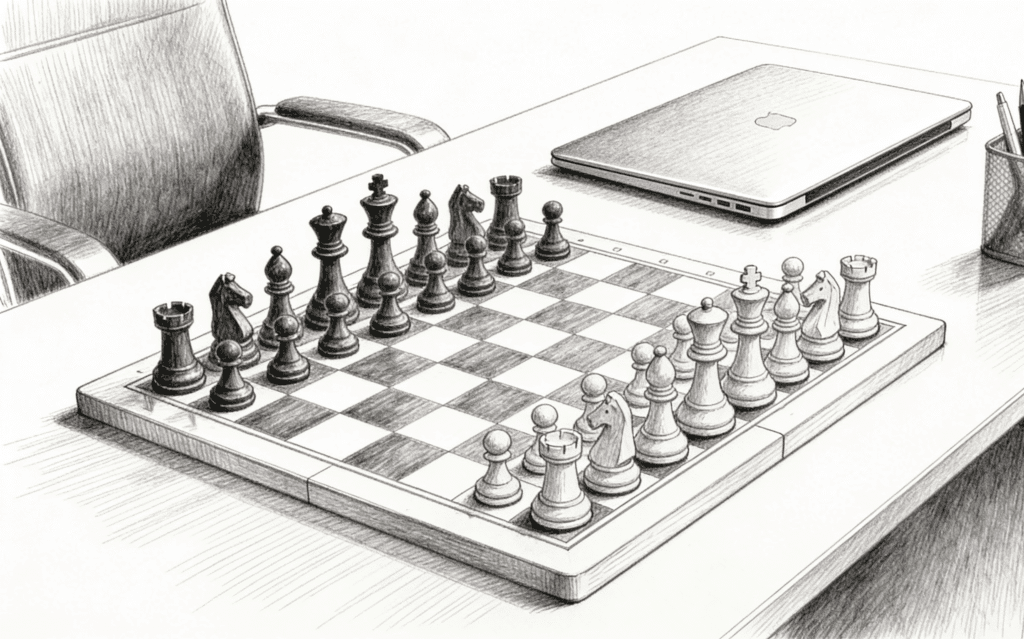
The desk holds the usual suspects: a laptop, a coffee mug, framed photos of the family. But next to the chaos of quarterly reports sits something unexpected. A chessboard. Not as decoration. Not gathering dust. The pieces are slightly asymmetrical, mid-game, as if someone just stepped away for a phone call.
Most visitors assume it’s a relic from a college dorm room or a gift from a well-meaning relative. They’re wrong. That chessboard is working harder than the motivational poster on the wall.
The Game That Never Stops Teaching
Chess has survived centuries not because it’s fun, though it is, but because it mirrors something fundamental about decision making. Every piece has constraints. Every move creates consequences. Every opponent thinks differently. The board doesn’t care about your job title or how confident you feel. It just waits for your next decision.
CEOs make roughly 100 decisions per day, according to research from Stanford. Most happen in seconds. Hire this person. Kill that project. Double down or cut losses. The stakes vary wildly, but the underlying challenge stays the same: incomplete information, competing priorities, and outcomes that won’t be clear until much later.
Chess compresses this reality into 64 squares. A training ground where mistakes cost nothing but pride, yet teach everything about judgment.
Seeing What Others Miss
The amateur chess player sees pieces. The skilled player sees relationships. Where pieces support each other, where they block each other, where removing one suddenly changes everything else.
This isn’t about being smart. It’s about developing pattern recognition at a level that becomes almost instinctive. Corporate strategy works the same way. A new product launch isn’t just a product launch. It affects manufacturing capacity, sales team focus, brand positioning, customer expectations, and competitor responses. Pull one thread and watch ten others move.
Chess players call this the ability to visualize where pieces will be several moves ahead. The board shows the present. The mind maps the future. CEOs need the same skill. The current org chart matters less than the one that must exist in two years when market conditions shift.
The Patience Problem
Modern business culture worships speed. Move fast and break things. Fail forward. Bias toward action. These mantras have value, but they’ve created a generation of leaders who confuse activity with progress.
Chess teaches a different lesson. Sometimes the best move is quiet. Subtle. Almost invisible to the untrained eye. Improving a piece’s position by one square. Denying the opponent a key diagonal. Creating a small weakness that won’t matter for another ten moves but will become decisive then.
Microsoft under Steve Ballmer acquired dozens of companies, launched numerous products, and generated constant headlines. Microsoft under Satya Nadella has been more selective, more patient, more willing to make moves that seem small initially. Shifting to cloud infrastructure. Buying GitHub. Integrating AI gradually rather than forcing it everywhere immediately. The stock price under Ballmer barely moved for a decade. Under Nadella it increased more than tenfold.
The difference wasn’t intelligence or work ethic. It was recognizing when to push and when to position. Chess players spend hours studying games where the decisive moment came on move 23, but the real work happened on moves 14 through 18 when one player quietly improved their position while the other thrashed around looking for immediate tactics.
Losing With Style
Every CEO will make bad decisions. The question is what happens after. Do they double down to protect their ego? Do they blame market conditions or bad luck? Do they learn something?
Chess players lose constantly. Even world champions lose. The game guarantees it. What separates strong players from weak ones isn’t avoiding mistakes, but the speed and honesty with which they analyze them afterwards.
There’s a tradition in serious chess called the post-mortem. After a game ends, both players sit down together and reconstruct what happened. They find the critical moments, the missed opportunities, the point where one player’s advantage became decisive. Egos get checked at the door. The goal isn’t to explain away the loss but to understand it completely.
This practice seems almost alien in corporate culture, where failure often triggers defensiveness, finger-pointing, or carefully worded press releases that avoid acknowledging reality. But companies that treat failures like chess post-mortems tend to stop repeating them. Amazon’s Fire Phone flopped spectacularly, costing hundreds of millions. Jeff Bezos could have buried the experience. Instead, Amazon dissected what went wrong and applied those lessons to the Echo and Alexa, which succeeded partly because they avoided the Fire Phone’s mistakes.
The chessboard in the office serves as a daily reminder that losing is information, not humiliation.
Strategy vs. Tactics
Business books love the word strategy. Most of what they describe is actually tactics. Real strategy is harder to see because it operates at a different level.
Tactics are concrete: launch this product, acquire that company, hire these people. Strategy is about the kind of company you’re becoming and what battles you’re willing to fight. Tactics ask how to win the current situation. Strategy asks which situations to create in the first place.
In chess, tactics involve winning material or delivering checkmate through specific sequences. Strategy involves controlling key squares, managing pawn structures, and dictating what type of position emerges. A tactical player asks how to attack the opponent’s king. A strategic player asks how to create a position where their pieces naturally become more effective than the opponent’s pieces.
Intel’s decision to exit the memory chip business in the 1980s looked purely tactical, a response to Japanese competition. But it was strategic. Intel wasn’t just abandoning a losing battle. It was defining itself as a microprocessor company and committing to a future where that identity mattered more than historical products. That choice shaped every subsequent decision about research investment, partnerships, and market positioning.
CEOs who understand chess understand that strategy means accepting certain disadvantages to create overwhelming advantages elsewhere. You can’t control every square. Trying to do so spreads resources too thin and creates no real strength anywhere.
The Opponent Has a Plan Too
Corporate echo chambers are dangerous. Surrounded by people who agree, use the same frameworks, and share the same assumptions, leaders start to forget a basic truth. Someone else is trying to win too.
Chess forces confrontation with opposing intelligence. The opponent isn’t passive. They have goals, they spot weaknesses, they create problems. Every plan must account for interference.
Chess teaches defensive thinking not as pessimism but as realism. Before committing to a plan, strong players ask what the opponent’s best response would be. Then they ask if they can handle that response. If not, they choose a different plan. This isn’t paranoia. It’s respect for the fact that competition involves intelligent adaptation on both sides.
When to Trade, When to Complicate
Some chess positions are simplified. Few pieces remain. The path forward is clear. Other positions are complex, with pieces tangled together and multiple plans competing for attention.
Knowing which type of position favors you is half the battle. If you’re ahead, simplification often makes sense. Trade pieces, clarify the position, reduce your opponent’s chances to create chaos. If you’re behind, complexity is your friend. Keep as many pieces on the board as possible. Create multiple threats. Make the position difficult to calculate.
The business equivalent shows up constantly. Market leaders often benefit from clear, predictable markets where their advantages compound over time. Challengers need disruption, new technologies, or sudden shifts that reset everyone’s positions.
Apple entering the smartphone market was a complexity play. The established players like Nokia and BlackBerry had optimized for a particular type of phone. Apple didn’t try to make that type of phone slightly better. It created enough complexity with touchscreens, apps, and a different user experience that the old optimization became temporarily irrelevant.
The chessboard reminds CEOs that sometimes the goal isn’t to solve the current position but to transform it into a different type of position entirely.
The Long Game
Most chess games are decided in the middlegame, but they’re shaped in the opening. The first ten moves often look boring. Pieces develop. The center gets contested. Nothing dramatic happens. Yet these moves determine what becomes possible later.
CEOs face similar time horizons. Today’s mundane decisions about hiring, culture, and infrastructure create tomorrow’s options or limitations. The company that invests in developing leaders internally might see no immediate benefit. Five years later, when competitors struggle to fill executive roles, that early investment becomes decisive.
Chess players know that building a sustainable advantage takes time and a willingness to make moves that don’t show immediate results. The same patience separates companies that dominate their industries from those that flame out after brief success.
The Ritual of Thinking
Perhaps the real value of that chessboard on the CEO’s desk isn’t about chess at all. It’s about preserving space for actual thinking.
Twenty minutes on a difficult chess position requires the kind of concentration that feels increasingly rare. No multitasking. No notifications. Just pure problem solving in a context where quality of thought directly determines outcomes.
This ritual builds a muscle that business constantly demands but rarely allows time to develop. The ability to sit with a complex problem, resist the urge for immediate action, and work through possibilities systematically.
Every game resets. Every position is different. Every opponent presents new challenges. The learning never stops because the problems never repeat exactly.
That’s why the chessboard sits on the desk. Not as a symbol or a conversation piece, but as a working tool. When the next impossible decision arrives, when the competition makes an unexpected move, when the path forward becomes unclear, the CEO doesn’t need to theorize about decision making.
They just move a piece and see what happens next.