Table of Contents
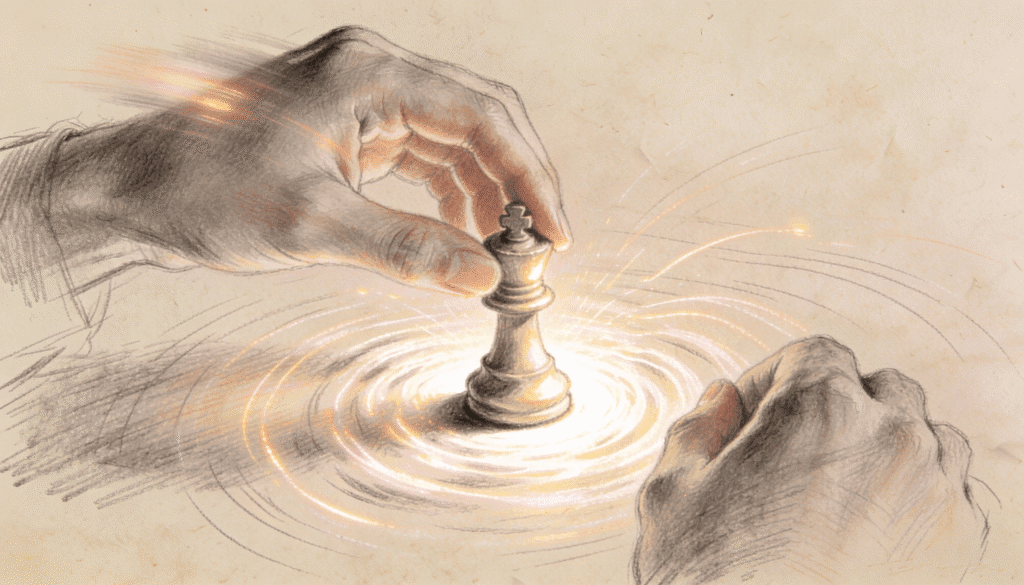
The clock ticks. The world dissolves. A grandmaster sits across the board, eyes fixed on the position, yet somehow looking through it. Minutes pass, but time has become irrelevant. The crowd, the cameras, the million-dollar prize—all of it fades into a soft blur. There is only the board, the patterns, the beautiful geometry of possibility.
This is flow. And neuroscience is beginning to understand why chess, more than almost any other game, has such a remarkable ability to produce it.
When the Brain Finds Its Rhythm
Mihaly Csikszentmihalyi, the psychologist who spent decades studying optimal experience, gave us the term “flow state.” He described it as complete absorption in an activity, where skill meets challenge at just the right threshold. Too easy and you’re bored. Too hard and you’re anxious. But in that narrow channel between the two, something magical happens. The sense of self disappears. Hours feel like minutes. Performance soars.
Chess lives in this channel.
Consider what happens neurologically when a player sits down to a serious game. The prefrontal cortex, that part of the brain responsible for planning and decision-making, lights up with activity. But here’s where it gets interesting. As flow deepens, something counterintuitive occurs. The brain doesn’t work harder. It works more efficiently. Activity in certain regions actually decreases, particularly in areas associated with self-consciousness and the wandering mind.
Psychologists call this transient hypofrontality. The analytical, overthinking parts of the brain quiet down. What remains is pure processing, pattern recognition operating at its highest level. The chess player stops thinking about thinking. They simply see.
The Meditation Connection
Buddhist monks spend years training their minds to achieve what meditators call “one-pointed concentration.” Brain scans of experienced meditators show reduced activity in the default mode network, the part of the brain active when the mind wanders and gets caught up in self-referential thoughts. The ego, for lack of a better word, gets out of the way.
Strong chess players experience something remarkably similar during deep calculation. The constant mental chatter that fills most of our waking hours—the worries about tomorrow, the replays of yesterday, the running commentary on our own performance—simply stops. There is no room for it. The position demands everything.
The Chemistry of Absorption
The neurochemistry of flow reveals why the state feels so compelling. When someone enters flow, the brain releases a cascade of neurochemicals that are, frankly, intoxicating. Dopamine, the reward chemical, surges. Norepinephrine, which heightens focus and arousal, floods the system. Endorphins, the brain’s natural painkillers, appear. Serotonin, associated with feelings of contentment, rises.
This is one reason chess can become genuinely addictive. The brain learns to crave that state. Every player knows the feeling of finishing a long, absorbing game and immediately wanting another. Not because the game was easy or pleasant—often it was grueling—but because the quality of consciousness during that game was simply superior to ordinary waking experience.
There’s an irony here. Chess is often seen as the ultimate rational game, the domain of pure logic. Yet the state that produces the best chess is one where cold rationality gives way to something more intuitive, more felt than thought.
Pattern Recognition and the Trained Mind
A beginning player looks at a chess position and sees thirty-two pieces on sixty-four squares. A grandmaster looks at the same position and sees something entirely different. They see pawn structures that echo games from seventy years ago. They recognize piece configurations that signal advantage or danger. They perceive the position as a coherent whole, the way a fluent reader sees words rather than individual letters.
This is the result of tens of thousands of hours training the brain’s pattern recognition systems. The temporal lobes, where pattern recognition largely occurs, become remarkably efficient in experienced players. They chunk information, grouping related pieces and squares into meaningful units. This frees up working memory, allowing the conscious mind to handle more complex calculations.
It also creates the conditions for flow. When pattern recognition is automatic, the brain can operate without the friction of conscious effort. The player doesn’t have to laboriously analyze every possibility. Viable moves suggest themselves. Bad moves are dismissed before they fully form as thoughts. The game flows.
The Challenge-Skill Balance
Flow requires that delicate balance where ability meets difficulty. Too much challenge and the anxiety response kicks in. The amygdala, the brain’s fear center, activates. Stress hormones flood the system. The player tightens up, makes mistakes, and the downward spiral begins.
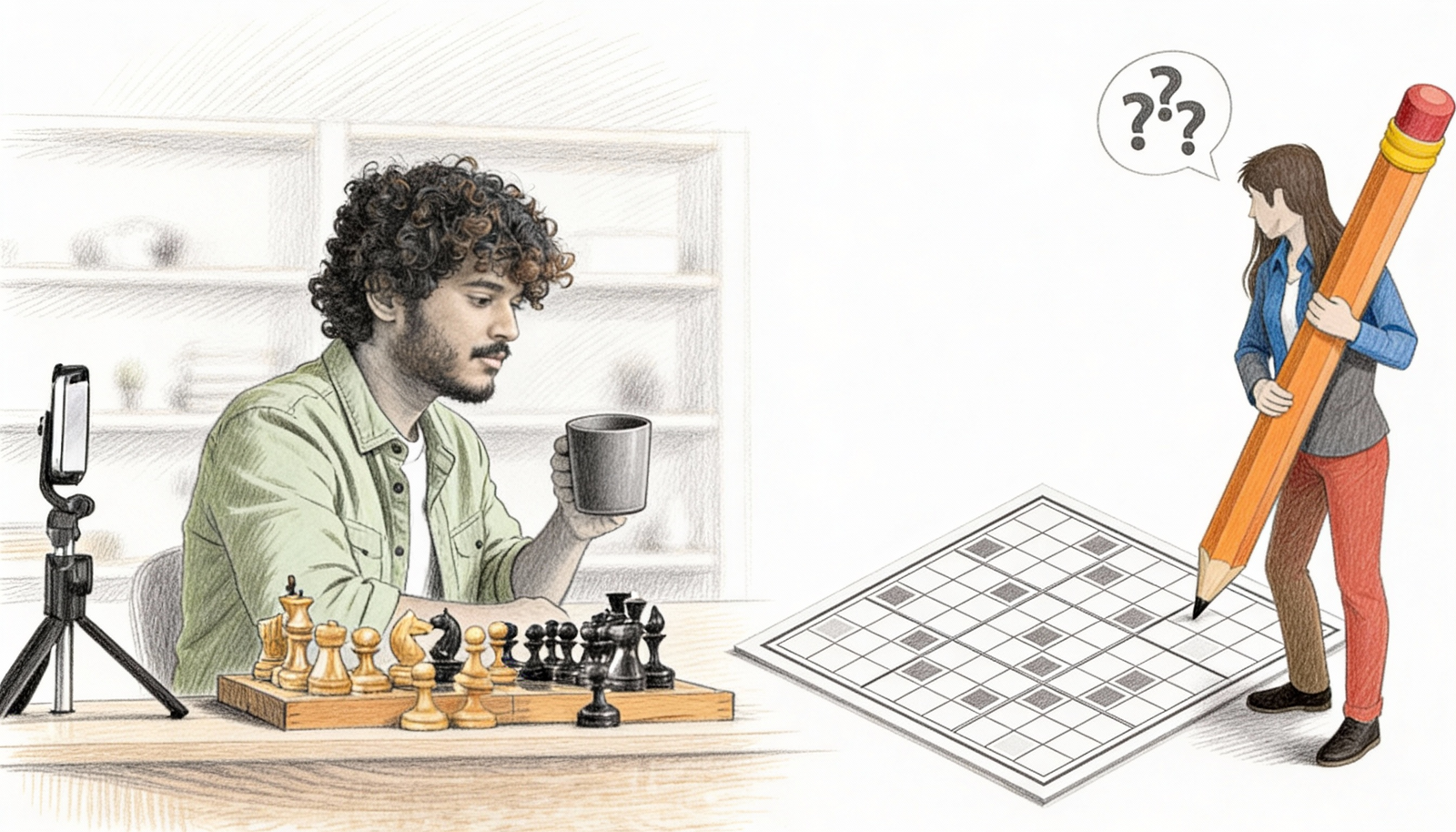
Too little challenge and the brain disengages. Attention wanders. The dopamine reward system needs novelty and difficulty to maintain interest. A grandmaster playing a beginner feels no flow. A beginner attempting a puzzle far beyond their level finds only frustration.
But a well-matched game or a puzzle at exactly the right difficulty creates something precious. The player’s entire capacity is engaged, but not overwhelmed. They stretch without breaking. This is why rating systems matter, why good coaches carefully calibrate difficulty, why the best training is self-adjusting to maintain that golden ratio.
Time Distortion and Subjective Experience
One of the most striking features of flow is how it warps the perception of time. Chess players emerge from long games shocked to discover hours have passed. What felt like thirty minutes of thought was actually two hours. The internal clock, normally so reliable, simply stops reporting accurately.
In flow, attention is so focused that peripheral information—the kind that normally helps construct our sense of duration—never gets encoded. When the game ends and the player tries to reconstruct the experience, there are fewer markers, fewer reference points. The time seems compressed because less information was recorded.
The Silence Beneath Calculation
There’s a quality to deep chess thought that resembles certain meditative states in another way—the experience of silence beneath activity. Even as the calculating mind churns through variations, testing plans, evaluating positions, there’s an underlying quiet. The emotional reactivity that normally colors thought is absent. Fear of losing, hope of winning, frustration at mistakes—these emotions arise, but they don’t stick. They pass through without creating turbulence.
Experienced players learn this through thousands of games. The nervous beginner makes impulsive moves to escape uncomfortable positions or rushes to capitalize on perceived advantages. The master maintains composure, treating each position as simply the next problem to solve. This emotional regulation is not just good sportsmanship. It’s neurologically necessary for flow to continue.
The Return to Ordinary Consciousness
Every flow state ends. The game finishes, the puzzle is solved, or something breaks the spell. A noise, a thought, a moment of self-awareness creeps back in. The default mode network reboots. The inner narrator returns with its running commentary.
The contrast between flow consciousness and normal waking awareness is stark enough that ordinary life can feel dull by comparison. This is part of why chess, like meditation, can become a practice rather than just an activity. The state it produces is worth pursuing for its own sake, regardless of wins or losses.
Modern life offers fewer opportunities for flow than our ancestors likely experienced. We’re overstimulated, distracted, rarely operating at the edge of our abilities in any focused way. Chess offers a corrective. It demands and rewards complete presence in a way that feels increasingly rare.
The board is sixty-four squares. The rules fit on a single page. Yet within that simple structure lies a doorway to an altered state of consciousness that neuroscience is only beginning to understand. Not supernatural, not mystical, but a natural capability of the human brain operating at its peak.
The world dissolves. The clock ticks. There is only the position, the patterns, the beautiful geometry of possibility. This is flow. This is chess. And perhaps they’ve been the same thing all along.