Table of Contents
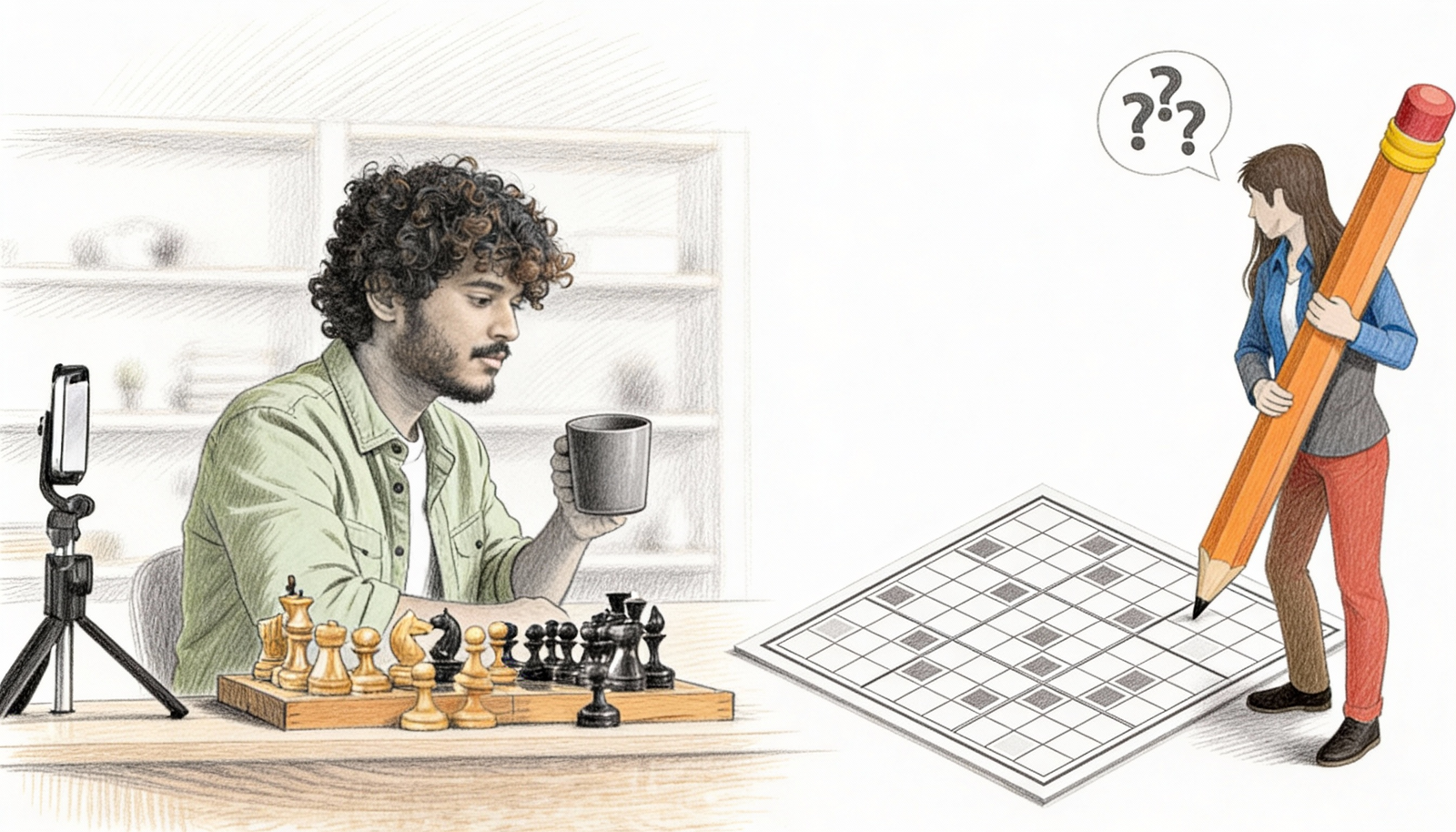
The classroom falls silent. Twenty-five students stare at their geometry worksheets, pencils frozen. They’ve memorized the formulas. They know the theorems. But faced with an unfamiliar problem, most of them wait for the teacher to show them the path forward. That’s not critical thinking.
Meanwhile, across town in a community center, an eight-year-old sees his queen trapped. No one will rescue him. The position looks hopeless, but he keeps searching. He tries one idea, mentally plays it out, finds the flaw, tries another. Five minutes later, he finds a brilliant retreat that saves the game. Nobody taught him this specific solution. He created it.
This gap between knowing information and actually thinking reveals one of modern education’s deepest failures. Schools excel at transmitting knowledge but struggle to build the raw cognitive machinery students need to solve novel problems. The paradox is striking: we produce students who can pass tests about critical thinking without actually being able to think critically when it matters.
The Illusion of Teaching Thinking
Walk into most schools and you’ll find critical thinking listed prominently in mission statements and learning objectives. Teachers genuinely want to cultivate independent thinkers. Administrators design curricula around higher-order thinking skills. The intention is sincere and universal.
Yet something goes wrong in translation. The typical approach treats critical thinking as content to be delivered rather than a skill to be developed through repeated practice. A literature class might spend a week analyzing how to identify themes, then move on. A science class covers the scientific method in September, then barely mentions it again. The assumption is that students will automatically transfer these lessons to new situations.
They don’t. Research from cognitive science shows that thinking skills developed in one context rarely transfer to another without extensive practice across multiple domains. A student who excels at analyzing poetry may struggle to evaluate whether a news article is credible. Someone brilliant at solving physics problems might make terrible financial decisions. The brain doesn’t develop general thinking ability. It builds specific neural pathways through repetition and variation.
The educational system knows this, which is why we have students practice multiplication tables until they become automatic. Yet when it comes to higher-order thinking, schools often act as if one explanation and a few exercises should suffice.
What Chess Actually Demands
Chess forces something different. Every single position is a novel problem. Sure, players study openings and endgames, learning patterns that appear frequently. But the middlegame offers effectively infinite possibilities. Even computers with access to billions of games still encounter positions never before played.
This means players cannot rely on memorization. They must evaluate positions from scratch, weighing multiple factors simultaneously. Material count matters, but so does piece activity, king safety, pawn structure, and time. Each element interacts with the others in complex ways. A material advantage means nothing if your king is about to be checkmated.
The player must generate candidate moves, imagine the likely responses, project several moves ahead for each possibility, and evaluate the resulting positions. They’re building mental models, testing hypotheses, and revising assessments based on new information. This happens dozens of times each game, hundreds of times each week for serious players.
Consider what happens when a plan fails. In school, a wrong answer often means moving on to the next problem. In chess, a bad move creates a new, harder problem that must be solved immediately. The opponent just created a threat. The position that looked manageable now looks dire. There’s no teacher to ask, no answer key to consult. The player must reassess everything and find a defense.
This forced adaptation under pressure builds cognitive flexibility in ways that classroom exercises rarely match. Educational psychologists call this “productive struggle,” and they know it drives learning. But most school activities protect students from genuine struggle. The problems are carefully calibrated to be solvable with recently taught methods. Struggle that lasts too long is seen as a sign that instruction failed.
Chess offers no such protection. Players regularly face positions beyond their current ability. They struggle, fail, and slowly expand what they can handle. The game provides immediate feedback. The position either improves or deteriorates. Over time, patterns that once required painful calculation become recognizable at a glance. Tactical motifs that were invisible become obvious.
The Transfer Problem
Critics reasonably ask whether chess skills actually transfer to other domains. After all, becoming better at chess might just mean becoming better at chess. The evidence is mixed but intriguing.
What does seem to transfer is something more fundamental than specific skills. Players develop what psychologists call metacognition, the ability to think about their own thinking. Strong players constantly monitor their thought processes. They notice when they’re calculating sloppily or evaluating positions based on wishful thinking. They catch themselves making assumptions without verification.
This self-awareness matters. A student might know all the steps of the scientific method yet fail to apply them because they don’t notice their own reasoning going astray. They jump to conclusions, ignore contradictory evidence, and convince themselves that superficial analysis is sufficient. The knowledge is there. The self-monitoring isn’t.
Chess builds this monitoring through necessity. Every player has lost games because they stopped checking carefully, assumed too much, or failed to consider their opponent’s threats. The pattern becomes visceral: sloppy thinking leads to immediate, concrete losses. Over time, players internalize higher standards for their own reasoning. They become suspicious of their first impressions and more thorough in their analysis.
Decisions Under Uncertainty
Perhaps the most valuable skill chess develops is comfort with uncertain, incomplete information. Most school problems have clear right answers found through defined methods. Real-world problems rarely do. Business decisions, medical diagnoses, legal arguments, and personal choices all require acting despite ambiguity.
Every chess move is made under uncertainty. The player doesn’t know what the opponent will do. They can calculate variations, but they can’t foresee everything. At some point they must evaluate positions that depend on factors impossible to calculate precisely. Is this active piece placement worth the pawn weakness it creates? Hard to say for certain.
Strong players learn to make peace with this. They gather information, analyze what they can, form judgments about the rest, and commit to decisions while acknowledging they might be wrong. Then they adapt as new information emerges. This cycle of decision making mirrors what effective thinking looks like outside the game.
The classroom typically avoids this messiness. Problems are designed to have solutions that students can reach with available tools. When students encounter genuine ambiguity, they often freeze or demand more guidance. They’ve been trained to believe that not knowing what to do means they’re missing some fact or technique.
Chess teaches something different. Not knowing what to do is the normal state of affairs. The task is finding the best move anyway, not waiting for certainty to arrive. Players who can’t tolerate uncertainty never improve because they avoid the difficult positions where growth happens. The same pattern appears in every field. People who need complete information before acting tend to accomplish less than those comfortable with calculated risks.
The Social Dimension
Something unexpected happens when people play chess regularly. They develop intellectual humility. This seems counterintuitive given chess’s competitive nature. Yet the game provides endless evidence of human fallibility.
Every player, no matter how strong, regularly misjudges positions and overlooks tactics. Even world champions blunder. The gap between what players think they see and what’s actually there never fully closes. This creates a healthy skepticism toward one’s own brilliance.
Contrast this with educational environments that treat intelligence as a fixed trait revealed through grades. Students learn to protect their self-image by avoiding challenges where they might fail. Admitting confusion feels dangerous. This fragility undermines learning because genuine development requires acknowledging current limitations.
Chess communities have their share of ego, but the game itself enforces humility. The board doesn’t care about reputation. A beginner can pose difficult problems. An expert can blunder. This regular confrontation with personal fallibility creates space for growth that many educational settings inadvertently suppress.
There’s also something valuable in the chess culture of analyzing games afterward, often with opponents. Players sit together examining the positions where they went wrong. They collaborate to find improvements. The person who just defeated you helps you understand your mistakes. This models intellectual discourse as cooperative truth-seeking rather than status competition.
What Schools Could Learn
The insights from chess don’t require putting boards in every classroom. The deeper lesson is about how thinking actually develops. It emerges from repeated practice with problems that force analysis, adaptation, and self-correction. It requires failure and recovery. It needs genuine difficulty where the solution isn’t obvious.
Most educational activities avoid these conditions because they make assessment harder and feel inefficient. Teachers must cover material. Standards demand measureable outcomes. Time is limited. All true and understandable. Yet the result is that students spend years being taught about thinking without actually building the neural machinery that makes good thinking possible.
The chess player who spends an hour stuck on a difficult position, trying different approaches, slowly discovering deeper patterns, is doing something qualitatively different from the student completing twenty practice problems using a recently taught method. Both have value. But only one builds the adaptability and persistence that characterize strong thinking.
The gap remains. Education provides knowledge and occasional practice. Chess provides thousands of hours of forced problem-solving under conditions that make thinking visible, consequential, and constantly demanding of more.
…
The eight-year-old saving his trapped queen is learning something schools struggle to teach: that thinking is hard work, that problems yield to sustained analysis, and that the next challenge is always waiting.