Table of Contents
The chessboard sits there, silent and still. Sixty-four squares, thirty-two pieces, two players. Yet within this simple geometry lies one of life’s most valuable lessons: everyone has weaknesses, and success often depends on your ability to spot them and act accordingly.
Most beginners think chess is about building the perfect position. They imagine grandmasters calculating endless sequences, finding brilliant combinations, executing flawless plans. This is partly true, but it misses something fundamental. Chess at its core is about people, not pieces. And people make mistakes.
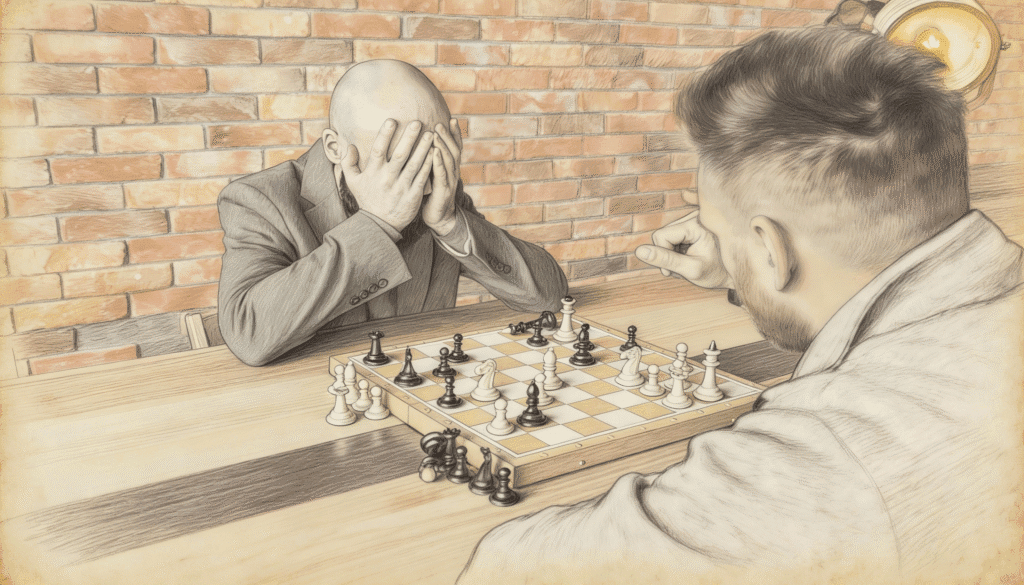
Consider the club player who finally faces the intimidating opponent everyone warns about. This player has studied openings, memorized principles, practiced tactics for months. The game begins. The intimidating opponent makes solid moves, nothing spectacular, just steady and purposeful. Then around move fifteen, something small happens. The opponent moves a knight to what seems like a decent square. Not a blunder, not even a clear mistake. Just a slightly awkward placement that restricts future options.
Most players would continue with their own plan, never noticing. But the player who understands exploitation sees opportunity. That awkward knight means one less defender for the kingside. It means certain squares become permanently weak. It means the opponent has unconsciously chosen a path that leads to problems they cannot see yet.
This is where chess becomes deeply instructive for life beyond the board.
The Art of Recognition
Weaknesses in chess come in countless forms. A weak square is a square that cannot be defended by pawns. A weak piece is one that lacks good squares or becomes overburdened with defensive tasks. A weak king is one without adequate shelter. But the most exploitable weakness is often invisible to the player who creates it.
Think about the psychological dimension. A player who loves attacking often neglects defense. Someone who plays too cautiously misses opportunities that require courage. The methodical player who trusts their preparation struggles when the position becomes chaotic. Each style contains the seeds of its own defeat.
The skilled player develops a kind of peripheral vision. They are not just looking at the position but through it, reading what the arrangement of pieces reveals about their opponent’s thinking. That overextended pawn tells a story about impatience. That passive piece suggests doubt. That repeated maneuver indicates someone following a remembered pattern rather than responding to what the board actually demands.
Grandmasters often speak about playing the opponent, not just the position. This means understanding that the person across from you has preferences, habits, blind spots. Someone who just suffered a loss in the previous round carries that emotional weight into the next game. Someone who is winning might grow overconfident. Someone low on time makes different decisions than someone with plenty of it.
The chessboard becomes a mirror reflecting human nature.
Creating Weaknesses
Here’s where it gets interesting. You don’t always wait for weaknesses to appear. Sometimes you create them.
Imagine a fortress. Stone walls, armed guards, supplies stockpiled. Impregnable, or so it seems. But the defender must make choices about where to concentrate forces. Every commitment to defend one sector means fewer resources elsewhere. The attacker’s job is to make the defender choose, and choose badly.
In chess, this principle manifests constantly. You threaten something on one side of the board, forcing your opponent to react. That reaction, even if it successfully defends the threat, often creates vulnerability somewhere else. The pieces rush to plug one hole, leaving another exposed. The opponent uses time dealing with your threats rather than pursuing their own plans.
This is not brute force. It’s about understanding that every decision involves tradeoffs. When you force your opponent to make uncomfortable choices, they eventually make mistakes. Not because they are weak players, but because the position you’ve created gives them only bad options.
The late chess teacher Mark Dvoretsky wrote extensively about what he called “exploiting advantages.” He emphasized that a small edge means nothing unless you can transform it into something bigger. You must understand what your opponent cannot do, what squares they cannot reach, what plans they cannot execute. Then you build your strategy around these limitations.
The Timing Question
Knowing a weakness exists and knowing when to exploit it are different skills. Strike too early and your attack sputters out, leaving you overextended. Strike too late and your opponent finds time to fix the problem.
Chess teaches patience mixed with decisiveness. You accumulate small advantages, improve your position, restrict your opponent’s options. The weakness is there, perhaps a weak square near their king, but rushing toward it accomplishes nothing if your pieces aren’t coordinated. So you wait. You improve piece positions. You control key squares. You limit what your opponent can do.
Then the moment arrives. Not announced by trumpets, just a quiet recognition that the conditions have aligned. The attack that would have failed ten moves ago now succeeds. The weakness you identified twenty moves ago finally becomes exploitable. Your patience transforms into decisive action.
This rhythm of patience and aggression appears throughout competitive endeavors. The entrepreneur who identifies a market weakness but waits for the right moment to enter. The athlete who probes an opponent’s defense before launching the decisive strike. The negotiator who sees leverage but holds back until circumstances amplify it.
The Burden of Weakness
There’s a peculiar psychology to defending weak positions. It’s exhausting. Every move requires calculating whether it exposes the weakness further. Every plan must account for that vulnerable point. Mental energy drains away, not from active defense, but from constant awareness that something is wrong.
Players defending inferior positions often crack, not from one devastating blow, but from accumulated pressure. They make the defensive moves. They hold the position. But the psychological burden grows. Eventually, they miscalculate or lose focus, and the weakness they’ve been guarding so carefully becomes the entry point for defeat.
This teaches something about resilience and vulnerability in any competitive field. Weaknesses don’t just create tactical problems. They create psychological ones. They demand attention and resources. They shape all future decisions. The mere existence of a weakness changes the game.
Beyond the Personal
Chess also reveals something counterintuitive. Sometimes the best way to exploit your opponent’s weakness is to first shore up your own. This sounds defensive, even passive. But consider the logic.
If both players have weaknesses, the game becomes about who can exploit the other’s first. But if you eliminate your own weaknesses while your opponent retains theirs, you fundamentally change the dynamic. They must balance their own plans with defending their weakness. You can focus entirely on attack. This asymmetry proves decisive.
The principle extends to teams, organizations, companies. Before aggressively pursuing competitors’ vulnerabilities, ensure you’re not leaving yourself exposed. The company so focused on exploiting market opportunities that it neglects operational weaknesses often stumbles. The athlete targeting an opponent’s backhand while their own forehand falters faces problems.
The Ethics of Exploitation
Chess forces an interesting ethical question, though rarely discussed explicitly. Is it honorable to win by exploiting mistakes? Should you feel satisfied winning because your opponent blundered?
Most players resolve this easily. Chess is a game. Exploiting weaknesses is simply playing well. But the question touches on something deeper about competition and human interaction. In chess, the social contract is clear. Both players agree to test each other’s skills. Mercy is not expected. Exploiting mistakes is part of the game’s beauty.
Life beyond chess presents murkier situations. Business competition, political contests, social interactions all involve identifying and potentially exploiting weaknesses. The chess framework offers clarity. You can compete vigorously, exploit every legitimate advantage, push every weakness, while maintaining respect for your opponent. The board is the arena. Outside it, different rules apply.
The Master’s Perspective
World champion Emanuel Lasker, who held the title for twenty-seven years, was famous for psychological chess. He didn’t always play the objectively best moves. Instead, he played moves that would cause his specific opponent the most difficulty. Against cautious players, he created complications. Against aggressive players, he absorbed their attacks and counterattacked. He exploited not just positional weaknesses, but psychological ones.
Lasker understood that the weakness isn’t just on the board. It’s in how your opponent thinks, what makes them uncomfortable, where their understanding has gaps. This elevated exploitation from mechanical to psychological. He was playing the person, and the person’s weaknesses were often more exploitable than the position’s weaknesses.
The Ultimate Lesson
Perhaps chess’s deepest teaching about weakness is this: everyone has them. The grandmaster, the novice, the world champion. No position is perfect. No player is without gaps in their game. Success comes not from eliminating all weaknesses, which is impossible, but from understanding the landscape of vulnerability, both yours and your opponent’s.
The board teaches you to see with new eyes. That innocent looking position contains hidden flaws. That powerful looking attack has subtle vulnerabilities. The game rewards those who can read between the pieces, who understand that chess is as much about recognition as calculation.
When you leave the board and return to daily life, you carry this vision with you. The ability to see weaknesses, to understand when and how to act on them, to recognize that competition is often decided not by who is strongest but by who best understands where strength ends and vulnerability begins.
The sixty-four squares become a training ground for seeing what others miss, for understanding that advantage often hides in plain sight, waiting for someone patient and perceptive enough to find it and turn it into victory.