Table of Contents
Picture a general surveying the battlefield. His artillery stands ready, cannons lined up with precision. But there’s a question that separates good commanders from great ones: How much firepower do you really need on a single point? And perhaps more importantly, what formation will strike terror into the enemy’s heart?
In chess, this question manifests in two powerful concepts that players often confuse: Alekhine’s Gun and the Double Battery. Both involve stacking major pieces on the same line. Both can be devastating. Yet the difference between them is as significant as the difference between a hammer and a sledgehammer.
The Birth of a Legend
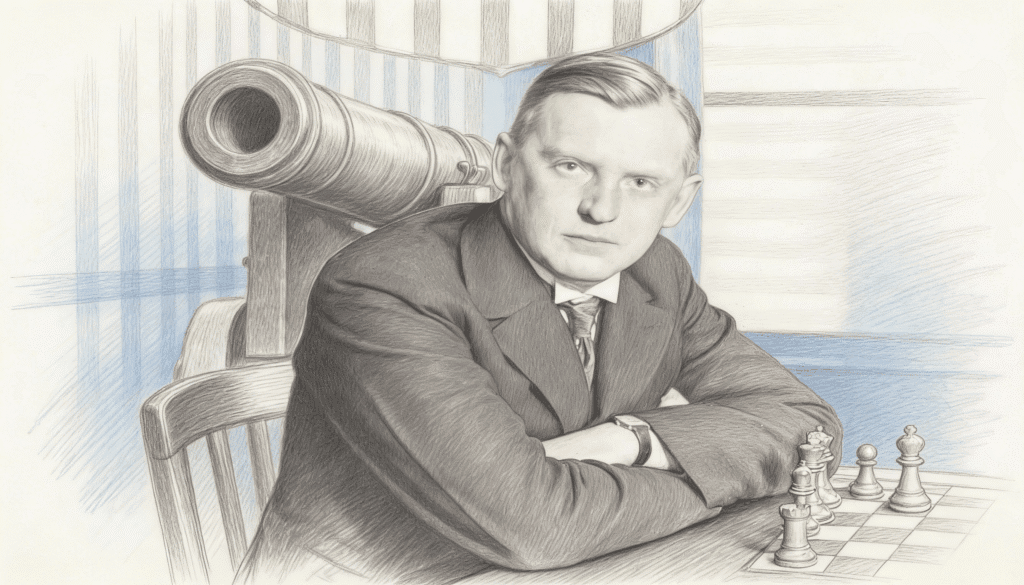
The term Alekhine’s Gun comes from a game played in 1930. Alexander Alekhine, the fourth World Chess Champion, created a formation so memorable that it earned its own name in chess history. He stacked all three of his major pieces on a single file: queen behind, supported by both rooks in front. The image was unmistakable. Three heavy pieces aimed at a single target like a cannon ready to fire.
But here’s where the story gets interesting. Alekhine didn’t invent the concept of stacking pieces. Players had been doubling rooks for centuries. What made his formation special was the specific architecture: the queen behind, both rooks supporting ahead, all focused on penetrating enemy territory through an open or vulnerable file.
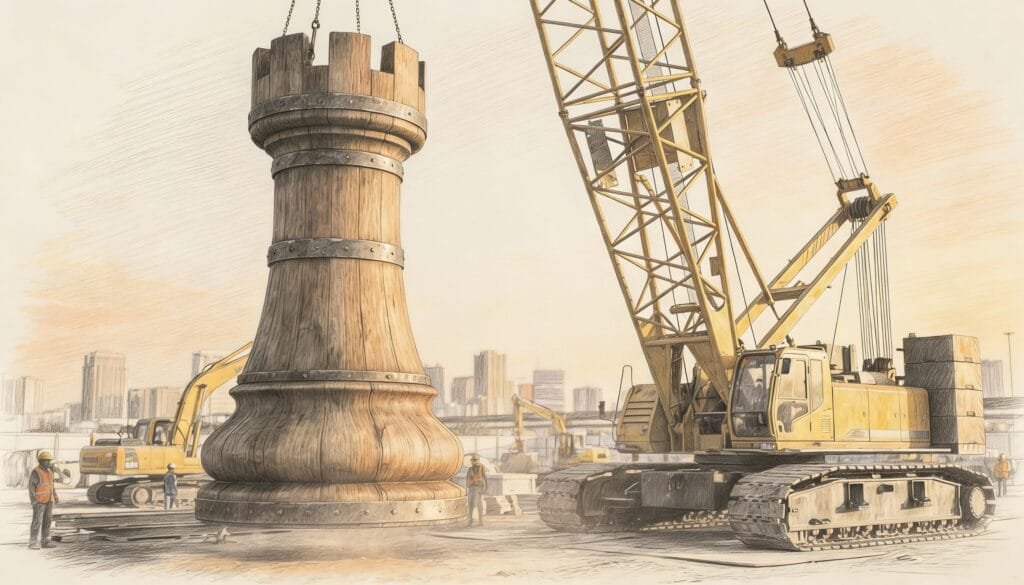
Think of it like building a tower. Not just any tower, but one with a very specific blueprint.
The Double Battery: A More Modest Ambition
The Double Battery, by contrast, is simpler. Take two major pieces and stack them on the same line. That’s it. No specific order required. No queen necessarily involved. Two rooks on an open file? That’s a Double Battery. A rook and queen working together vertically? Still a Double Battery.
The name itself is less glamorous. Nobody attached a famous player’s name to it. That’s because doubling major pieces is fundamental chess wisdom, like saying “develop your pieces” or “control the center.” It’s been done since players first understood that coordination matters.
But simple doesn’t mean weak. A Double Battery can be absolutely crushing. The difference lies in scope and purpose. Where Alekhine’s Gun is about overwhelming force concentrated for invasion, a Double Battery is about sufficient force applied intelligently. It’s the difference between a tank division and a strike team.
The Architectural Difference
Understanding these formations requires thinking like an architect. Every structure has a purpose, and every piece has a role.
In Alekhine’s Gun, rooks become bulldozers. They don’t need fancy footwork. They push forward on that single file, supporting the queen’s advance and preventing the opponent from challenging the file easily. Try to trade one rook off? The other remains. Try to challenge with your own heavy pieces? You’re facing three pieces with two.
A Double Battery has no such rigid requirements. Rooks can appear in any order. A queen and rook can stack with either piece in front, depending on what the position demands. The formation is flexible by nature. It adapts to circumstances rather than imposing a structure.
Strategic Intent: Invasion vs. Domination
Here’s where philosophy enters the picture. These formations don’t just differ in structure. They differ in what they’re trying to achieve.
Alekhine’s Gun is an invasion tool. It’s built to penetrate deep into enemy territory, specifically targeting the seventh or eighth rank. The goal is to get behind enemy lines where pawns become vulnerable and the king starts sweating. This formation announces its intentions clearly: we’re coming through, and we’re bringing overwhelming force.
Think of it as a siege weapon. You don’t build a trebuchet for skirmishes. You build it to break down walls. Alekhine’s Gun works the same way. It’s overkill for simple file control. But when you need to crack open a position, when you need to punish a weakness with maximum prejudice, this is your tool.
The Double Battery, meanwhile, aims for domination rather than invasion. It controls. It pressures. It makes your opponent think twice about every move. Sure, it can support an invasion. But it can also prevent one. Two rooks on your back rank? That’s a Double Battery serving defensive purposes. Two major pieces aimed at a weak pawn? That’s applying pressure without necessarily invading.
The strategic flexibility is the key difference. A Double Battery can shift gears. Need to defend? Pull back. Need to trade pieces? You have options. Alekhine’s Gun, once committed, becomes an all-or-nothing proposition. You’re going forward or you’re dismantling the formation.
When Three Becomes Two (And Why That Matters)
Chess players often face this question: When do I actually need all three major pieces stacked? When is two enough?
The answer lies in resistance. If your opponent can adequately defend a file with two pieces, and you also have two pieces attacking it, you’ve reached a stalemate. Neither side can make progress without additional support. But add a third piece? Now the balance tips. Now you can force trades that favor you, or maintain pressure that your opponent can’t match.
This is why Alekhine’s Gun represents the ultimate commitment. You’re saying, “I’m investing everything in this breakthrough.” Three major pieces is nearly your entire attacking force concentrated on one goal. If it works, you crush your opponent. If it fails, you’ve left other parts of the board vulnerable.
A Double Battery represents measured aggression. You’re applying serious pressure without overcommitting. You can maintain flexibility. You can respond to threats elsewhere. You’re strong on this file, but you’re not betting the farm on it.
The Setup Time Problem
Building these formations takes time. And in chess, time is a currency you can’t print more of. Every move you spend arranging pieces is a move your opponent gets to improve their position.
Alekhine’s Gun requires at least three moves to construct, usually more. First, you need an open file or the means to create one. Then you need to maneuver a rook to it. Then the second rook. Then the queen. Your opponent isn’t sitting idle during this process. They’re building defenses, creating counterplay, or possibly launching their own attack.
This is why true Alekhine’s Gun formations are relatively rare in master games. The setup demands calm waters. Your opponent needs to either not notice what you’re doing or be unable to prevent it. In sharp positions with mutual attacks, spending four or five moves on piece coordination might get you killed.
Double Batteries are easier to construct. Two pieces take less time than three. Simple math, but the implications are profound. You can create real threats faster. You can respond to the position more dynamically. The formation becomes practical in a wider range of situations.
The Psychological Dimension
Chess is played on the board, but it’s fought in the mind. The psychological impact of these formations differs dramatically.
Seeing all three enemy major pieces lined up on a file creates a specific kind of dread. It looks overwhelming because it is overwhelming. Defending becomes a nightmare. Where do you put pieces? How do you challenge this monster? Every defensive resource you commit to this file is a resource stripped from elsewhere. The formation itself becomes an intimidation tactic.
This psychological pressure can force mistakes. Your opponent might overreact, weakening their position unnecessarily. Or they might freeze, unable to decide how to respond effectively. The mere presence of Alekhine’s Gun can warp the game’s entire character.
A Double Battery creates pressure without panic. Your opponent knows they need to address it, but it doesn’t look insurmountable. This can actually be advantageous sometimes. You want your opponent thinking and calculating, potentially finding the wrong solution. You don’t always want them in pure panic mode where they might lash out with everything they have.
Practical Limitations and Realities
Theory is beautiful. Reality is messy. Both formations face practical limitations that textbooks sometimes gloss over.
Alekhine’s Gun requires space. You need room to stack three major pieces vertically. In closed positions where files aren’t opening and pieces have limited mobility, good luck building it. The formation also becomes vulnerable to tactical shots. Three pieces on one file means they can potentially be pinned, skewered, or otherwise targeted together.
There’s also the problem of diminishing returns. That third major piece might be more useful elsewhere. Breaking through on one file doesn’t guarantee winning if your opponent has adequate counterplay on another part of the board. You can build the perfect battering ram and still lose if their cavalry circles around and attacks your king.
The Question of Naming
Why does Alekhine’s formation get a special name while doubling rooks remains generic? This reveals something about chess culture. We name things that are distinctive and memorable. We name things that represent a complete idea rather than a component.
Alekhine’s Gun is a complete tactical idea. It’s a finished product with specific characteristics. Anyone can look at a position and say definitively whether Alekhine’s Gun is present. The criteria are clear: three major pieces, all on the same file.
A Double Battery is more of a category. It describes a family of formations rather than one specific setup. This generality makes it more common but less noteworthy. It’s like the difference between “a sandwich” and “the Reuben.” One is a category, the other is a specific creation.
The Art of Knowing Which Tool to Use
The real skill isn’t building these formations. Any decent player can stack pieces on a file. The art lies in knowing when each formation is appropriate.
Alekhine’s Gun makes sense when you’ve identified a weakness you can only crack with overwhelming force. When your opponent’s defense is stubborn but static. When you have time to build the formation without facing immediate threats elsewhere. When the breakthrough on one file will be decisive rather than just advantageous.
A Double Battery suits dynamic positions where flexibility matters. When you need to maintain pressure while keeping options open. When you’re not sure yet whether this file will be your main battlefield or just one front in a larger war.
The Human Element
Chess theory can make these formations sound mechanical. Stack pieces here, apply pressure there, break through eventually. But real games involve imperfect humans making imperfect decisions under time pressure and stress.
Building Alekhine’s Gun is a statement. It tells your opponent: “I’m so confident in this plan that I’m committing my entire arsenal.” That confidence can be contagious, making you play better. Or it can be a trap, leading you to ignore warning signs that your plan isn’t working.
Double Batteries are humbler. They say: “I’m improving my position methodically.” This mindset can keep you grounded and flexible. But it can also lead to indecision, where you never commit fully to any plan.
Final Thoughts on Force and Precision
Alekhine’s Gun represents maximum force. It’s chess as overwhelming power, as siege warfare, as inevitable doom for your opponent if they can’t find a tactical escape. It’s spectacular when it works. It’s embarrassing when it doesn’t.
A Double Battery represents sufficient force applied precisely. It’s chess as calculated pressure, as strategic advantage gradually converted to victory. It’s less dramatic but perhaps more reliable.
Neither formation is inherently better. The question isn’t which one you should use. The question is which one the position demands. Great players recognize this distinction instinctively. They build Alekhine’s Gun when it’s right and stop at a Double Battery when that’s enough.
The beauty of chess lies in these choices. In knowing not just how to build powerful formations, but when to build them, and when to recognize that sometimes, two pieces are worth more than three if they’re placed correctly and timed perfectly.
After all, the goal isn’t to create impressive looking formations. The goal is to win. Sometimes that requires a gun. Sometimes it just requires a battery.
The wisdom lies in knowing the difference.