Table of Contents
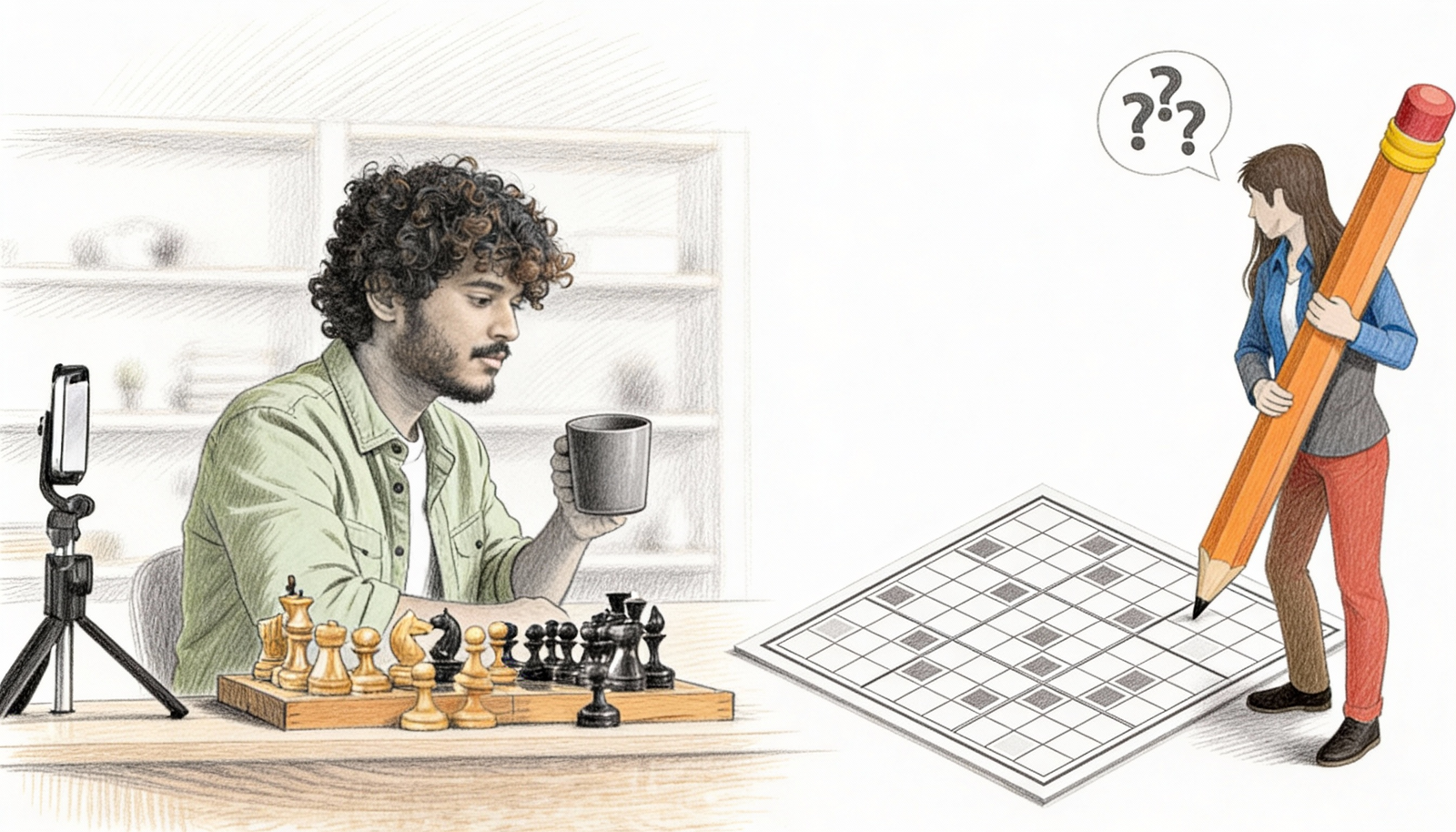
The coffee shop was packed on a Tuesday afternoon when two strangers sat down at a chess board. One player, let’s call him David, moved his knight early in the game. The other player, Sarah, smiled. Three moves later, David realized his knight was trapped. He hadn’t seen it coming.
This small disaster wasn’t about the knight. It was about something deeper. David had made a choice without asking the question that separates beginners from masters: “And then what?”
Chess is a conversation between cause and effect. Every move whispers a promise about the future. Some promises are kept. Others turn out to be lies we tell ourselves.
The Web Nobody Sees
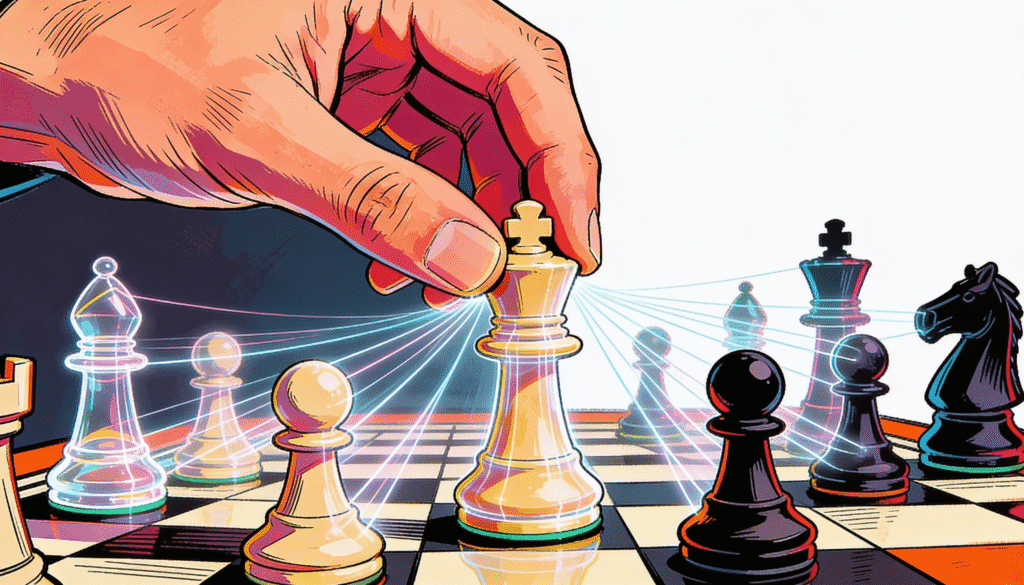
Picture a spider web after morning rain. Each thread connects to another. Touch one strand and the whole structure trembles. Chess works the same way. The board might look still, but beneath the surface, everything connects to everything else.
When a player pushes a pawn forward, they’re not just moving wood across squares. They’re creating space, blocking pathways, and changing what’s possible for every other piece on the board. The pawn doesn’t move in isolation. It rewrites the geometry of the game.
Most people see the pieces. Chess players see the relationships between them. A bishop on one side of the board protects a pawn on the other. A rook in the corner supports an attack three moves away. Remove one piece and five others become weaker. Strengthen one position and opportunities bloom elsewhere.
This is the hidden language of the game. Cause and effect, written in movement and space.
The Trap of Looking One Step Ahead
Beginners make a classic mistake. They see an opportunity and take it. A piece hangs undefended, so they capture it. An attack looks promising, so they launch it. The board offers a gift, so they accept.
Then the roof falls in.
The problem isn’t that they looked ahead. It’s that they didn’t look far enough. They saw the immediate consequence but missed the chain reaction. Chess punishes this kind of thinking the way gravity punishes someone who forgets about the ground.
Consider a player who captures a pawn in the center of the board. The pawn was free for the taking. But grabbing it means moving a piece away from defending the king. Two moves later, the opponent’s pieces flood into the gap. The king comes under attack. The free pawn suddenly costs a kingdom.
This happens thousands of times in chess clubs around the world. The pattern is always the same. A player sees A leads to B. They miss that B leads to C, and C leads to disaster.
The game teaches a brutal lesson: immediate rewards often hide delayed costs. Every choice has offspring. Those offspring have offspring of their own.
The Butterfly Effect on 64 Squares
Scientists talk about chaos theory, where a butterfly flapping its wings in Brazil eventually causes a tornado in Texas. Chess compresses this phenomenon into half an hour.
A player moves a piece to safety. Seems reasonable. But that piece was defending another piece. Now that second piece has to move to safety too. Which means it stops controlling a crucial square. Which allows the opponent to advance a pawn. Which creates a passed pawn that becomes unstoppable ten moves later.
One small decision. One tiny retreat. The consequences ripple outward until the position transforms completely.
Strong players develop a sixth sense for these ripples. They move a piece and mentally fast forward. They watch the dominoes fall in their imagination. If they don’t like where the dominoes lead, they choose a different first move.
This skill transfers beyond the board. In business, someone makes a small policy change. The change seems harmless. But it shifts incentives. People start behaving differently. Six months later, the whole company culture has transformed. The same pattern. Small causes, large effects, invisible connections.
The Paradox of Patience
Here’s where chess gets interesting. Sometimes the best move accomplishes nothing visible.
A player shifts a piece to a better square. The opponent doesn’t react. Nothing has changed on the surface. But the player has improved their position microscopically. They’ve made their pieces slightly more coordinated, their formation slightly more solid.
Do this twenty times and suddenly the position has transformed. The small improvements compound. What looked like nothing becomes overwhelming.
Chess calls this prophylaxis. Most people call it boring. But it reveals something profound about cause and effect. Not all causes produce immediate effects. Some work slowly, like water wearing down stone.
The player who improves their position move by move understands delayed gratification in its purest form. They invest in causes whose effects won’t arrive for twenty moves. They plant seeds knowing the harvest comes later.
This contradicts how most people think. We want to see results now. We want our actions to produce visible changes immediately. Chess says: the most powerful causes often work invisibly.
The Illusion of Control
A player sits down feeling confident. They have a plan. Move the pieces here, attack there, victory follows. The plan makes perfect sense.
Then the opponent moves. Suddenly the plan doesn’t work. The opponent didn’t cooperate. They created threats of their own. Now the player has to respond to enemy plans instead of executing their own.
This is the great humbling of chess. Every cause creates an effect, but the opponent’s moves are causes too. Two sets of intentions collide. Two visions of cause and effect compete for the same board.
The weak player gets frustrated when opponents don’t follow the script. The strong player expects interference. They know their causes will meet counter causes. They plan for friction.
This mirrors reality with uncomfortable accuracy. We can control our actions but not the environment those actions enter. Our causes meet other causes. The effects multiply and interact in ways we never predicted.
The chess player who accepts this limitation paradoxically gains more control. They stop trying to force the board to obey them. Instead, they work with what the position offers. They shape probabilities rather than dictating outcomes.
The Burden of Responsibility
Every move in chess is permanent. Touch a piece, you must move it. Make a move, you can’t take it back. The rules are strict about this for good reason.
If players could undo moves, they’d never learn. They’d touch a piece, see the disaster coming, and reverse course. The cause would never reach its effect. The feedback loop would break.
By forcing permanence, chess creates accountability. You own your decisions completely. When the position collapses, there’s nobody to blame but yourself. You chose the causes that created this effect.
This can be painful. A player makes a move and immediately sees the mistake. The piece hangs. The attack fails. The defense crumbles. They have to sit there and watch the consequences unfold. No do overs. No excuses.
But this pain teaches. It burns the pattern into memory. Next time, the player looks deeper before moving. They check twice. They imagine harder. The stakes of getting cause and effect wrong become visceral.
The Long Game
Strong players think in campaigns, not battles. They understand that winning one piece might mean losing three pieces later. They sacrifice material now to gain position later. They accept short term pain for long term advantage.
This requires seeing cause and effect across time horizons that feel unnatural. Most human thinking focuses on the immediate future. What happens in the next five minutes matters more than what happens next month.
Chess reverses this. A positional sacrifice might not pay off for fifteen moves. A weakness created now might not become critical until the endgame, thirty moves away. The player must value future effects as much as present ones.
Grandmasters can look at a position and evaluate consequences twenty moves deep. Not by calculating every possibility, which is impossible. But by understanding patterns, recognizing structures, feeling which causes lead where.
This pattern recognition comes from experience. From making mistakes and watching them unfold. From creating causes and tracking their effects through countless games. The brain learns to compress complex chains into intuition.
The Teacher That Never Lies
Chess has no mercy. It doesn’t care about effort or intention. It only cares about what actually happens on the board. This brutal honesty makes chess an exceptional teacher of cause and effect. The board shows you exactly what your decisions created. No ambiguity. No mixed messages. The effect follows the cause with mathematical certainty.
In life, causes and effects often blur together. Multiple factors influence every outcome. We can rationalize failures and claim unearned credit for success. Chess strips away these comfortable fictions.
When a player loses a game, they can review every move. They can find the exact moment where cause led to effect led to defeat. The game provides a perfect laboratory for studying how actions create results.
Beyond the Board
The player who learns to think in chains of cause and effect at the chess board carries this skill everywhere. They start seeing the hidden connections in daily life. The small decision that creates large consequences. The immediate pleasure that leads to future pain. The invisible preparation that enables visible success.
They become fluent in a language most people struggle with. They ask “and then what?” automatically. They trace actions to their logical conclusions. They spot feedback loops and chain reactions.
This fluency is rare. Most people think in single steps. They see A leads to B and stop there. The chess player sees A leads to B leads to C leads to D, and keeps going.
In meetings, they’re the person who asks about second order effects. In projects, they spot the consequences nobody else considered. In crises, they understand how one problem will create others.
Not because they’re smarter. Because they’ve spent hundreds of hours watching causes become effects on a chess board. They’ve trained their minds to follow the threads, to see the web, to trace the patterns.
The board was just the classroom. Cause and effect is the subject. Fluency is the reward.