Table of Contents
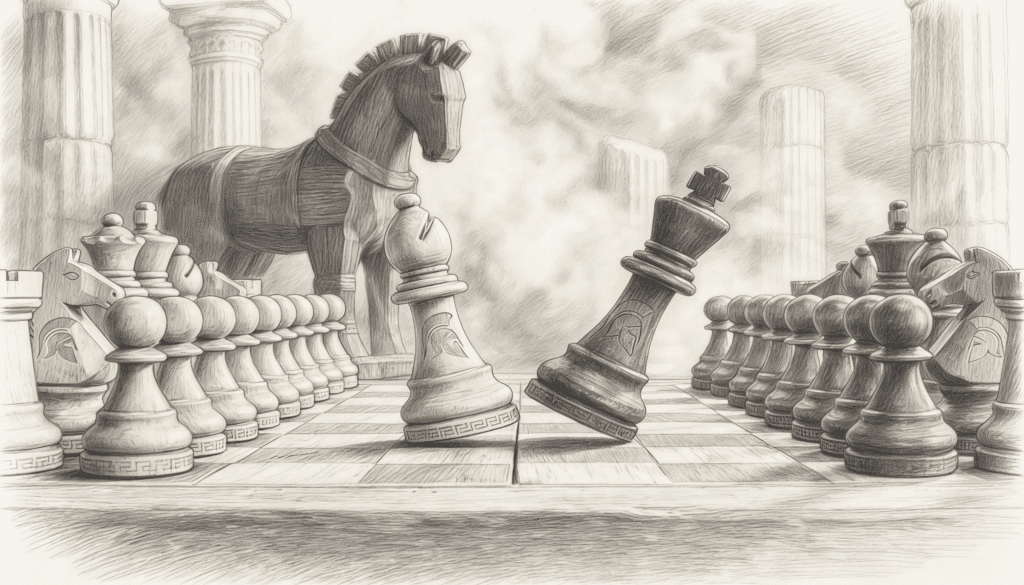
There are gifts you want to receive, and then there are gifts you should probably decline. The box of chocolates from a friend? Wonderful. The wooden horse left outside the gates of Troy? Perhaps less so. In chess, there exists a sacrifice so famous, so devastatingly effective, and so deeply rooted in ancient treachery that it bears the name of that very deception: the Greek Gift.
Every chess player, from the beginner fumbling through their first checkmates to the grandmaster calculating twenty moves deep, has either delivered or suffered this particular brand of violence. It appears suddenly, often when the position looks calm. A bishop lands on a square next to the enemy king, offering itself up for capture. The defender faces a choice that feels like no choice at all. Take the piece and accept material advantage, or refuse and look cowardly. Most take it. Most regret it.
The Greek Gift is not just a tactical trick. It represents something deeper about chess itself: the way material advantage can become a burden, the way kings that look safe can be fatally exposed, and the way accepting something that looks too good to be true usually means it is.
The Setup: When Gifts Arrive Uninvited
Picture a typical chess position in the middlegame. White has castled kingside, tucking the king behind a wall of pawns on f2, g2, and h2. Black has done the same, with pawns on f7, g7, and h7 forming a protective shell. These pawn structures look solid. They appear to be doing their job, which is keeping the king safe from harm.
Now imagine White has a bishop that can reach the h7 square, right next to the Black king. The bishop offers itself for capture. Black takes with the king, because what else would you do when someone gives you a free piece? The king moves from g8 to h7, grabbing the bishop and looking forward to being up a whole piece.
This is where the gift becomes a curse.
The king, now standing on h7, is no longer protected by pawns. It stands alone on the side of the board, separated from its own pieces, exposed to checks and attacks. What looked like winning a piece transforms into fighting for survival. White pieces, seemingly appearing from nowhere, begin a coordinated assault. Knights jump into the attack. Queens slide along diagonals. Rooks swing across the board. The Black king, clutching its prize of a captured bishop, realizes too late that it has walked into an ambush.
This pattern has destroyed countless games at every level of chess. It works because it violates one of the fundamental rules players learn early: don’t move your king into danger. But the Greek Gift makes this violation look like the right move. It disguises catastrophe as opportunity.
The Psychology of Acceptance
Why do players keep falling for this sacrifice? Why, after a century of chess literature documenting this pattern, do people still grab the bishop?
The answer lies in how chess players think about value. A bishop is worth roughly three pawns. Capturing it for free represents a significant material advantage, the kind of edge that usually leads to winning the game. Chess players are trained to calculate exchanges carefully, to count material, to understand that being up a piece is almost always decisive.
The Greek Gift exploits this training. It presents a transaction that looks profitable on the surface. The defender sees the bishop, calculates the exchange, and thinks they are making a sound decision. The problem is that not all chess decisions can be reduced to simple arithmetic. Position matters. King safety matters. Coordination matters. Sometimes the material you gain is worth less than the weaknesses you accept.
There is also the psychological weight of refusing a gift. Declining the bishop sacrifice means acknowledging that the opponent has created a serious threat. It means admitting that your position has problems. Many players would rather take the piece and try to defend, hoping they can survive the attack and emerge with their material advantage intact. This hope is usually misplaced.
The Greek Gift succeeds because it transforms greed into vulnerability. It makes the defender complicit in their own downfall. The attacker does not checkmate a king that stayed safely in the corner. They checkmate a king that walked out into the open, lured by the promise of profit.
The Architecture of Destruction
What makes the Greek Gift work on a positional level? Why does this particular sacrifice create such devastating attacks?
The answer involves several interconnected factors that all work together. First, the sacrifice removes a key defensive pawn from the king’s position. That h7 pawn is not just a piece of material. It is a shield. It keeps pieces from checking the king. It prevents the king from being forced forward. Once the pawn disappears and the king captures on h7, that entire side of the board becomes vulnerable.
Second, the king on h7 is cut off from escape squares. It cannot retreat easily to g8 because that square is often controlled by attacking pieces. It cannot stay on h7 because checks will force it to move. It cannot advance further up the board without walking into more danger. The king becomes trapped in a small area where every move leads to worse problems.
Third, the attacking pieces can coordinate more easily than the defending pieces. White pieces, already developed and aimed at the kingside, can join the attack quickly. Knights jump to perfect squares. Queens find powerful diagonals. Rooks lift to the third rank and swing over to the h file. Meanwhile, Black pieces struggle to defend. They are often on the other side of the board, or blocked by their own pawns, or simply too slow to reach the king in time.
The Greek Gift creates what chess players call a “mating attack,” but this phrase does not capture the full reality. It is not just about delivering checkmate. It is about creating a position where the defender has no good moves, where every option leads to either immediate loss or slow strangulation. The defender might survive a few more moves, might even trade some pieces, but the fundamental problem remains: the king is fatally exposed.
Reading the Warning Signs
The Greek Gift does not work in every position. There are specific conditions that need to be met for the sacrifice to be sound. Understanding these conditions helps both in executing the tactic and in defending against it.
The first requirement is that the attacker must have pieces ready to follow up. Sacrificing the bishop is only step one. If White has no way to deliver checks, no way to bring more pieces into the attack, then Black simply keeps the extra piece and converts the material advantage. The sacrifice only works when it opens the door to a wave of attackers.
The second requirement is that the defender must lack defenders. If Black has pieces that can quickly reach the king, if there are escape routes available, if counter threats exist, then the Greek Gift might fail. The tactic succeeds when the defending king is isolated from help, when the pieces that should protect it are tied down elsewhere or too far away.
The third requirement is timing. Launch the Greek Gift too early, when pieces are not yet coordinated, and it fizzles. Launch it too late, when the defender has consolidated and created a fortress, and it bounces off harmlessly. The sweet spot exists in the middlegame, when pieces are active but positions are still fluid, when the defender has not yet addressed all weaknesses.
Players who understand these requirements can spot Greek Gift opportunities before they fully materialize. They notice when their opponent’s king lacks defender support. They see when their own pieces are perfectly placed for a kingside attack. They recognize the moment when the sacrifice transforms from speculative to winning.
The Defense: When to Say No
Defending against the Greek Gift requires a different mindset than most chess positions. The natural instinct is to capture the offered piece. Material matters, and turning down a free bishop feels wrong. But sometimes the right defense is simply to decline the gift.
If the sacrifice is refused, if Black moves the king away from h7 or defends the pawn with another piece, what happens? White has committed a bishop to an aggressive square and gotten nothing for it. The bishop might be trapped. The attack might evaporate. The position might even favor Black, who can now counter attack while White’s pieces are out of position.
Declining the sacrifice requires confidence and calculation. The defender must be certain that refusing the gift is safe, that no other tactical blow exists, that the position remains solid. This is not always easy to see. The temptation to grab material is strong. But the best defense against the Greek Gift is often to simply not take it.
When the sacrifice must be accepted, when there is no safe way to decline, the defender needs a different approach. Rush pieces back to the king. Create escape squares. Trade off attacking pieces. Look for counter attacks against the opponent’s king. The goal is not to hold onto the extra bishop, which is usually impossible. The goal is to survive the immediate attack and reach a position where the extra material might matter again.
Many players defend the Greek Gift poorly because they try to keep everything. They want the extra piece and also want their king to be safe. This is usually impossible. The correct defensive mindset is to sacrifice material back, to give up the bishop or even more, to neutralize the attack. Survival matters more than greed.
Beyond the Tactic: What the Greek Gift Teaches
The Greek Gift is not just a pattern to memorize. It represents deeper truths about chess that apply far beyond this specific sacrifice.
First, it teaches that material is not everything. Chess is not simply about collecting pieces. Position, coordination, and king safety all matter. Sometimes having fewer pieces in the right places is stronger than having more pieces in the wrong places. The Greek Gift punishes players who count material without considering position.
Second, it teaches that king safety is paramount. All the material in the world means nothing if your king is checkmated. Players sometimes get distracted by action on other parts of the board, by pawn breaks, by minor piece trades, by plans that seem important. The Greek Gift reminds everyone that the king’s position is always the most critical factor.
Third, it teaches about commitment and point of no return. Once Black captures the bishop on h7, there is no going back. The king is exposed. The attack is coming. The decision has been made. Chess is full of these moments where a single choice creates irreversible consequences. Recognizing these moments, understanding when a position is about to fundamentally change, separates strong players from weak ones.
Fourth, it teaches about patterns and recognition. The Greek Gift is famous because it appears regularly. The same structure, the same ideas, the same tactical themes repeat across millions of games. Players who study patterns do not need to calculate everything from scratch. They recognize the position, remember the themes, and find the right moves faster. Pattern recognition is one of the most powerful tools in chess.
The Modern Game: Old Tricks, New Contexts
Even at the highest levels of chess, the Greek Gift still appears. Grandmasters, who have studied this pattern since childhood, still find opportunities to employ it. This is remarkable when you consider how much chess theory has evolved, how deeply players prepare, how powerful computer analysis has become.
Why does it still work? Because chess positions are complex. Because even the best players miss things. Because the Greek Gift can arise from seemingly innocent positions where neither side was consciously aiming for it. A few trades, a few pawn moves, and suddenly the conditions are perfect. The attacking pieces are perfectly placed. The defending king has subtle weaknesses. The sacrifice becomes not just possible but optimal.
In modern games, the Greek Gift often appears in disguised forms. The basic pattern remains the same, but the context varies. Maybe extra pieces have been traded. Maybe pawns have moved to unusual squares. Maybe the sacrifice happens on the queenside instead of the kingside. The fundamental idea endures even as the specific details change.
This adaptability is what makes the Greek Gift a timeless concept rather than just a memorized trick. It is not about repeating the same sequence of moves. It is about understanding the underlying principles, recognizing when a king becomes vulnerable, knowing when to strike. These skills transfer across different positions and different styles of play.
The Final Lesson: Gifts and Consequences
Chess rewards skepticism. When something looks too good to be true, investigate carefully before accepting it. When an opponent offers something for free, consider what they might gain in return. When a position seems to suddenly favor you, pause and recalculate.
The Greek Gift embodies this lesson perfectly. It is a trap disguised as an opportunity. It offers material gain that leads to positional disaster. It tempts players into making the move that destroys them. And it does all this openly, famously, in a pattern that has been documented for over a century.
Perhaps this is the ultimate irony. Everyone knows about the Greek Gift. Countless books explain it. Every chess teacher demonstrates it. Every database contains thousands of examples. And yet players still fall for it, game after game, because in the moment, with the clock ticking, with the position in front of them looking like it offers a free piece, the temptation proves too strong.
The story of Troy teaches that the most dangerous gifts come from enemies. The story of the Greek Gift teaches the same lesson on a chessboard. When your opponent offers you something valuable, when they seem to make a mistake that benefits you, remember that ancient city and those wooden walls. Remember that not every gift should be brought inside the gates. Sometimes the wisest move is to leave it outside and strengthen your defenses instead.
In chess, as in myth, the most beautiful traps are the ones that victims choose to walk into themselves, convinced they are making the smart decision, certain they are getting the better deal. The Greek Gift succeeds because it transforms the defender’s judgment against them, making greed and optimism into weapons. It is not just a tactic. It is a perfect miniature of how small decisions lead to large consequences, how one moment of weakness creates cascading problems, how quickly victory turns to defeat when the foundations crumble.
And that is why, centuries after the game was invented, players still study this sacrifice, still fall victim to it, and still find new ways to deliver it. The Greek Gift endures because it speaks to something fundamental about chess: the eternal struggle between material and position, between safety and ambition, between what we want and what we should accept.