Table of Contents
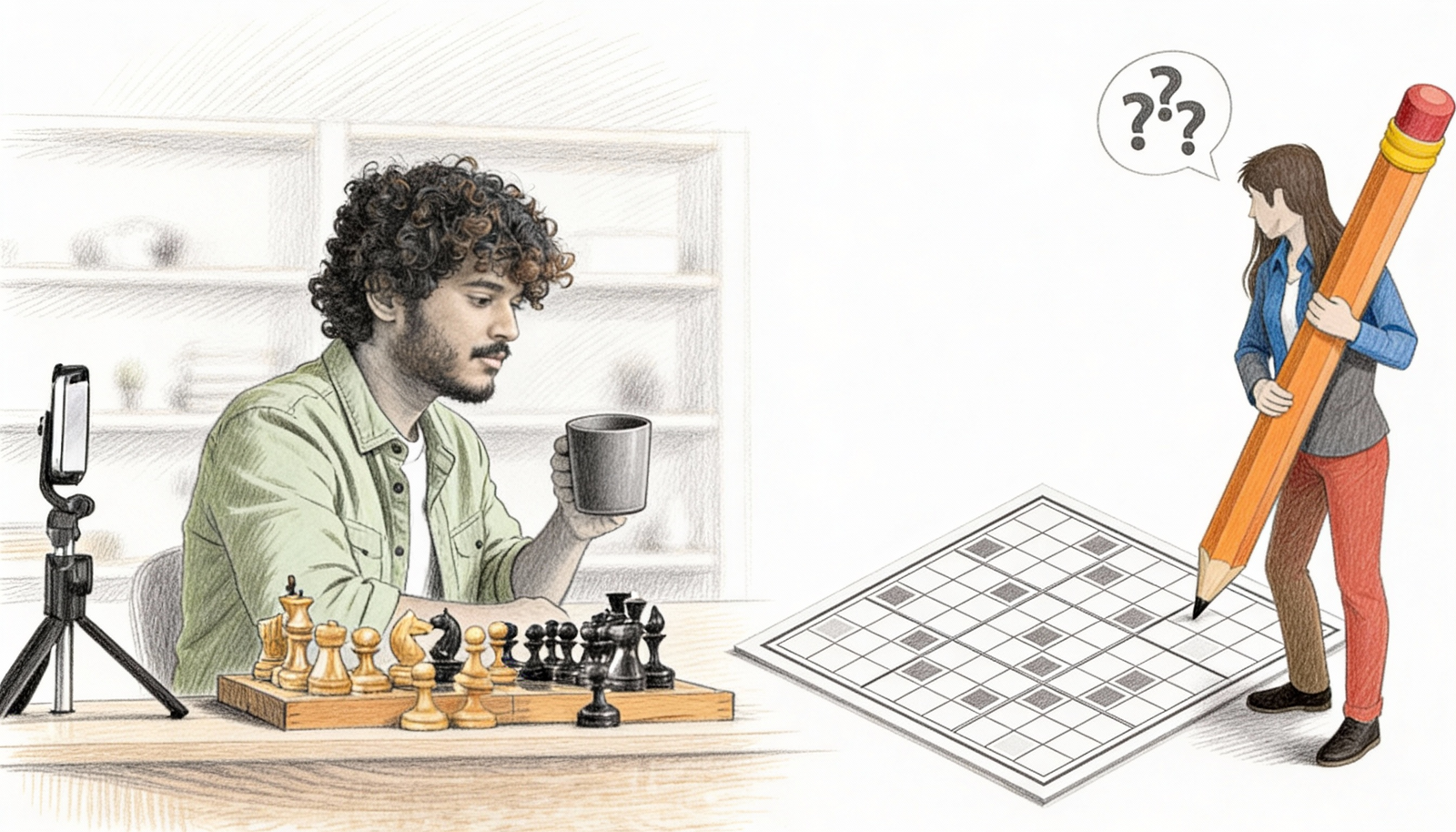
The elderly woman at the coffee shop corner table has been filling in the same crossword puzzle for twenty minutes. Across from her, two men hunch over a wooden chessboard, debating their next moves with the intensity of generals planning a military campaign. Both groups believe they’re giving their brains a thorough workout. But who’s actually getting the better cognitive deal?
The question matters more than most people realize. We’re living longer than ever before, and the prospect of spending our final decades sharp and mentally agile versus confused and forgetful weighs heavy on many minds. Billions of dollars flow into brain training apps, puzzle books, and cognitive enhancement products each year. Everyone wants to know the secret to maintaining mental sharpness.
The answer turns out to be surprisingly complex.
The Case for Crosswords
Crosswords seduce us with their elegant simplicity. A grid of empty squares, a list of clues, and the satisfying snap of certainty when the right word slots perfectly into place. The appeal runs deeper than mere entertainment.
When someone solves a crossword, they’re engaging in what neuroscientists call semantic memory retrieval. The brain must search through vast stores of vocabulary, trivia, and general knowledge. The clue “Four letter word for ancient Roman garment” sends neural signals racing through memory networks, pulling up “toga” from wherever it happens to be stored alongside information about Julius Caesar, college parties, and that one Halloween costume from years ago.
This constant retrieval practice keeps those memory pathways active and efficient. Use it or lose it, as the saying goes. Research has shown that people who regularly engage with puzzles do tend to maintain better vocabulary and general knowledge as they age. A 2011 study found that seniors who did puzzles like crosswords had delayed onset of memory decline.
But here’s where the picture gets murkier. Crosswords primarily exercise the parts of your brain you’ve already developed. If you’ve been doing crosswords for thirty years, you’ve gotten very good at doing crosswords. Your brain has built efficient neural highways for exactly this task. The question is whether that expertise transfers to anything else in your life.
The Strategic Depth of Chess
Chess operates on entirely different principles. When a player sits down at the board, they’re not retrieving stored knowledge so much as generating new ideas in real time. Every game presents a unique landscape of possibilities.
The cognitive demands are severe. Players must hold multiple potential move sequences in their working memory simultaneously. They must evaluate positions, anticipate opponent responses, and adjust plans based on new information. Chess requires spatial reasoning, pattern recognition, strategic planning, and tactical calculation all working together in concert.
The complexity multiplies exponentially with each move. After just four moves by each side, there are over 288 billion possible positions. The number of possible chess games exceeds the number of atoms in the observable universe. No amount of memorization can prepare you for every situation you’ll face.
This forces the brain to build flexible problem solving skills rather than rigid expertise. Chess players develop what psychologists call fluid intelligence, the ability to reason and solve novel problems independent of any specific knowledge base. When a chess player encounters an unexpected position, they can’t simply recall the answer from memory.
They must think.
The Transfer Problem
But does any of this matter if you’re not trying to become a crossword champion or chess master?
The critical question is transfer. When you strengthen your brain in one domain, do those improvements carry over to other areas of life? If crosswords make you better at remembering words, does that help you remember where you put your car keys? If chess improves your strategic thinking, does that help you make better financial decisions?
The research here delivers a sobering message. Most cognitive training is remarkably specific. Getting good at crosswords makes you good at crosswords. Getting good at chess makes you good at chess. The brain is not a muscle that gets globally stronger with any form of exercise. It’s more like a collection of specialized tools that each improve with use.
However, the type of thinking required by each activity suggests different transfer potential. Crosswords strengthen crystallized intelligence, your store of facts and vocabulary. This helps with tasks requiring similar retrieval, like remembering names at parties or recalling historical dates. But it doesn’t fundamentally change how you think.
Chess builds fluid intelligence and executive function. These capacities govern how you approach novel problems, manage multiple streams of information, and adapt to changing circumstances.
The Social Dimension
There’s another factor that research increasingly highlights as crucial for cognitive health: social engagement. The human brain evolved primarily for social interaction. Our most sophisticated cognitive abilities developed to navigate complex social relationships, not to solve abstract puzzles.
Crosswords are typically solitary affairs. You, the grid, and silence. This isn’t inherently bad, but it misses out on the cognitive benefits of social stimulation. Chess, while playable alone, truly comes alive in competition. The psychological element, reading an opponent, adjusting to their style, adds layers of complexity that computer chess can’t replicate.
The post game analysis, where players dissect their decisions and debate alternatives, engages verbal reasoning and social cognition alongside the purely strategic elements. Teaching chess to someone else requires breaking down intuitive understanding into communicable concepts, strengthening metacognition.
The Motivation Factor
Perhaps the most important consideration is which activity you’ll actually continue doing. The best cognitive exercise is the one you’ll practice consistently over years and decades.
Crosswords offer immediate gratification. Each correct word provides a small dopamine hit. The puzzle has a definite ending point. You can complete one over morning coffee and feel accomplished before your day truly begins.
Chess demands more patience. Games can last hours. Losses sting more than incomplete crossword grids. The learning curve is steep, and plateaus can be frustrating. Many people who try chess abandon it within months. But for those who persist, chess offers something crosswords cannot: infinite depth.
The Verdict
So which keeps your brain sharper? The answer depends entirely on what you mean by sharp.
If you want to maintain your vocabulary, general knowledge, and verbal fluency, crosswords are excellent. They’re accessible, enjoyable, and proven to help maintain certain cognitive functions. For someone worried about forgetting words or losing their verbal edge, daily crossword practice offers measurable benefits.
If you want to develop adaptive thinking, improve your ability to plan under uncertainty, and strengthen skills that transfer more broadly to complex real world decisions, chess offers more. The mental demands are higher, but so are the potential cognitive rewards.
The ideal approach? Do both. Crosswords in the morning to wake up your linguistic brain. Chess in the evening to challenge your strategic thinking. Vary your cognitive diet just as you would your food intake.
But here’s the twist: the activity that will keep your brain sharpest is probably whichever one gets you away from passive entertainment. Both crosswords and chess demolish television watching in terms of cognitive benefits. Both require active engagement rather than passive reception.
The real competition isn’t between these two mental activities. It’s between doing something cognitively demanding versus doing nothing at all. The person doing crosswords is leagues ahead of the person scrolling mindlessly through social media. The chess player is miles ahead of someone binge watching their fifth streaming series of the month.
Your brain craves challenge. It withers in comfort and thrives under pressure. Whether that pressure comes from a tricky clue or a tactical puzzle matters less than the simple fact that you’re making your neurons fire in complex patterns.
The woman with her crossword and the men with their chess pieces are all winning. They’ve chosen engagement over passivity, challenge over ease. Their brains are building connections, reinforcing networks, and maintaining the plasticity that keeps minds young.
The only losing move is not playing at all.