Table of Contents
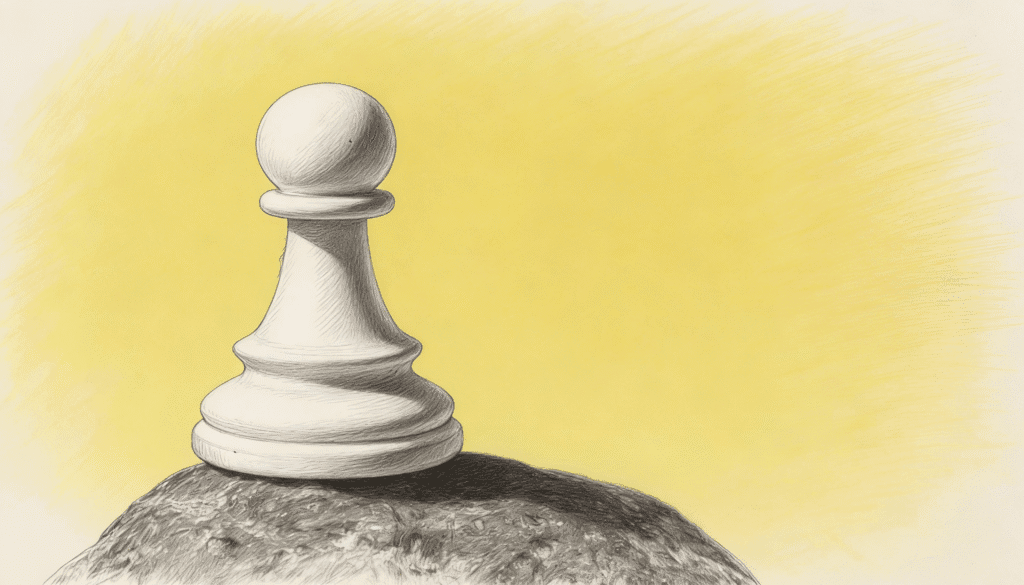
The pawn sits on the second rank, modest and unassuming. Eight of them line up before the game begins, a wall of foot soldiers ready to march forward. Most will never see the back rank. Many will be traded away for tactical advantages they never understood. A few might transform into something greater, but only if they survive long enough to reach the other side.
This is the life of a pawn. And sometimes, this is the life we choose without realizing it.
Every chess player knows that pawns are expendable. They exist to be sacrificed for greater purposes, to open lines for more powerful pieces, to create weaknesses in the opponent’s position. A good player thinks nothing of trading three pawns for a bishop or a knight. The pawn structure matters, certainly, but individual pawns? They are tools, nothing more.
The tragedy occurs when a player begins to see themselves as a pawn rather than the hand that moves the pieces.
The Architecture of Control
Chess teaches us something profound about power structures. At the top of the hierarchy sits the king, the piece that cannot be captured but whose safety determines everything. Just below, the queen commands the board with sweeping authority. The rooks control open files, bishops dominate diagonals, knights leap to outposts. And below them all, the pawns advance one square at a time.
But here is where the metaphor gets interesting. In chess, you control all the pieces. You are not the king or the queen or even the knight. You are the player, the mind behind the entire army. Every piece, including the lowliest pawn, moves according to your will.
In life, the question becomes: are you playing the game, or are you being played?
Consider the workplace. A manager sets a strategic direction for the quarter. Projects get assigned, teams form around initiatives, individuals take on tasks. Nothing wrong with this. Organizations need structure and direction. But watch carefully. Some people execute tasks while understanding how their work fits into the broader vision. They see the entire board. Others simply do what they’re told, completing assignments without questioning whether those assignments serve their own development or interests.
The former are players. The latter are pawns.
The Seduction of Small Moves
Pawns move one square at a time. This makes them perfect for incremental progress, the kind that feels productive but may not lead anywhere meaningful. Push a pawn, gain a little space, feel like something happened. Do this enough times and suddenly you realize your position has weakened while you were busy making small advances that ultimately benefited someone else’s plan.
A man takes on extra projects at work, each one a small commitment. Help with this presentation. Join that committee. Review these documents. Each request seems reasonable in isolation. Each one is just one square forward. But six months later, he has become the person everyone calls when they need something done, while his own career goals sit untouched. He advanced, certainly, but in whose strategy?
The seduction lies in the simplicity. Small commitments feel manageable. They feel like progress. They feel like contributing. And they are, but the question remains: contributing to what, exactly?
Chess players call this overextension. You push pawns forward aggressively, gaining space and feeling dominant, only to discover that your pawns have become weak, isolated, and vulnerable. You gave up safety for the illusion of progress. The advanced pawns that felt so powerful are now targets, and the structure behind them has holes that cannot be repaired.
Reading the Position
The best chess players develop what instructors call board vision. They don’t just see the current position. They see the position three moves from now, five moves from now. They recognize patterns and understand which structures lead to favorable outcomes. This vision comes from experience and study, from analyzing thousands of positions until the underlying logic becomes clear.
Most people go through life without developing this kind of vision for their own circumstances. They respond to immediate pressures without asking where those pressures come from or where they lead. Someone offers an opportunity, and they take it without examining the strings attached. Someone asks for help, and they give it without considering the precedent being set.
This is not about being selfish or refusing to help others. This is about understanding the game being played around you.
A young employee gets praised for working late and handling emergencies. The praise feels good. Recognition matters. So he continues the pattern, staying late, being available, becoming the reliable one. Three years later, he is still in the same role while others who set boundaries and protected their time got promoted. He was praised for being useful, not for being excellent. He was rewarded for pawn behavior while others were building skills and positioning themselves for advancement.
The pattern was visible from the beginning, but he never developed the vision to see it.
The Question of Agency
Agency means having the power to make meaningful choices about your own direction. Pawns have minimal agency. They can move forward, occasionally capture diagonally, and under specific circumstances make a two square advance on their first move. That’s it. Every other piece has more freedom, more options, more ability to shape the position.
When people talk about feeling stuck, they often describe a pawn’s existence. They can only move in one direction. They cannot retreat. They have no choice but to advance or be captured. The position around them dictates their options more than any internal sense of purpose or direction.
Breaking free from this requires recognizing when your choices are actually choices and when they are predetermined by a structure someone else designed. That job you took because it was the logical next step? That relationship you maintained because leaving felt too complicated? That habit you keep because everyone around you does it? Each might be a genuine choice, or each might be a square you were pushed onto by forces you never questioned.
The intellectual challenge here goes beyond simple awareness. Humans are embedded in systems that predate them and will outlast them. Society, culture, economy, family. These systems have their own logic, their own strategies. Opting out entirely is neither possible nor desirable. The question is not whether you exist within systems, but whether you understand them well enough to navigate with intention rather than drift with their currents.
The Sacrifice You Never Agreed To
In chess, sacrificing a pawn can be brilliant. Give up material now for a stronger position later. Open a file for your rook. Create a passed pawn on the other side of the board. Destroy the opponent’s pawn structure. The sacrifice serves a purpose, advances a plan, moves toward victory.
But what happens when the pawn being sacrificed is you, and you never agreed to the exchange?
Organizations make these trades constantly. Sacrifice employee wellbeing for quarterly profits. Trade worker stability for operational flexibility. Give up individual development for team productivity. Sometimes these trades are necessary. Sometimes they serve a legitimate strategic purpose. But often, the people being traded away are the last to understand what’s happening.
A company announces restructuring. The language is careful, positive even. “Streamlining operations.” “Focusing on core competencies.” “Positioning for future growth.” What this means, in plain language, is that some people will lose their jobs so that others can report better numbers to shareholders. The people losing jobs are pawns being sacrificed. The people making the decision are playing a different game on a different board.
This is not a moral judgment about business decisions. This is an observation about the importance of knowing which side of the exchange you’re on.
The same pattern appears in relationships. One person sacrifices their goals, their time, their energy to support another person’s ambitions. Again, nothing inherently wrong with this. Partnerships involve give and take. But when the giving flows consistently in one direction, when one person’s dreams always take priority, when sacrifice becomes the defining feature of your role, you have become a pawn in someone else’s story.
Building Your Own Strategy
So how does a pawn become a player?
The first step is developing strategic thinking. This means asking questions that pawns don’t ask. Where am I heading? What am I building toward? Who benefits from my current path? What alternatives exist? What would happen if I said no?
These questions feel simple, but they require a mental shift. Pawns follow rules and respond to immediate situations. Players create rules and shape situations. The difference is a matter of perspective and, ultimately, a matter of choice.
Strategic thinking in chess involves understanding what kind of position you want to reach. Do you prefer open positions with tactical opportunities or closed positions with long term maneuvering? Are you building an attack on the kingside or trying to dominate the center? Every move should serve your larger plan, not just respond to your opponent’s threats.
Strategic thinking in life involves the same clarity of purpose. What kind of life are you building? What matters to you beyond the immediate tasks and obligations? What would fulfillment actually look like? These are hard questions, harder than most people want to admit, but avoiding them doesn’t make them go away. It just means someone else answers them for you.
The second step is recognizing that strategy requires saying no. Every yes contains a thousand implicit nos. Say yes to working late, say no to dinner with friends. Say yes to taking on extra projects, say no to developing new skills. Say yes to maintaining a relationship that drains you, say no to the energy and space required to find something better.
Pawns cannot say no. They advance when pushed or they get captured. Players decide which pieces to move and which to hold back. The power of no is the power of strategic choice.
The Transformation
In chess, a pawn that reaches the eighth rank transforms into any piece except a king. Almost always, players choose a queen. This promotion represents the ultimate reward for a pawn that survived the journey. What began as the weakest piece on the board becomes the strongest.
The metaphor holds but requires translation. Transformation in life doesn’t come from reaching a predetermined square on someone else’s board. It comes from realizing you can design your own board entirely.
This sounds abstract, so consider it practically. A teacher spends twenty years helping students learn and grow. She is good at this work and finds meaning in it. But she also watches as administrators make decisions that undermine education in favor of test scores and funding formulas. She can continue being a pawn in a system she doesn’t believe in, or she can become a player.
Maybe this means moving into administration to change the system from within. Maybe it means leaving to start a different kind of school. Maybe it means staying in the classroom but developing her own methods that serve students rather than metrics. The specific choice matters less than the shift from reactive to proactive, from being moved to moving yourself.
The transformation is about consciousness and agency. It’s about waking up to the fact that you have been following a script written by someone else and deciding whether that script serves you.
The Cost of Playing
Becoming a player instead of a pawn carries real costs. Pawns are safe in their simplicity. They follow rules, meet expectations, fit into systems. Players take risks. They make choices that might be wrong. They face criticism for breaking with norms. They trade security for autonomy.
A man turns down a promotion because it would require relocating his family away from their community. He knows this decision will affect his career trajectory. He’s choosing family over advancement, presence over position. His colleagues question the choice. His parents don’t understand it. He is violating the expected script. But he is playing his own game now, and that game values different pieces.
The cost is real, but so is the alternative. Spending a life as a pawn means spending a life in service to strategies you never chose and might not even understand. It means arriving at the end and realizing you advanced many squares but never in a direction that mattered to you.
The False Choice
None of this means you must be completely independent or reject all systems and structures. That’s a false choice and an impossible one. We exist in relation to others. We build things together. We participate in shared endeavors. The question is not whether to be part of something larger, but whether you consciously choose your participation and understand its terms.
The best chess players know when to follow classical principles and when to break them. They learn the rules thoroughly and then play with creativity within and sometimes beyond those rules. They are not rebelling for rebellion’s sake. They are making informed choices based on deep understanding.
Similarly, being a player in your own life means understanding the systems you’re part of well enough to navigate them intentionally. Work within organizations but maintain clarity about your own goals. Contribute to relationships while preserving your own identity. Follow social norms when they serve you and break them when they don’t.
The goal is not to become a king. Kings are actually quite limited in chess, able to move only one square in any direction, spending most of the game hiding behind pawns. The goal is to be the player, the consciousness that directs all the pieces with purpose and vision.
The Endgame
Every chess game reaches an endgame where the board is simplified and each piece carries enormous weight. Pawns that survive to the endgame become powerful not because they transformed into queens, but because space opens up and their potential matters.
Life has its endgames too. Moments of clarity where the noise falls away and what remains is essential. In these moments, the question surfaces with perfect clarity: did you live your own strategy, or were you a piece in someone else’s?
The good news is that this question can be answered differently tomorrow than it was answered today. Chess games reset. Patterns can change. A pawn on move ten can start playing like a player by move eleven.
But this requires waking up to the game being played, understanding your position within it, and deciding with clear eyes what moves to make next. Not the moves others expect. Not the moves that feel safe. The moves that serve your strategy, whatever that strategy may be.
The board is always there. The pieces are always moving. The only question is who controls your piece.