Table of Contents
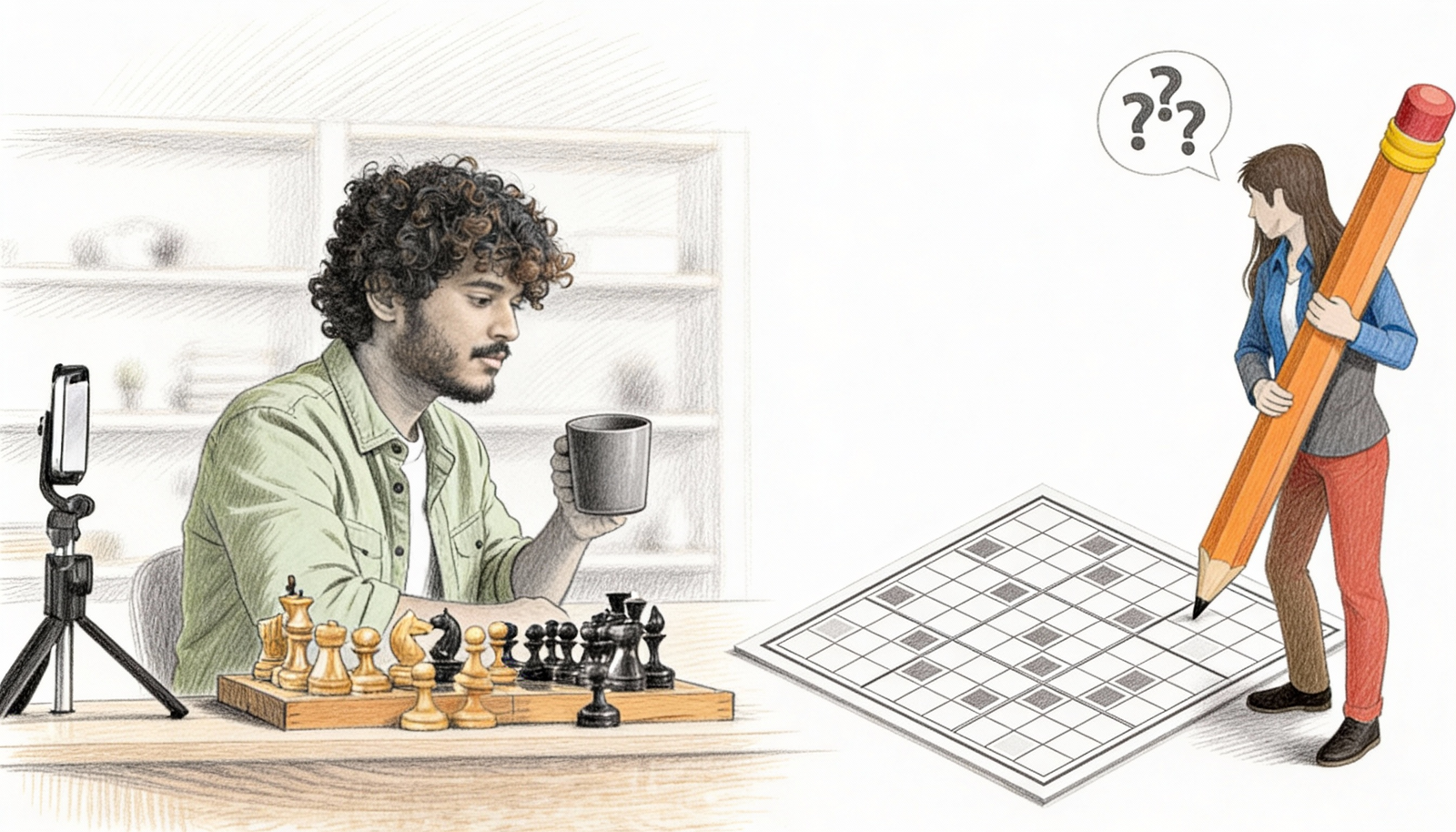
The modern knowledge worker sits surrounded by screens, notifications pinging from every direction. Three browser tabs promise to boost productivity. Five apps claim to eliminate distractions. Two podcasts explain how to achieve deep work. And yet, the quarterly report remains unfinished, cursor blinking on a blank document.
Meanwhile, across town, an eight year old stares at a chessboard for seven full minutes before moving a single piece. No phone in sight. No productivity system. Just pure, unbroken concentration that would make a Zen monk jealous.
Something strange is happening here. While Silicon Valley races to build the perfect focus tool, chess players have been practicing something far more powerful for over a millennium. They call it calculation, but it might be the most effective concentration technique ever developed.
The Paradox of Modern Focus Tools
The productivity management app market will hit over $200 billion by 2032, according to Precedence Research. Millions of people subscribe to digital tools designed to help them concentrate. Block websites. Time your work sessions. Track your habits. Gamify your goals.
Yet studies show we’re more distracted than ever. Microsoft research found that the average attention span has dropped to eight seconds, less than a goldfish. The irony is suffocating. We use apps to fight distraction, but the apps themselves become another layer of digital noise. We spend so much time organizing our productivity systems that we forget to actually produce anything.
Chess offers a different path. No apps required. No life hacks. No optimization tricks. Just you, the board, and the raw act of thinking deeply about something that matters.
What Chess Players Actually Do
When a chess player sits down to think, something remarkable happens. They build entire worlds in their minds. Not vague daydreams, but precise, detailed simulations of reality.
A player considers moving their knight. But before touching the piece, they must see the next 3 to 10 moves. Not just their own moves, but their opponent’s responses. And their answers to those responses. Each branch splits into more branches, creating a tree of possibility that exists only in thought.
This is not casual pondering. This is exhausting mental labor. The player must hold multiple board positions in memory simultaneously, each slightly different from the last. They must switch between these imagined positions while keeping track of which pieces moved where, what threats emerged, what opportunities appeared.
Grandmaster level players can maintain this intensity for five or six hours straight. They burn through calories at rates comparable to marathon runners. Their heart rates spike. Their bodies sweat. All from sitting still and thinking.
The Secret Ingredient Nobody Talks About
Here is what makes chess focus different from every meditation app or productivity technique. It is not about emptying your mind. It is about filling your mind so completely with one thing that nothing else can fit.
Most focus advice tells you to eliminate distractions. Close the door. Silence your phone. Find a quiet space. These are fine suggestions, but they treat focus as the absence of disruption. Chess teaches something more powerful. Focus as presence, not absence.
When you calculate variations in chess, you cannot simultaneously worry about your email inbox. The mental load is too heavy. Your working memory has limited capacity, and chess calculation uses every available slot. There is simply no room left for anxiety about that meeting tomorrow or replaying that awkward conversation from yesterday.
This is not suppression. You are not fighting unwanted thoughts. You are crowding them out with something more demanding and more interesting.
Why This Works When Everything Else Fails
The human brain evolved to solve concrete problems, not to resist abstract temptations. Telling yourself “don’t think about work” rarely works because it keeps work as the central concept. But giving your brain an actual puzzle to solve activates different neural pathways entirely.
Chess provides what psychologists call a state of high cognitive load. Your brain is too busy processing information to process distractions. But unlike stressful multitasking, this load comes from a single coherent task. All your mental resources point in one direction.
This is the opposite of how most people work. Scattered focus means your brain constantly switches between tasks, each switch costing time and mental energy. Chess trains you to go deep on one thing and stay there.
Chess focus is not some mystical gift reserved for tournament players. It is a learnable skill built on a specific structure. Understanding this structure lets you apply the same principles to any focused work.
First, chess demands clear evaluation. Before you calculate anything, you must understand the current position. What are the strengths? What are the weaknesses? Where do opportunities exist? This assessment phase seems simple but requires careful observation.
Many beginners rush this step. They see a tempting move and calculate its consequences without fully understanding the starting position. Inevitably they miss something crucial. The discipline of proper evaluation forces you to be present with current reality before imagining future possibilities.
Second, chess requires concrete visualization. You cannot think about moving your knight “somewhere better.” You must see the specific square. You must picture the new position exactly as it would appear on the board. Vague intentions accomplish nothing. Only precise mental images move you forward.
Third, chess enforces sequential thinking. You must consider one variation completely before jumping to another. If you bounce randomly between different ideas, you lose track of what you already analyzed. You waste mental energy recalculating the same positions. The path to clarity runs through one branch at a time, followed to its logical conclusion.
Finally, chess teaches you to accept incomplete information. You will never calculate everything. At some point you must make a decision based on evaluation, not proof. This is not failure. This is wisdom.
Where Productivity Culture Gets It Wrong
The modern productivity movement treats focus like a resource to manage. Budget your attention. Allocate your energy. Optimize your schedule. This framing makes focus feel like something scarce and precious, something you might run out of if you’re not careful.
Chess suggests the opposite. Focus is not a limited resource you conserve. Focus is a skill you exercise. Like a muscle, it grows stronger with use. The more you practice sustained concentration, the easier it becomes.
This explains why chess players can sit for hours without apparent strain while others feel mentally exhausted after thirty minutes of focused work. It is not genetic. It is training. Thousands of games, each one demanding extended concentration, build psychological stamina.
Most productivity advice also assumes you need external structure. Use the Pomodoro Technique. Work in 90 minute cycles. Take scheduled breaks. These systems help some people, but they are training wheels. They provide artificial structure because internal structure feels too hard to develop.
Chess builds internal structure. After years of calculating variations, players develop an intuitive sense of how long to spend on a problem. They know when to trust their first instinct and when to dig deeper. They recognize the difference between productive thinking and mental spinning. No app required.
The Part About Mistakes That Changes Everything
Chess has a brutal relationship with error. Make one serious mistake and you might spend the next hour playing a lost position, trying to salvage something from the wreckage.
This creates tremendous pressure to focus. The stakes feel real because they are real, at least within the context of the game. One moment of distraction, one lazy calculation, one casual assumption can cost you everything.
But here is the counterintuitive part. This pressure does not create anxiety. It creates clarity. When the cost of losing focus is tangible and immediate, focus becomes easier, not harder. Your brain understands why concentration matters. Abstract goals like “be more productive” cannot compete with the concrete reality of an opponent waiting to punish your mistakes.
The best training for focus might not be learning to relax. It might be raising the stakes.
What This Means for Everyone Else
Most people will never play competitive chess. That is fine. The principles transfer.
Whatever work you do, you can import chess style focus by creating the same basic conditions. Give yourself a concrete problem with clear boundaries. A specific question to answer. A particular challenge to solve. Not “work on the project” but “figure out how these three data points connect.”
Then commit to holding the problem in your mind completely. Not skimming the surface. Not multitasking. Full immersion into the details until you reach a conclusion or hit a wall.
This is uncomfortable at first. Your mind will rebel. It will offer compelling reasons why you should check your email right now. It will suggest that you are not making progress, that you should try something else, that this is taking too long.
Push through. The discomfort is the training. Your brain is building new patterns, learning to sustain attention on hard problems. Like any workout, it gets easier with repetition.
Start small. Ten minutes of unbroken focus on a single question. No email. No Slack. No music with lyrics. Just you and the problem. When ten minutes feels manageable, try fifteen. Then twenty.
You are not trying to eliminate distraction from your environment. You are building the capacity to fill your mind so completely that distractions have nowhere to land.
The Ancient Game Meets the Modern Mind
Chess survived 1,500 years because it does something fundamental to human cognition. It creates a space where thinking matters. Where attention has consequences. Where focus is not a productivity hack but the entire point.
The game existed long before smartphones and push notifications. It will exist long after whatever productivity app currently dominates the market becomes obsolete. The reason is simple. Chess does not try to manage distraction. It makes distraction irrelevant by offering something more compelling.
Every chess player knows the feeling of looking up from a board after deep calculation and realizing an hour passed without notice. Time did not disappear because they were having fun or because they found some motivational trick. Time disappeared because their minds were completely occupied with something that demanded everything they had.
This is not escape. This is engagement. The difference matters.
Modern life is filled with shallow engagement. Scrolling feeds that pretend to be interesting. Meetings that pretend to be productive. Work that pretends to be important. We spend so much energy trying to focus on things that do not actually engage us that we forget what real focus feels like.
Chess reminds us. Real focus is not a battle against distraction. Real focus is what happens when something captures your attention so completely that distraction never gets a chance.
The best focus technique is not an app you download. It is not a system you implement. It is a depth of engagement you cultivate by repeatedly doing something hard enough to demand your full attention. Chess just happens to be very good at providing that demand. But the principle works anywhere. Find something that requires sustained mental effort. Do it regularly. Watch your capacity for focus grow.
…
The eight year old staring at the chessboard for seven minutes is not fighting distraction. They are learning something far more valuable. How to think deeply about one thing until the answer reveals itself.
That skill, once learned, applies everywhere. And no notification can take it away.