Table of Contents
The conventional wisdom sounds perfectly reasonable. Wait until your mind is clear. Sit down when you’re centered and focused. Play chess when you’re at your best, not your worst. This advice gets repeated in chess clubs and online forums with the certainty of gospel truth.
It’s also backwards.
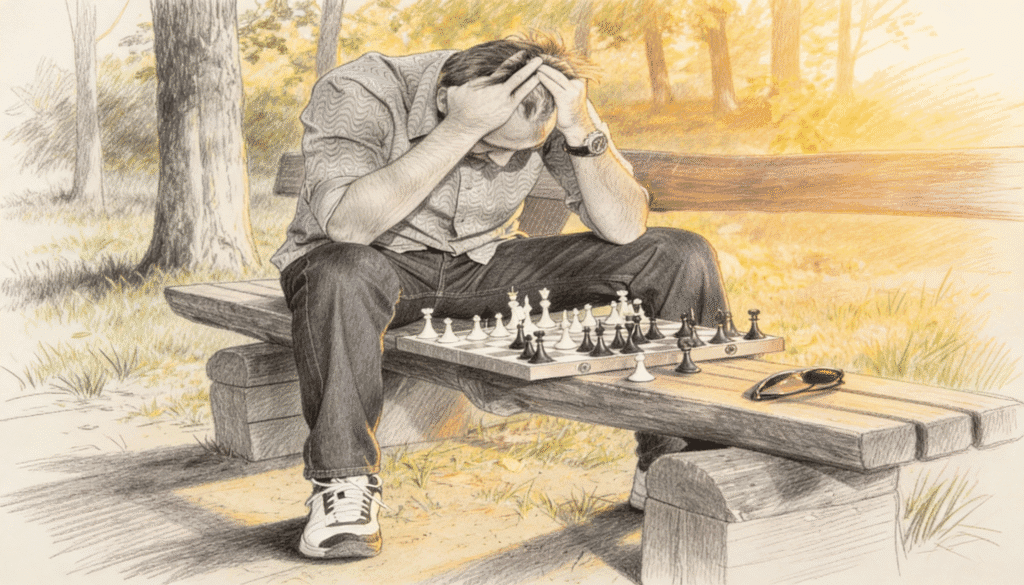
The typical chess player treats the game like a meditation garden that can only be entered with a peaceful mind. They wait for the perfect mental state, that mythical moment when stress evaporates and clarity reigns. Meanwhile, life keeps throwing curveballs. The work deadline looms. The argument with a loved one replays on loop. The bank account dwindles.
And the chessboard sits untouched, waiting for conditions that rarely arrive.
But chess wasn’t designed for monks in silent contemplation. It was born in the chaos of medieval courts and military camps, where stressed minds needed somewhere to channel their turbulence. The game has always been a crucible for transforming mental noise into structured thought.
The Stress Paradox
Consider what happens in the brain during stress. The amygdala fires up, flooding the system with cortisol and adrenaline. This isn’t a malfunction. Evolution designed this response to sharpen focus and speed up decision making when threats emerge. The problem isn’t stress itself but where that heightened state gets directed.
Without a productive outlet, stress spirals inward. It feeds on itself, creating loops of worry that go nowhere. The mind races but covers no ground. Energy builds with no release valve. This is when people scroll social media for hours, pick fights over nothing, or stare at the ceiling at 2am running through worst case scenarios.
Chess offers something different. It takes that revved up mental engine and gives it somewhere to go. The racing thoughts that ping around aimlessly suddenly have a target. The nervous energy that makes hands fidget and legs bounce can be channeled into analyzing positions and weighing options. Stress doesn’t disappear. It transforms into fuel.
The calm player sits down with a relaxed nervous system. Their mind drifts easily. They might play well, but they’re not accessing the heightened state that stress provides. The stressed player brings intensity that can be harnessed. They’re already operating at a higher gear. Chess just points them in the right direction.
The Concentration Forge
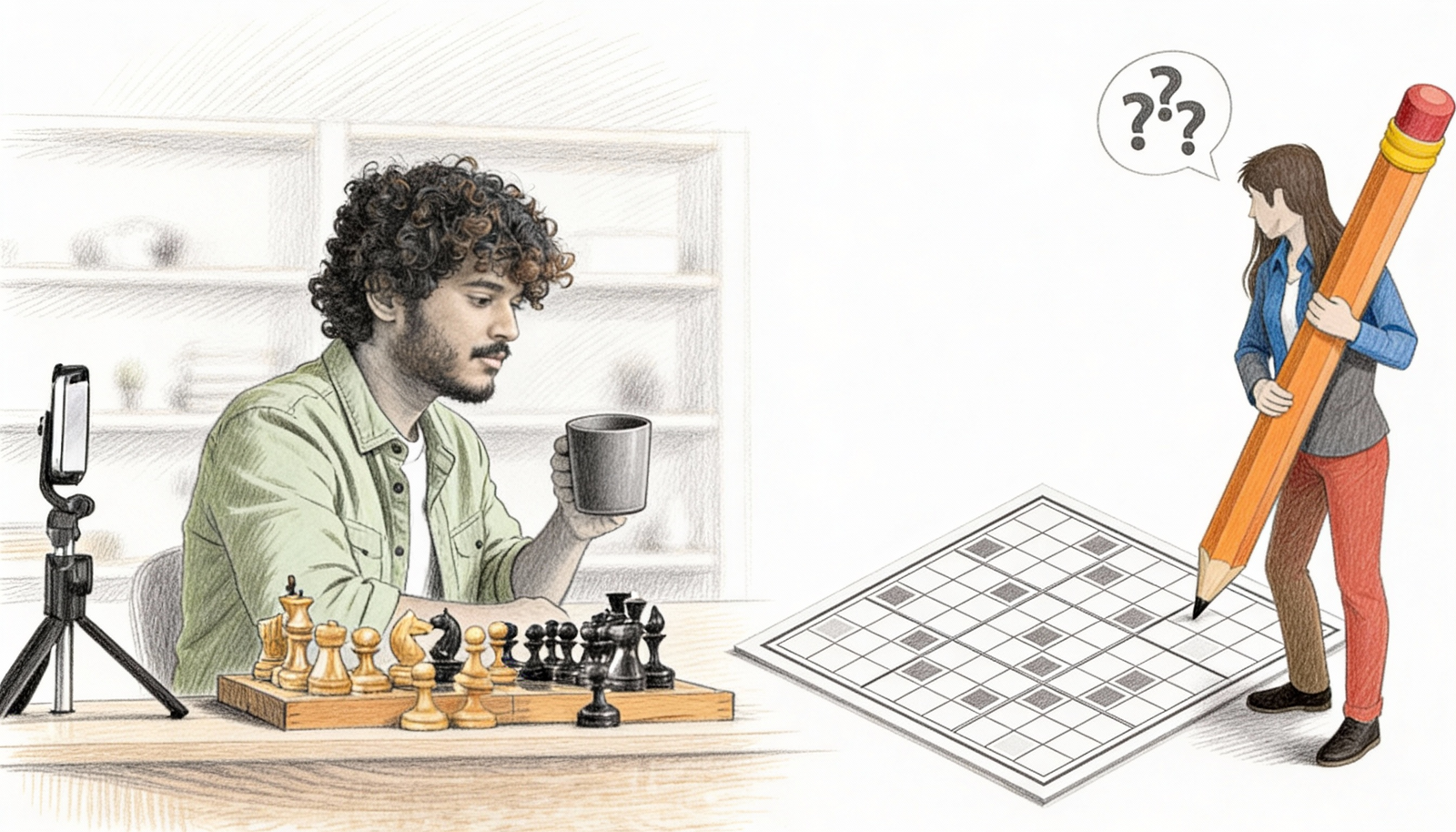
Here’s what makes chess uniquely suited for stressed minds. The game demands complete attention but within a contained system. It’s not like trying to meditate, where a stressed person gets told to clear their mind and finds it impossible. Chess doesn’t ask you to stop thinking. It gives you something specific to think about that crowds out everything else.
When stress hits, the mind fixates on problems that feel unsolvable. The job situation with no clear path forward. The relationship tension with no obvious resolution. The financial worry that compounds with every examination. These problems share a frustrating quality. They’re too big, too vague, too tangled to tackle directly in the moment.
Chess provides the opposite. Every position presents a concrete problem with a finite solution space. The mind that was spinning its wheels on abstract worries suddenly has something tangible to grip. There are pieces on specific squares. There are threats that can be calculated. There are plans that can be evaluated. The problems are real but solvable.
This creates what psychologists call optimal challenge. The task is difficult enough to demand full engagement but structured enough to feel manageable. For a stressed mind, this combination works like a pressure release valve. All that mental energy that was circling anxiety drains into the position on the board.
The transformation happens quickly. Five minutes into a game, the racing thoughts about work or relationships or money fade into background noise. Not because they’ve been resolved, but because the immediate problem of the position commands total focus. The queen pins the knight. The center pawn structure needs attention. The opponent’s king safety looks shaky. These concerns aren’t world changing, but they’re completely absorbing.
Strategic Thinking as Stress Relief
Something unexpected happens when a stressed mind engages with chess strategy. The analytical frameworks that apply to the board start bleeding into the sources of stress itself. Not in some mystical way, but through practical pattern recognition.
Chess teaches position evaluation. Every move changes the landscape, creating advantages and disadvantages that need assessment. A stressed person worrying about job security might start applying similar evaluation to their actual situation. Instead of catastrophizing, they begin seeing the position for what it is. What real threats exist? What resources are available? What plans are possible?
The game also trains recognition of false urgency. In chess, the piece that looks threatening often isn’t the real danger. The obvious move often isn’t the best move. Stress amplifies everything, making minor concerns feel like crises. Chess quietly teaches the difference between what demands immediate attention and what only seems urgent.
Risk assessment becomes second nature. Every move involves weighing potential gains against possible costs. Some positions reward aggression. Others demand caution. The stressed player learns to distinguish between them, developing intuition about when to push forward and when to consolidate. This skill doesn’t stay on the board. It seeps into decision making elsewhere.
Perhaps most valuable is the training in emotional regulation under pressure. Games create their own stress. Positions collapse. Opponents find brilliant tactics. Time pressure mounts. But the game continues, demanding clear thinking despite rising tension. This becomes practice for maintaining rationality when life applies its own pressure.
The Containment Effect
One underrated benefit of playing chess while stressed is how it contains the emotional experience. Stress in daily life feels boundless. It can touch everything, seeping into unrelated areas and contaminating hours or days. Chess puts boundaries around intensity.
A game has a clear beginning and end. Thirty minutes, sixty minutes, maybe ninety for longer time controls. The stress of the position exists within that window. When the game ends, it’s truly over. The position is resolved one way or another. There’s closure, something real life stress rarely provides.
This temporal boundary creates safety. A stressed person can throw themselves fully into the game’s intensity, knowing it won’t last forever. They can experience pressure, frustration, even the sting of defeat within a container that doesn’t threaten to expand indefinitely. This is remarkably therapeutic.
The spatial boundary matters too. The stress exists on an eight by eight grid. Nowhere else. The problems are confined to sixty four squares. This limitation transforms overwhelming diffuse anxiety into focused challenge. Big feelings get directed at small wooden pieces, which is oddly satisfying.
Learning From Setbacks
Chess also changes the relationship with failure, which matters tremendously for stressed minds. Stress often comes from feeling overwhelmed by things going wrong or potentially going wrong. The stressed person tends to view mistakes as catastrophic, setbacks as permanent.
Every chess player loses. Often. Even the best players in the world lose nearly half their games at the highest levels. The game normalizes losing in a way few other activities do. It reframes failure as information rather than verdict.
This perspective shift has surprising power. The player who loses a game because they overlooked a tactic doesn’t close their laptop in shame. They analyze what they missed, understanding the pattern for next time. The position they thought was winning but turned into a loss teaches them about overconfidence and position evaluation. Mistakes become lessons rather than judgments.
For someone stressed about life setbacks, this mindset is revolutionary. The job application that got rejected isn’t a declaration of worthlessness. It’s information about fit or timing. The relationship that’s struggling isn’t proof of fundamental inadequacy. It’s data about compatibility and communication patterns. Chess doesn’t make these situations less painful, but it models a more productive response to difficulty.
The game also teaches the concept of calculated risk and acceptable loss. Sometimes sacrificing material is necessary for gaining position. Sometimes accepting a worse endgame is the price of avoiding immediate tactical disaster. Not every decision has a purely positive outcome. Often the choice is between manageable problems and worse problems.
This maps directly onto stress management. The stressed person often feels paralyzed because no option seems purely good. Chess teaches that choosing the best available option, even when it involves some cost, is skillful play. Perfection isn’t the standard. Optimal decision making given real constraints is the standard.
The Community Dimension
Playing chess, especially online, offers another underrated benefit for stressed individuals. The game connects people across boundaries without requiring emotional disclosure. The stressed player who doesn’t want to talk about their feelings doesn’t have to. They can sit down and play, engaging socially through the shared language of moves and positions.
This indirect connection matters. Loneliness compounds stress, but forced social interaction while stressed can feel exhausting. Chess offers a middle path. The player engages mentally and socially but within a structured format that doesn’t demand emotional labor. The interaction is real but bounded by the game itself.
The anonymous or semi anonymous nature of online play adds another layer of freedom. The stressed player can show up exactly as they are, agitated and scattered, and simply play. No need to maintain appearances or explain their state. The board doesn’t judge. The opponent only knows them through their moves.
Paradoxically, this emotional distance often leads to genuine connection. Players who meet regularly over the board, even virtually, develop respect and camaraderie. The shared struggle with the game’s complexity creates bonds. But these bonds form organically, without the pressure of mandatory vulnerability.
The Flow State Gateway
Stress and flow seem like opposites, but they’re actually adjacent states. Both involve heightened arousal and intense focus. Stress becomes flow when it finds proper direction and challenge that matches skill level.
Chess is remarkably good at creating flow states because the game automatically adjusts difficulty through matchmaking and player strength. A stressed beginner faces opponents at their level. A stressed expert faces proportionate challenges. The game scales, always providing that sweet spot where the task is demanding but achievable.
In flow, time distorts. Hours feel like minutes. Self consciousness evaporates. The stressed player who sat down with mind racing and chest tight stands up after a session feeling emptied out in the best way. Not because stress disappeared but because it was fully spent on something engaging.
This effect compounds with practice. The brain learns that sitting down at the chessboard means entering that absorbed state. The association becomes automatic. Eventually, even preparing to play begins activating the mental shift. The ritual of opening the chess app or setting up the physical board signals the transition from scattered stress to focused engagement.
Practical Application
None of this suggests chess is therapy or medical treatment. Serious stress and anxiety disorders require professional help. But for the everyday stress that everyone experiences, the kind that comes from modern life’s relentless demands, chess offers a remarkably effective tool.
The key is reversing the common advice. Don’t wait until you’re calm to play. Sit down when stress hits. Let the racing thoughts and nervous energy pour into the game. Use the heightened arousal stress provides as fuel rather than fighting it.
Start simple. Five minute games when feeling overwhelmed. Ten minute games when stress builds. Longer time controls when ready to really dig into positions. The format matters less than the act of engaging.
Don’t worry about playing well. Some of the most satisfying games happen when players are stressed and making imperfect decisions. The goal isn’t peak performance. The goal is channeling intensity into something structured and finite.
Notice what happens to the mind during play. Observe how stress transforms from diffuse anxiety into focused problem solving. Pay attention to the shift from rumination to analysis. These changes aren’t accidents. They’re the game doing what it’s designed to do.
The Deeper Truth
Perhaps the deepest benefit comes from what chess teaches about the nature of stress itself. Stress isn’t the enemy. It’s energy. The problem isn’t experiencing stress but what happens when that energy has nowhere to go. Stress without purpose becomes anxiety. Stress with direction becomes engagement.
Chess doesn’t eliminate stress from life. It teaches navigation through stress, transformation of stress, productive use of stress. These lessons transfer. The player who learns to convert anxious energy into focused calculation at the board starts recognizing opportunities to apply the same principle elsewhere.
The stressed parent facing chaos at home recognizes it as a complex position requiring careful maneuvering. The overwhelmed employee sees their workload as a strategic challenge demanding prioritization and tactics. The worried student understands their exam preparation as an endgame requiring precise technique. The metaphors aren’t perfect, but the underlying skill transfers remarkably well.
This is why playing chess when stressed beats waiting for calm. Calm is passive. Stress is active. Chess takes that active energy and gives it form and purpose. The game meets intensity with structure, chaos with pattern, overwhelm with solvable problems.
So the next time stress hits, don’t wait for it to pass. Don’t try to force calm. Don’t keep spinning in anxious thoughts. Open the board. Start a game. Let stress become something else entirely.
The pieces are waiting, and they don’t care if your mind is racing. They just offer sixty four squares of possibility and a timer counting down. Sometimes, that’s exactly what a stressed mind needs.