Table of Contents
Every chess opening has a personality. Some are refined scholars dressed in tweed jackets, patiently maneuvering for microscopic advantages. Others are street fighters who prefer to settle things quickly, even if it means taking a punch. The Scotch Gambit belongs firmly to the second category. It’s the opening that walks into the bar, buys everyone a drink, and starts a brawl before the ice melts.
The Scotch Gambit isn’t about patience. It’s about action. While other openings tiptoe around the board like diplomats at a peace conference, this one kicks down the door and demands immediate attention. Material? Who cares about a measly pawn when you can have momentum, activity, and the kind of pressure that makes opponents sweat through their shirts?
The Birth of a Rebel
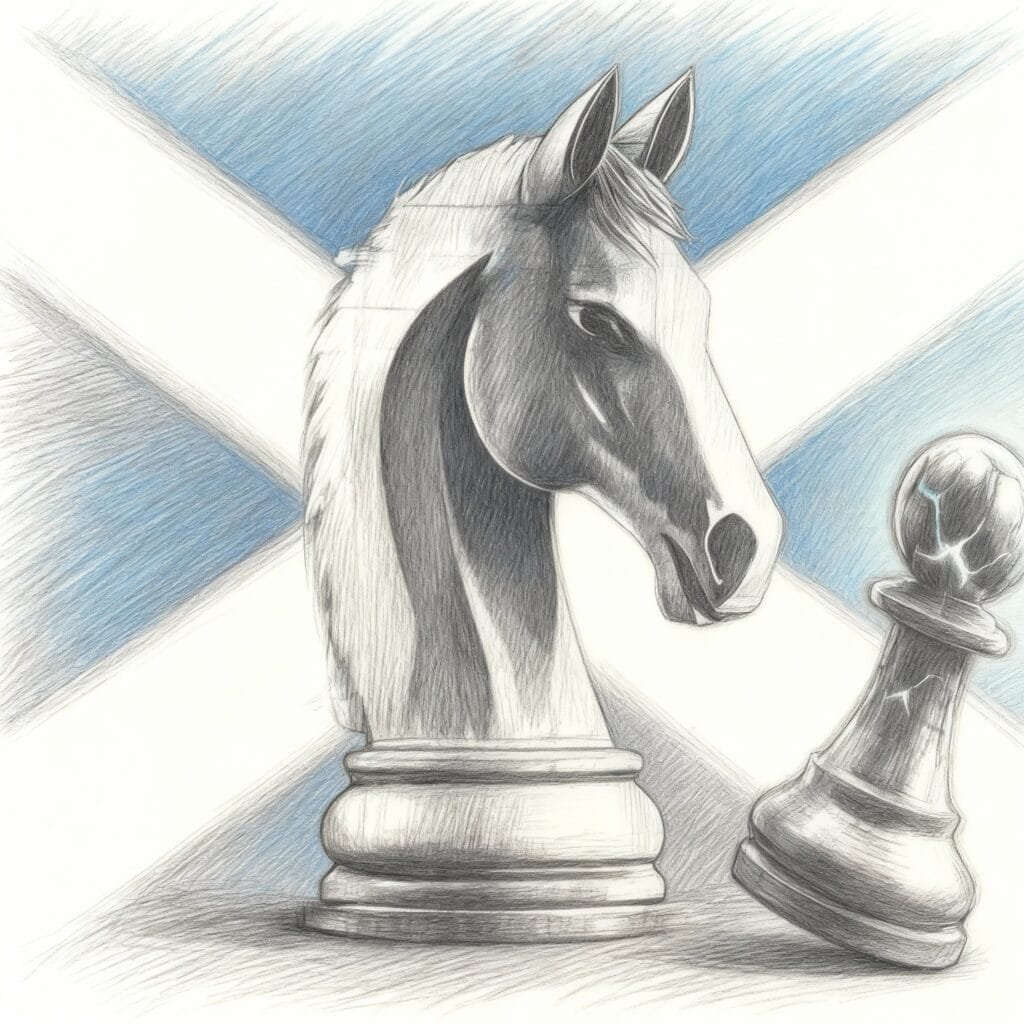
The story begins in 1824, back when chess players sent their games through the mail and waited weeks for replies. London and Edinburgh chess clubs engaged in a correspondence match that year, and the opening that emerged from those games would carry the Scottish city’s name forever. The romantic era of chess was in full swing. Players didn’t calculate twenty moves deep with computer precision. They calculated just enough to make things interesting, then trusted their tactical vision and attacking instincts.
The Scotch Game family lived through the 19th century as a respected member of chess society. Then something happened. The 20th century arrived with its positional revolution, and suddenly everyone wanted to play like they had all the time in the world. By 1900, the Scotch had declined in popularity, dismissed as too straightforward, too honest, too willing to show its cards early.
The gambit variation, the truly wild child of the family, faced even harsher judgment. Serious players shook their heads. “You’re just giving away material,” they said. “Modern chess has evolved beyond such primitive tactics.”
Then Garry Kasparov showed up.
The Revival Nobody Saw Coming
When the greatest player of his generation decided to resurrect the Scotch Game in his 1990 world championship match against Anatoly Karpov, people noticed. Kasparov used it sporadically but successfully for the next decade, proving that old dogs could learn new tricks, or perhaps that new dogs should respect old tricks.
But the Scotch Gambit remained on the fringes, too wild even for Kasparov’s attacking tastes. It takes a special kind of chess player to sacrifice material in the opening with no guaranteed compensation. The computer age should have killed it completely. After all, engines can calculate whether a gambit actually works, right?
Wrong. Or at least, not entirely. Because chess isn’t played between computers. It’s played between humans, and humans make mistakes when they’re under pressure. The Scotch Gambit creates pressure like a fire hose creates water flow: constant, overwhelming, and hard to redirect.
The Philosophy of Giving to Receive
Most chess players hoard their pawns like dragons guard gold. The Scotch Gambit player thinks differently. That pawn isn’t treasure. It’s currency, and currency exists to be spent on things that matter more. What matters more than pawns? Time, space, and the initiative.
Think of chess like a street market. You can clutch your money tightly and walk around looking at goods, or you can spend immediately to secure the best items before anyone else grabs them. The Scotch Gambit is the equivalent of showing up at the market with a wad of cash and buying everything you need in the first five minutes. Sure, you spent more than careful shoppers, but you also got what you wanted and went home while they were still comparing prices.
The framework of any gambit rests on three pillars: development, king safety disruption, and initiative. The Scotch Gambit delivers all three with brutal efficiency. Instead of carefully repositioning pieces to ideal squares over fifteen moves, you’re throwing them into action immediately. The opponent’s king, comfortable in the center or preparing to castle safely, suddenly feels exposed. Every move carries the weight of calculation because one mistake could be fatal.
The Strategic Constitution
Understanding the Scotch Gambit means understanding what matters when the center opens up like a wound. Typical tactical ideas involve targeting key squares, particularly the weak points in Black’s position that haven’t been reinforced yet. The framework isn’t complicated, which is precisely what makes it dangerous.
First comes rapid deployment. While the opponent is collecting extra pawns like a greedy squirrel hoarding nuts, pieces fly to active squares. Bishops land on dangerous diagonals. Knights jump to aggressive outposts. The rooks eye open files with predatory interest.
Second comes the question of the king. Specifically, the opponent’s king. In chess, the king is simultaneously the most important piece and the biggest liability. Keep it safe and you can survive any storm. Let it get caught in the open and even a small breeze becomes a hurricane. When development advantages meet exposed kings, tactical chances explode.
The third element involves squares. Not all squares are created equal. Some control important territory, others allow pieces to coordinate effectively, and a few serve as launching pads for devastating attacks. The Scotch Gambit fights for control of these critical squares before the opponent has established firm defenses. It’s easier to seize territory than to wrest it away from an entrenched defender.
The Psychological Warfare
Here’s where things get interesting. Chess at the club level isn’t just about finding the objectively best moves. It’s about psychology, time management, and the very human tendency to panic under pressure. The Scotch Gambit weaponizes all three.
Your opponent sits down expecting a normal game. Maybe they’ve prepared some fancy defense to the Spanish Opening or studied the latest Italian Game theory. Then you sacrifice a pawn on move four and suddenly their preparation is worthless. They’re on their own, navigating unfamiliar territory, and the clock is ticking.
This is where the gambit earns its bad boy reputation. It doesn’t play fair. It doesn’t give opponents time to settle in and find their rhythm. It says, “We’re fighting right now, and you’d better be ready.” Most players aren’t ready. They take the pawn because turning down free material feels wrong. Then they spend the next fifteen moves desperately trying to consolidate while pieces swarm around their king like angry bees.
The beauty lies in the imbalance. Material versus activity. Pawns versus piece coordination. Greed versus fear. These tensions create mistakes, and mistakes create opportunities. Even though Black can equalize with correct play, positions tend to be unbalanced, giving both sides chances to outplay each other.
Who Should Dance With This Devil?
Not every player should pick up the Scotch Gambit. It requires a certain temperament, a willingness to walk the tightrope between brilliance and disaster. Conservative players who prefer solid positions and grinding endgames will find it uncomfortable. They’ll miss their extra pawn and wonder why they’re taking such risks.
But for the player who loves tactics, who thrives on calculation, who wants every game to be a battle rather than a marathon, the Scotch Gambit is perfect. Players need openings that develop a sense of initiative, an ability to calculate variations, and a good feeling for king safety. This gambit teaches all three, whether you want the lesson or not.
Beginners can learn from it too, though with caution. It’s like learning to drive on a sports car instead of a sedan. You might crash more often, but you’ll learn quickly what the limits are and how to handle speed. The gambit punishes sloppy thinking but rewards aggressive, concrete calculation. Every game becomes a tactical puzzle that demands solving.
Intermediate players find gold here. They have enough tactical vision to spot the combinations but haven’t yet developed the conservative instincts that make them fear material sacrifice. They can throw themselves into the complications and learn through trial and error, building pattern recognition along the way.
The Framework in Motion
Imagine the board as a battlefield where two armies face each other across no man’s land. Traditional openings are like WWI trench warfare: dig in, establish supply lines, probe for weaknesses, and only attack when everything is perfectly prepared. The Scotch Gambit is more like a Viking raid: hit fast, hit hard, and get out before the enemy organizes a proper defense.
The pawn sacrifice creates open lines immediately. These lines serve as highways for your pieces, allowing them to reach critical squares in record time. While the opponent’s army is still marching out of the barracks, yours is already engaged in combat. This time advantage, called “tempo” in chess terminology, translates to concrete pressure that must be addressed.
Nothing comes free, not even in chess. The Scotch Gambit’s aggressive nature carries risks that honest discussion must acknowledge. Black can decline the gambit and reach comfortable positions, and well prepared opponents can navigate the complications to reach equal or even superior positions.
The material deficit is real. That pawn you sacrificed could become important in the endgame if the position simplifies. If the attack fizzles and pieces come off the board, you might find yourself grinding a difficult position where every move requires precision and any mistake could be fatal.
Preparation matters too. Opponents who have studied the gambit know the critical defensive resources. They know when to return material to defuse the attack, when to block dangerous lines, and when to sacrifice their own material to break the initiative. Knowledge is power, and in chess, knowledge of specific positions is even more powerful.
The time commitment poses another challenge. Learning the Scotch Gambit properly means studying tactical patterns, understanding when to press and when to consolidate, and developing the judgment to evaluate whether your activity compensates for the material deficit. This takes practice, and practice means playing games where you might lose spectacularly while figuring things out.
Theory says one thing. The chess board says another. In tournament play, especially below master level, the Scotch Gambit scores well because humans make mistakes under pressure. The objective evaluation might favor Black after perfect defense, but perfect defense is rare when the clock is ticking and tactical complications multiply with every move.
The modern chess landscape, dominated by computer analysis and opening theory, paradoxically makes gambits like the Scotch more viable at amateur levels. Why? Because when everyone studies the same computer lines, deviating from theory and creating unique positions becomes an advantage. Your opponent can’t rely on memorized moves when the position on the board doesn’t match anything in their preparation.
The Verdict on Our Bad Boy
The Scotch Gambit won’t make you a grandmaster. It won’t single handedly win tournaments against prepared opposition. But it will teach you chess in a way that solid, respectable openings cannot. It forces you to calculate, to evaluate dynamic factors over static material, and to trust your tactical vision even when the computer raises its silicon eyebrows in disapproval.
Is it objectively the best way to play chess? Probably not. The computer prefers openings that maintain small advantages and grind opponents down through superior understanding. But chess isn’t played by computers, and humans need excitement to stay engaged and improve. The Scotch Gambit provides excitement.
The opening also builds confidence. There’s something empowering about sacrificing material and making it work. Each successful game reinforces the idea that calculation and activity can overcome material deficits, and this lesson carries over to other aspects of chess. Players become more willing to trust their tactical instincts and less afraid of positions that don’t conform to quiet positional norms.
For players who love tactics, who want faster improvement, or who simply enjoy the thrill of attacking chess, the Scotch Gambit delivers. It’s not the safest path or the most theoretically sound. But it’s fun, educational, and effective against the vast majority of opposition you’ll face over the board.
Will you master it? That depends on your dedication and tactical ability. But if you give it a fair chance, this bad boy of the chess opening world might just teach you more about the game than a lifetime of safe, solid, respectable openings ever could. Sometimes the best teacher is the one who pushes you into the deep end and forces you to learn to swim.
The Scotch Gambit pushes. The question is whether you’re ready to swim.