Table of Contents
There’s a story about José Raúl Capablanca that perfectly captures his genius. During a tournament in the 1920s, a spectator watched him play for hours without showing any emotion. After Capablanca won yet another game with seemingly minimal effort, the spectator remarked that the Cuban champion made chess look boring. His opponent, exhausted from the mental battle, replied with a bitter smile: “You should try playing against him.”
This was the paradox of Capablanca. He made winning look so easy that observers often missed the brilliance unfolding before their eyes. While other masters relied on dazzling combinations and deep calculations, Capablanca won through clarity, simplicity, and an understanding of chess that seemed almost mystical. At the heart of his approach lay principles so fundamental yet so powerful that they remain relevant a century later.
The Machine Before Machines
Long before computers dominated chess, Capablanca was called “the invincible chess machine”. The nickname wasn’t just about his results, though they were staggering. From February 1916 to March 1924, he went eight years without losing a single classical game. Eight years. Think about that. Most players can’t go eight games without a loss.
What made this achievement even more remarkable was how he did it. Capablanca didn’t win through superior memory or deeper calculation. He won by understanding something his opponents missed: chess, at its core, is about simple truths. While his rivals buried themselves in complex analysis, Capablanca played the board like a musician plays a familiar melody. Natural. Effortless. Inevitable.
The Rule That Changed Everything
Among all the wisdom Capablanca shared, one principle stands out for its elegant simplicity and profound impact. It’s known simply as Capablanca’s Rule, and it addresses one of the most common yet misunderstood situations in chess: what to do with your bishops and pawns.
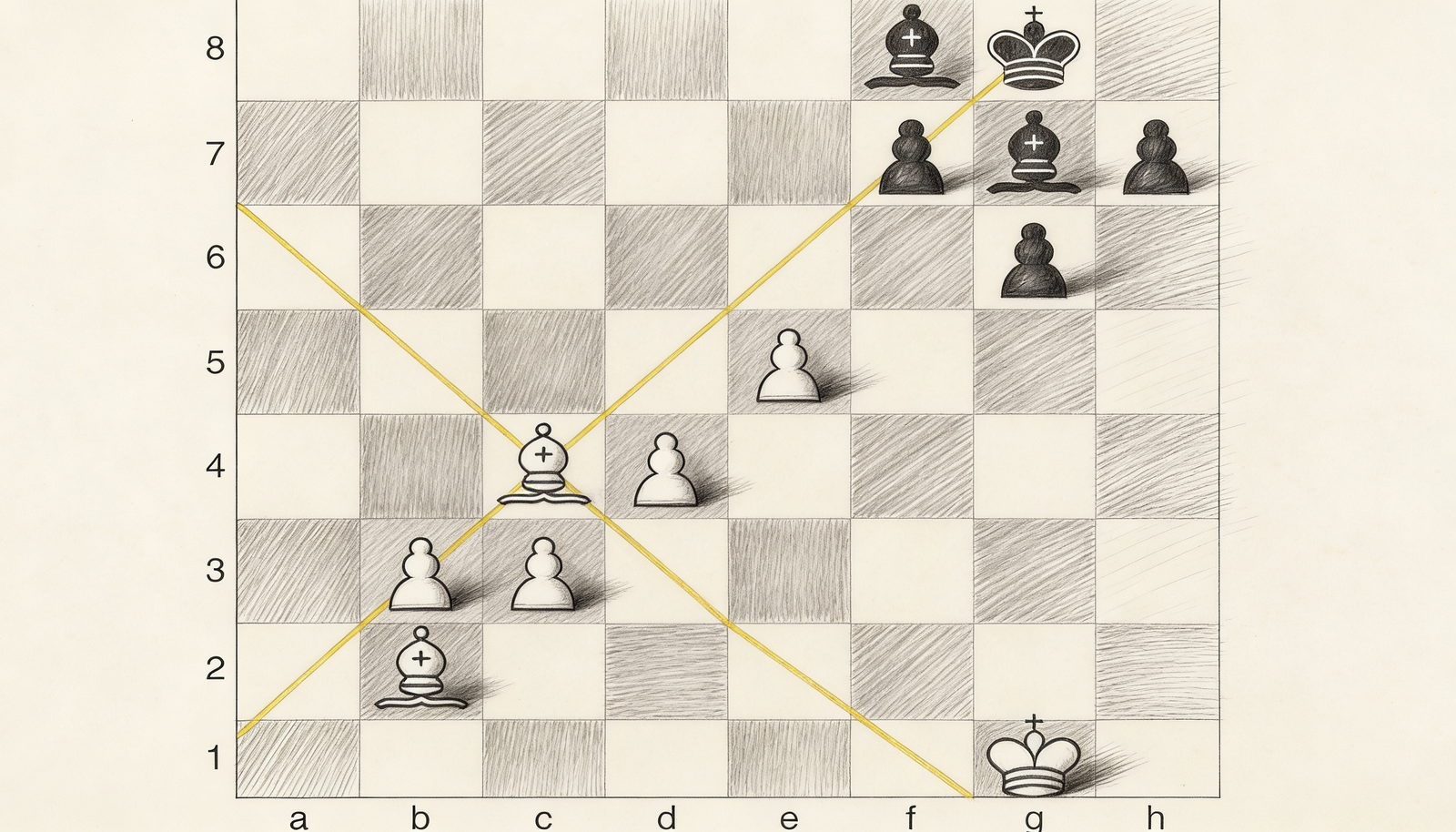
The rule states: When you have one bishop left on the board, place your pawns on the opposite color squares to your bishop.
That’s it. No complex formulas. No exceptions to memorize. Just a simple guideline that transforms how players approach the endgame. Yet this seemingly obvious principle trips up players at every level, from beginners to grandmasters.
Why does this matter? Imagine your bishop is a guard patrolling specific streets in a city. If you park your cars on those same streets, the guard can’t patrol effectively. The cars block the path. But if you park on different streets, the guard can move freely while your cars control the areas the guard can’t reach. Together, they dominate the entire city.
The rule works because it enhances your king’s mobility and allows better support for pawn advancement. When pawns sit on squares their bishop controls, they get in each other’s way. The bishop bumps into its own pawns like a driver stuck behind slow traffic. But place those pawns on opposite colored squares, and suddenly everything flows. The bishop has room to breathe. The pawns control squares the bishop can’t. The king can maneuver through the gaps.
Beyond Bishops: The Framework of Simplicity
Capablanca’s Rule about bishops and pawns is just one piece of a larger philosophy. His entire approach to chess rested on a framework that modern players often forget in their rush to study opening theory and tactical puzzles.
His core principles included: activate everything starting with the least active piece, and attack pawns because they’re easy targets. These weren’t abstract concepts for him. They were practical tools that guided every decision.
Consider the first principle: activate everything. Most players understand this in theory but fail in practice. They develop a few pieces, then immediately start looking for tactics. Capablanca taught something different. Look at your board. Find your worst piece. The one contributing nothing. The one sitting on its original square while the game happens elsewhere. Move that piece first.
This sounds simple, but it requires discipline. When an opponent makes a threat, the instinct is to respond directly. Capablanca often ignored minor threats to complete his development. He trusted that fully developed pieces would handle problems better than half developed ones scrambling to respond.
The second principle about attacking pawns reveals another layer of his genius. Pawns can’t move backward. They can’t run away. Once you attack them, they either need defense or they fall. Capablanca’s strength wasn’t in flawless calculation but in his superior positional understanding and consistent application of simple principles. By targeting pawns, he created weaknesses that lasted the entire game.
The Method in the Simplicity
What made Capablanca truly special wasn’t discovering these principles. Many masters knew them. What set him apart was his systematic application. His strategy followed a clear sequence: control the center by moving central pawns, develop minor pieces systematically, castle early, and avoid overthinking by prioritizing development over reacting to minor threats.
Think of it like building a house. You don’t start with the roof because it looks impressive. You lay the foundation, build the frame, then add finishing touches. Capablanca approached every game this way. Foundation first. Always.
The beauty of this approach is how it handles complexity.
He reduced the decision tree. By following his principles, he eliminated bad moves automatically. Should he move a piece twice in the opening before developing others? Usually no. Should he weaken his king position for a speculative attack? Probably not. Should he trade pieces when he’s winning? Often yes, because simplification helps when you’re ahead.
These filters meant he rarely needed to calculate deeply. The right move emerged naturally because he’d eliminated everything else.
The Endgame Advantage
Nowhere did Capablanca’s principles shine more than in the endgame. While other players studied endless theoretical positions, Capablanca understood the underlying concepts that made those positions work.
His approach to same colored bishop endings demonstrates this perfectly. The rule about pawns and bishops becomes especially important in same colored bishop endings, where putting your pawns on opposite colored squares from your bishop while fixing your opponent’s pawns on the same color as their bishop gives your bishop maximum scope and creates targets in their position.
But he didn’t just memorize this. He understood why it worked. With pawns on opposite colors from his bishop, Capablanca could coordinate his king, bishop, and pawns like a well rehearsed orchestra. The king traveled on one color. The bishop controlled the other. The pawns created barriers on different squares than the bishop. Nothing overlapped. Nothing interfered.
The Principle of the Least Active Piece
Perhaps Capablanca’s most practical contribution was what some call the Principle of the Least Active Piece: when you don’t have an obvious plan, identify your worst placed piece and improve its position.
This solves a problem every player faces regularly. You look at the board and nothing jumps out. No tactics. No obvious plan. What do you do?
Most players guess. They make moves that look reasonable but don’t improve the position. Or they wait for their opponent to do something, essentially passing the move. Both approaches waste time.
Capablanca taught a better way. Scan your pieces. Find the one doing the least. Maybe it’s a knight stuck on the edge. Maybe it’s a rook hiding behind pawns. Maybe it’s a bishop blocked by its own pieces. Whatever it is, that’s your move. Improve it.
This principle works because of mathematics. Chess games last a finite number of moves. Each move you waste is an opportunity lost. By systematically improving your worst piece, you ensure constant progress. Your position gets stronger every move, even without brilliant ideas.
Eventually, your opponent makes a mistake or your superior piece coordination creates winning chances. Either way, you’ve improved your position without needing to find genius moves. You’ve applied the Capablanca method: simple moves, consistently applied, leading to complex advantages.
The Modern Relevance
Some might think Capablanca’s principles are outdated. After all, chess has changed dramatically since the 1920s. Opening theory extends thirty moves deep. Computers analyze everything. Players train with engines that see tactics humans miss.
In fact, modern chess makes Capablanca’s principles more valuable, not less. With so much opening theory, players often emerge from preparation with no clear plan. What then? Engines can suggest moves but can’t teach understanding. Tactics training improves calculation but doesn’t build strategic sense.
Capablanca offers something different: a framework for thinking. Not memorization but understanding. Not calculation but evaluation. Not finding the computer’s first choice but finding good moves consistently.
For amateur players with limited study time, this approach is gold. You can’t memorize every opening line. You can’t calculate like a computer. But you can follow principles. Control the center. Develop pieces. Castle the king. Trade when ahead. Place pawns on opposite colors from your bishop.
His principles sound obvious. Yet applying them consistently is remarkably difficult.
Why? Because humans crave complexity. We want to find the brilliant move, the surprising tactic, the shocking sacrifice. Simple moves feel boring. They don’t generate excitement or admiration.
But chess rewards results, not style points. Capablanca understood this better than anyone. He didn’t need to impress spectators. He needed to win. And the most reliable way to win was through simple, strong moves that gradually improved his position.
This requires a kind of wisdom that’s harder to develop than tactical skill. It means resisting the urge to complicate. Turning down speculative sacrifices. Making the boring move that’s objectively best. Trusting that small advantages compound into winning positions.
The spectator who called Capablanca’s games boring was right, in a way. They were boring to watch because they lacked the wild swings of other games. No desperate attacks. No last minute saves. Just steady pressure building to an inevitable conclusion.
But that’s exactly what made them brilliant. Capablanca had solved chess at a level his opponents couldn’t match.
The Gold Standard Today
When chess players discuss the “gold standard” of strategy, they might mean different things. Opening preparation. Tactical sharpness. Endgame technique. But if we’re talking about the most reliable, most fundamental approach to improving at chess, Capablanca’s framework deserves the title.
His rule about bishops and pawns encapsulates his entire philosophy. It’s simple enough for beginners to understand. Deep enough that grandmasters still apply it. Based on chess’s fundamental nature rather than temporary fashion. Practical rather than theoretical.
Most importantly, it works. Place your pawns on opposite colored squares from your bishop. Why? Because it improves your bishop’s scope and your king’s mobility. When should you break this rule? When something more important demands it. That’s the gold standard. Not rigid dogma but flexible principles. Not memorization but understanding.
In a chess world drowning in information, Capablanca offers something precious: wisdom. Not what to think, but how to think. Not the answer, but the method for finding answers.
That’s why his rule and his broader framework deserve to be called the gold standard. They’re not just good advice. They’re the foundation on which all good chess is built. Master them, and you won’t just play better chess. You’ll understand chess at a level that transforms how you see the game.
And like Capablanca himself, you might start making it look easy.

Pingback: Essential Rook and King Coordination in Chess Endgame