Table of Contents
The humble pawn sits at the bottom of the chess hierarchy, worth a mere point in the crude mathematics of piece value. Yet this foot soldier holds a secret power that has toppled kings and decided world championships. When pawns march forward in coordinated waves, they transform from expendable troops into an unstoppable avalanche. This is the pawn storm, and understanding it separates players who see the board from those who truly understand the game.
The Psychology of the Storm
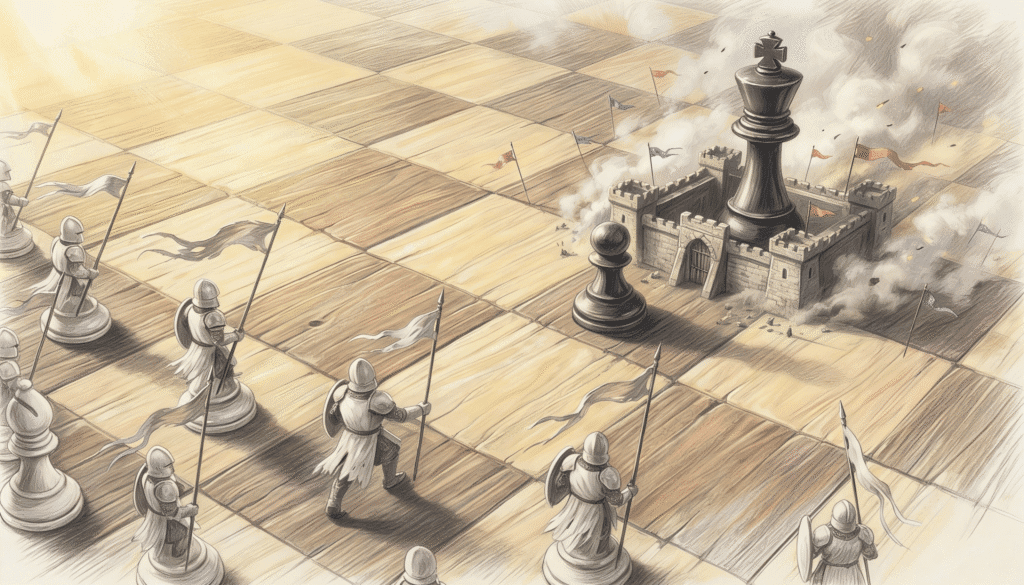
Picture a medieval siege. The attacking army doesn’t simply throw soldiers at the castle walls hoping for the best. They bring battering rams, siege towers, and sappers who tunnel beneath the foundations. The pawn storm operates on the same principle. It’s not about mindless aggression but calculated pressure applied to the exact point where the opponent’s position will crack.
What makes the pawn storm particularly dangerous is its inevitability. Once launched, it cannot be easily stopped or reversed. Pawns move in only one direction. There is no retreat, no second thoughts. This one way nature creates a psychological burden for the defender. They must find the perfect response now, not later. The clock is ticking, and the storm is coming whether they like it or not.
The attacker, meanwhile, enjoys a strange kind of freedom. Having committed to the advance, second guessing becomes pointless. The die is cast. This clarity of purpose often leads to sharper, more decisive play. The defender must solve an increasingly complex puzzle while the attacker simply pushes forward with the logic of gravity itself.
Reading the Position: When to Launch
Every competent player knows that pawn storms exist. The difference between competence and mastery lies in knowing when to unleash them. Launch too early, and the storm dissipates against a well prepared defense. The attacker ends up with a shattered pawn structure and nothing to show for it. Wait too long, and the opponent consolidates their position, sealing every crack and weathering whatever comes next.
The decision to storm requires reading subtle signals in the position. The first signal is king safety, or more precisely, the location of the opposing king. If both kings castle on opposite sides of the board, this creates a natural race condition. Each player storms toward the enemy monarch while their own king supposedly enjoys safety behind its pawn shield. The critical question becomes: whose attack arrives first?
Consider what happens when both players have castled kingside. Now a pawn storm on that flank becomes a double edged sword. The attacker’s own king sits exactly where the battle will rage. This doesn’t make the storm impossible, but it requires extraordinary calculation. The defender needs only to weather the assault and then counterattack against a weakened king position. The mathematics change completely.
The second signal is piece placement. A pawn storm without supporting pieces is just a bunch of pawns walking toward their doom. The minor pieces, the knights and bishops, must be poised to exploit the cracks the pawns create. The major pieces, rooks and queens, need open lines to deliver the final blow. Before launching the storm, look at where the pieces stand. Are they ready to follow the pawns into battle?
The third signal is structural. Some pawn formations invite storms while others resist them. If the opponent has already advanced their own pawns, they have created natural targets and weaknesses. If their pawns remain at home, the attacker must work harder to create entry points. The shape of the position whispers its secrets to those who listen carefully.
The Mechanics of Destruction
A pawn storm operates through several distinct mechanisms, each serving a specific strategic purpose.
The first mechanism is space creation. Each pawn advance claims another square, restricting the opponent’s pieces and expanding the attacker’s territory. Space matters in chess as it does in war. An army cramped into a small area cannot maneuver effectively. Pieces trip over each other, unable to reach critical squares. The storm physically compresses the opponent’s position, making coordination difficult and tactics harder to spot.
The second mechanism is line opening. When pawns advance and exchange, they create open files and diagonals. These are the highways along which rooks, bishops, and queens travel to deliver checkmate. A closed position can suddenly burst open, and whoever controls the newly opened lines usually controls the game. The storm deliberately engineers these openings at the most inconvenient moment for the defender.
The third mechanism is weakness creation. As the opponent responds to the storm, they must make concessions. Perhaps they advance their own pawns, creating holes in their position. Perhaps they place pieces on awkward squares to blockade the advance. Each defensive decision carries a cost. The storm forces the defender to choose between bad options and worse ones.
The fourth mechanism is simply destruction. Sometimes a pawn storm doesn’t need to be subtle. It marches forward, trades itself off, and rips apart the protective shield around the enemy king. Three pawns trading for three pawns might seem equal, but if those pawns guarded a king, their absence creates mortal danger. The defender suddenly faces a naked monarch with attacking pieces streaming toward it.
The Art of Defense
Defense against a pawn storm requires a completely different mindset than launching one. While the attacker thinks linearly, pushing forward with gathering momentum, the defender must think in multiple dimensions simultaneously. They must blockade, counterattack, and keep their position flexible enough to respond to whatever comes next.
The most fundamental defensive principle is restraint. If the opponent’s pawns can be prevented from advancing, the storm never develops its full fury. This means placing pieces, often knights, on squares directly in front of the advancing pawns. A well placed knight can hold back an entire pawn chain. But this defensive stance comes with a cost. The knight performs guard duty rather than participating in counterplay elsewhere.
The second principle is counterattack. The best defense is often a good offense, and this cliché holds particularly true against pawn storms. If the opponent has committed resources to attacking one side of the board, they have necessarily weakened another area. Find that weakness and strike at it. Force the attacker to divert pieces to defense. A pawn storm loses much of its terror when the attacker must constantly glance over their shoulder.
The third principle is calculation. This is where many games are won and lost. The defender must accurately assess whether the storm can be survived. This requires concrete calculation of variations, often many moves deep. Can the attacking pieces break through? If they break through, can the king escape? If the king cannot escape, can the defender create enough counterplay to deliver checkmate first? These are not philosophical questions but mathematical ones that demand precise answers.
The fourth principle is knowing when to hunker down and when to open lines. Sometimes the best defense involves keeping everything closed, denying the attacker the open files they need. Other times, opening lines actually helps the defense by activating defensive pieces and creating escape routes for the king. This judgment separates masters from amateurs.
The Race and the Balance
When both players launch pawn storms on opposite sides of the board, chess transforms into a race. Whoever breaks through first wins. Simple enough in theory, brutal in practice. These races demand accurate calculation, nerve, and precise timing.
The mathematics of opposite side attacks favor the player who starts their storm first, but only slightly. A tempo or two of advantage compounds as the attacks develop. This is why strong players often sacrifice material to accelerate their own storm while slowing the opponent’s. A pawn given up now might mean arriving at the enemy king one move earlier, and one move can be the difference between checkmate and getting checkmated.
What makes these races fascinating is that the balance constantly shifts. One player seems to be winning the race, then a defensive resource appears. The momentum swings. A tactical blow lands, and suddenly the other player is faster. The lead changes hands multiple times before the final outcome emerges. These games become dramatic narratives, full of plot twists and reversals.
The psychological pressure in these races cannot be overstated. Both players know they are walking a tightrope. One mistake likely loses immediately. This creates time pressure even when there is plenty of time on the clock. The mind races through variations, discarding some, following others down rabbit holes. The stress is immense, and whoever handles that stress better often wins.
Historical Context and Evolution
Pawn storms are not a modern invention. Players have launched pawns at enemy kings for centuries. But the understanding of when and how to storm has evolved dramatically. Early chess featured wild tactical melees where both players threw everything forward with little strategic basis. The game was shorter, more violent, and less refined.
The classical era brought sophistication. Players like Wilhelm Steinitz and Siegbert Tarrasch developed principles that governed pawn play. Don’t advance without support. Don’t create weaknesses. Build up slowly before striking. These principles led to games of immense strategic depth but sometimes paralyzing slowness.
The hypermodern revolution questioned these classical principles. Players like Aaron Nimzowitsch and Savielly Tartakower showed that pawn advances could be provocative rather than weakening. Invite the opponent to overextend, then strike at the base of their pawn chain. The pawn storm became more nuanced, a tool to be wielded with both force and finesse.
The modern era, aided by computer analysis, has pushed understanding even further. Engines calculate pawn storms with brutal precision, finding the exact sequence that crashes through. Human players, learning from these silicon teachers, have adopted more concrete approaches. They calculate rather than follow general principles. They storm when the position demands it, not when tradition permits it.
Yet the fundamental nature of the pawn storm remains unchanged. It is an instrument of violence, applied with purpose to achieve a specific goal. The goal is always the same: checkmate the enemy king.
Common Patterns and Themes
Certain pawn storm patterns recur throughout chess at all levels. Recognizing these patterns allows players to launch or defend against storms more effectively.
The minority attack represents a counterintuitive storm concept. The player with fewer pawns on one side of the board advances them against the opponent’s majority. The goal isn’t to checkmate but to create permanent weaknesses in the opponent’s structure. Once created, these weaknesses become targets for the entire game. This delayed payoff makes the minority attack particularly insidious.
The Greek gift sacrifice often follows or accompanies a pawn storm. The attacker sacrifices a bishop on the defender’s kingside, typically to rip away pawn protection. This sacrifice only works when the storm has already weakened the defensive structure. The bishop sacrifice and pawn storm form a devastating combination, turning positional pressure into tactical execution.
The breakthrough involves multiple pawns overwhelming a defensive blockade through sheer force. The attacker calculates a sequence where pawns trade and advance, creating a passed pawn that cannot be stopped. This pattern appears most often in endgames but can occur in the middlegame when one side has achieved overwhelming spatial advantage.
The slow storm creeps forward over many moves, each pawn advance subtle and seemingly harmless. The defender gradually realizes they are being squeezed, but by then it’s too late. The storm has arrived without announcement, and the position has transformed from comfortable to critical. This approach requires patience and strategic understanding, virtues not always found in ambitious players.
The Deeper Game
At its heart, the pawn storm embodies a fundamental chess truth: material advantage matters less than activity and momentum. A player down a pawn or even a piece can storm the enemy position and win through sheer force of attack. The pieces aren’t everything. How they work together, the dynamics they create, matters more than their sum.
This truth extends beyond chess into strategy generally. Raw resources matter less than how those resources are deployed. Timing beats power. Coordination beats individual strength. The pawn storm teaches these lessons in miniature, compressed into 64 squares and 32 pieces.
The storm also teaches about commitment. Once launched, there is no going back. The decision has consequences that ripple through the entire game. This mirrors life, where certain choices foreclose other options. Learning to commit decisively, while understanding the weight of that commitment, is a skill that transcends chess.
Finally, the pawn storm teaches about reading situations and seizing opportunities. The position whispers when the time is right. Most players miss these whispers, playing too slowly or too quickly. The master hears them clearly and acts accordingly. This ability to read subtle signals and respond appropriately separates good players from great ones.
The pawn storm remains one of chess’s most potent and dramatic weapons. From club games to world championships, storms decide outcomes and create memorable moments.
The next game you play, watch for the opportunity to storm. Feel the position, read the signals, and when the moment arrives, push forward with the inevitability of an avalanche. The pawns may be the weakest pieces on the board, but when they march together with purpose, they become an unstoppable force that reshapes the entire game.
That is the true power of the pawn storm, and that is why it will remain central to chess strategy for as long as the game is played.