Table of Contents
Picture this. Your opponent has you cornered. Their pieces are swarming. Victory is in sight for them. They can practically taste it. Their hand hovers over the piece that will deliver the final blow. And then you make a move that changes everything.
This is the Zwischenzug, and it might be the most satisfying tactical weapon in chess.
The German word literally translates to “in between move,” but that dry definition does it no justice. A Zwischenzug is chess’s version of the rope-a-dope. It’s the moment when someone who looks beaten suddenly reveals they’ve been three steps ahead all along. It’s the tactical equivalent of letting your opponent think they’re winning right up until they realize they’ve already lost.
The Setup That Looks Like a Mistake
Chess players love sequences. Move A leads to move B, which forces move C, and so on until checkmate or material gain. The human brain craves these patterns. We see the beginning of a forcing sequence and our minds automatically fill in the rest. It’s how we think. It’s how we calculate. And it’s exactly what makes the Zwischenzug so devastating.
The beauty of this tactic lies in its violation of expectations. When a forcing sequence begins, both players typically see the same roadmap. You take my piece, I take yours back. You threaten my queen, I move it to safety. These exchanges follow a predictable rhythm, like a dance where both partners know the steps.
But what if someone changes the music midway through?
Consider a simple exchange brewing on the board. Your opponent attacks your knight. The natural response is to move it. But what if instead of moving the threatened piece, you create an even bigger threat somewhere else? Your opponent must now address your threat first, and by the time they do, the entire landscape has shifted. That knight they were about to capture? It’s no longer there, or maybe it no longer matters, or perhaps your opponent no longer has the piece they needed to take it.
This is the essence of the in between move. It’s the tactical pause that isn’t really a pause at all. It’s an interruption that shifts the entire conversation.
Why Your Brain Hates It (And Why That Matters)
Human psychology plays right into the Zwischenzug’s hands. Our brains are prediction machines. When we start calculating a sequence, we commit to it mentally. We’ve already seen the future in our mind’s eye. This mental commitment creates a kind of tunnel vision.
Psychologists call this confirmation bias. Once we’ve decided on a course of action, we tend to see only the evidence that supports it. In chess, once a player has calculated a winning sequence, they stop looking for problems with it. They’ve seen checkmate in five moves. Why keep calculating?
The Zwischenzug exploits this perfectly. It appears in the exact moment when your opponent has stopped looking for surprises. They’ve done their homework. They’ve calculated the line. They know what’s supposed to happen next. And that confidence becomes their downfall.
This isn’t about being smarter or calculating faster. It’s about understanding that chess, like life, rarely follows the script we write for it. The player who remembers this simple truth will always have an advantage over the one who forgets.
The Anatomy of the Surprise
What makes an in between move work? It needs three elements to function properly.
First, there must be a forcing sequence already in motion. Something that looks inevitable. An exchange that seems destined to happen. The more obvious this sequence appears, the better the Zwischenzug works. Your opponent needs to feel certain about what comes next.
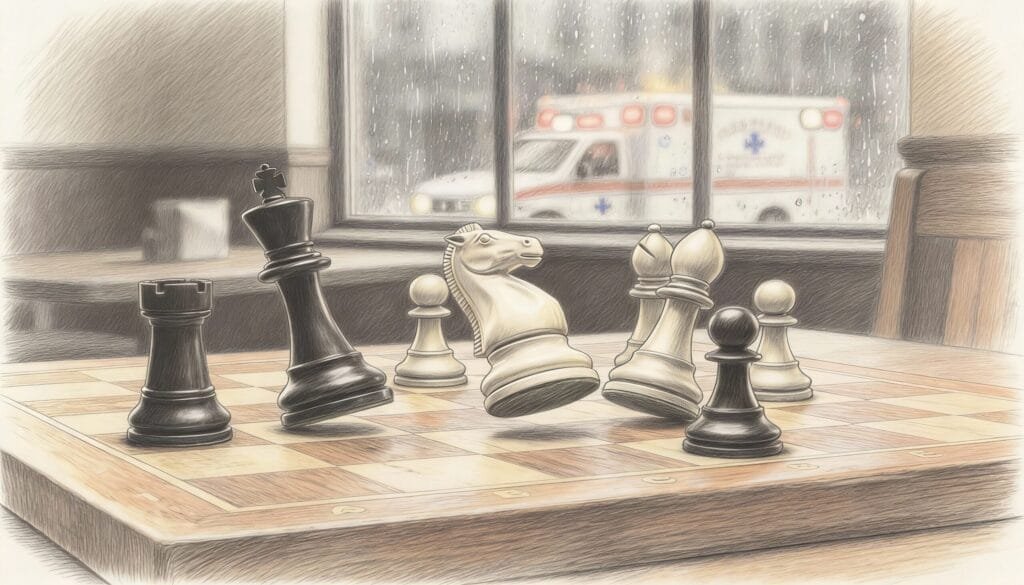
Second, the interrupting move must be even more forcing than the original sequence. It has to demand immediate attention. Usually this means check, or threatening checkmate, or attacking something more valuable than what was originally under threat. The ambulance metaphor works because your “emergency” becomes more urgent than their attack.
Third, and this is crucial, the interruption must fundamentally change the position. By the time your opponent deals with your threat, the board should look different enough that their original plan no longer works. Maybe the piece they wanted to capture has moved. Maybe they’ve lost the piece they needed for the capture. Maybe the entire tactical justification for their sequence has evaporated.
Without all three elements, you just have a random move that delays the inevitable. With all three, you have a tactical thunderbolt.
The Psychology of the Reversal
There’s something deeply satisfying about pulling off a successful Zwischenzug. It’s not just about winning material or avoiding loss. It’s about the narrative reversal. Stories resonate when they subvert expectations, and chess is ultimately about telling a story with pieces.
Your opponent thinks they’re writing a story about your defeat. They’ve set up all the pieces. The plot is clear. The ending is in sight. And then you grab the pen and write a completely different conclusion.
This psychological dimension matters because chess is played by humans, not computers. After falling for a Zwischenzug, your opponent isn’t just worse on the board. They’re also rattled mentally. They’ve just discovered that their understanding of the position was incomplete. Their confidence wavers. They start second guessing their calculations. One good in between move can poison the rest of the game for them.
The best chess players understand this. They don’t just play moves on the board. They play with their opponent’s psychology. The Zwischenzug is a power move precisely because it announces: I see further than you do. I’m controlling this game, not you.
Beyond the Tactic: A Way of Thinking
But here’s where it gets interesting. The Zwischenzug isn’t really just a tactic. It’s a mindset.
Players who understand in between moves start looking at chess differently. They stop seeing forcing sequences as straight lines. Instead, they see them as conversations that can be interrupted. They remain skeptical even when lines look clear. They always ask: what happens if I don’t respond directly?
This mindset transforms how you approach the game. Most players spend their time calculating variations. The Zwischenzug mindset instead asks a simpler question: does this sequence actually have to happen? Can it be derailed?
Sometimes the answer is no. Some forcing sequences truly are unstoppable. But asking the question reveals options that conventional calculation misses. It opens up creative possibilities. It finds resources in positions that looked hopeless.
This applies beyond tactics too. Strategic Zwischenzugs exist. Your opponent is slowly building an attack on one side of the board. The conventional response is to defend. But what if you start an even faster attack on the other side? You’ve interrupted their plan with something more urgent. By the time they’ve dealt with your threats, their original attack has lost its punch.
The Framework for Spotting Opportunities
So how does a player develop this way of thinking? It starts with recognizing the patterns that create Zwischenzug opportunities.
Look for positions where both sides have active pieces creating multiple threats. These rich tactical environments breed interruptions. When there’s only one thing happening on the board, in between moves are rare. When three or four things are happening simultaneously, they become common.
Pay attention to move order. Most tactical sequences have some flexibility in how they unfold. The player who controls the tempo controls the game. Sometimes making the second best move first, if it’s more forcing, beats making the best move at the wrong time.
Watch for pieces that can give check. Checks are the ultimate forcing moves. They demand immediate responses. A checking move that wasn’t part of your opponent’s calculations can derail entire plans. Even if the check itself doesn’t accomplish much, the tempo gain might be everything.
Look for captures that threaten something beyond the immediate material gain. Taking a piece while simultaneously attacking something else creates natural in between move opportunities. Your opponent can’t recapture if they have to deal with your other threat first.
Consider moves that activate dormant pieces. That bishop that’s been sitting in the corner? Maybe it can jump into the game with a threat that’s more urgent than what your opponent is threatening. Fresh piece activity often creates surprise.
The Defensive Dimension
Here’s something that doesn’t get discussed enough: Zwischenzugs are amazing defensive resources. When you’re on the back foot, when your position looks grim, the in between move becomes your lifeline.
Your opponent is attacking. They’ve built up pressure. They’re ready to break through. And then you find a forcing move that makes them pause. Suddenly they’re not attacking anymore. They’re defending. The tables have turned, and you’ve bought time to reorganize your forces.
This is why the ambulance metaphor fits so perfectly. You look like you need emergency care. Your opponent is ready to finish you off. But then you reveal that actually, they’re the one who needs the ambulance. The reversal is complete.
Great defenders understand this instinctively. They don’t just react to threats. They create counterthreats. They turn defense into counterattack. The line between defense and offense blurs when you’re constantly finding ways to interrupt your opponent’s plans.
The Role of Calculation
All of this might make it sound like the Zwischenzug is about creativity over calculation. That’s not quite right. You still need to calculate. You still need to verify that your interrupting move actually works. The difference is what you’re looking for while you calculate.
Most players calculate to find forcing sequences they can execute. Zwischenzug thinking means calculating to find places where you can interrupt forcing sequences. It’s a subtle shift in focus, but it changes everything.
You’re not just asking “what can I do?” You’re asking “what can I do that they aren’t expecting?” You’re not just looking for the obvious. You’re looking for the surprise move that makes sense only in hindsight.
This requires calculation that goes one level deeper. You need to see your opponent’s plan clearly enough to understand where it’s vulnerable. Then you need to find the move that exploits that vulnerability. Then you need to calculate far enough ahead to confirm the interruption actually improves your position.
It’s more work than conventional tactics. But the payoff is worth it.
Learning from Mistakes
Every chess player has fallen for a Zwischenzug at some point. You’ve calculated a winning line. You’ve triple checked it. You make your move with confidence. And then your opponent plays something you never considered. The position collapses. Your advantage evaporates. The game slips away.
These moments hurt. But they also teach the most important lesson about in between moves: always look for them. Not just in your own positions, but in your opponent’s plans.
Before executing a forcing sequence, take one last look. Ask yourself: what’s the most forcing move my opponent can make? Can they interrupt what I’m planning? Have I considered every check, every capture, every piece activation that might throw a wrench in my plans?
This defensive awareness makes you harder to surprise. And paradoxically, it also makes you better at finding Zwischenzugs yourself. You learn to recognize the patterns by watching for them everywhere.
The Practical Application
Understanding the theory is one thing. Applying it at the board is another. Here’s the practical framework.
When your opponent starts a forcing sequence, pause. Don’t automatically follow the script. Take an extra moment to survey the entire board. Are there pieces that could jump into the game? Are there checks available? Can you create a bigger threat than the one you’re facing?
When you’re planning your own attacks, think like your opponent. What interruptions might they have? What forcing moves could derail your plans? Can you structure your attack to minimize these possibilities?
During the game, stay flexible. Even the best plans sometimes need to be interrupted. If you see a more forcing option, consider taking it even if it deviates from what you intended. Chess rewards adaptation more than stubborn adherence to plans.
After your games, review them specifically looking for Zwischenzug opportunities. Where could you have interrupted? Where did you miss your opponent’s interruption? These concrete examples from your own games teach more than any abstract explanation.
The Bigger Picture
The Zwischenzug teaches something that extends beyond chess tactics. It’s a lesson about questioning assumptions and staying alert to possibilities that others miss. It’s about understanding that the obvious path isn’t always the best one.
In chess and in life, people often follow patterns because patterns feel safe. We do what’s expected because expectations provide comfort. The Zwischenzug mindset challenges this. It asks: what if we didn’t follow the expected path? What if we interrupted the normal flow?
This isn’t about being contrarian for its own sake. It’s about maintaining the mental flexibility to see opportunities that others miss because they’re too focused on the obvious. It’s about understanding that sometimes the best move is the one that makes everyone pause and rethink everything they thought they knew.
Chess is a game of patterns and pattern breaking. The Zwischenzug sits at the intersection of both. It works because patterns exist and can be recognized. It succeeds because it breaks those patterns at exactly the right moment.
The next time you’re at the board and your opponent has you cornered, remember the ambulance. Maybe you do need one. But maybe, just maybe, you can find that one forcing move that changes everything. That move that makes your opponent realize they’re the one in trouble. That move that turns defense into attack and potential defeat into surprising victory.
That’s the Zwischenzug. That’s the in between move. And once you start seeing them, you’ll find them everywhere.