Table of Contents
The idea sounds backwards at first. A game designed to simulate medieval warfare, where the entire objective is to corner an enemy king, somehow transforms players into more understanding human beings. Yet anyone who has spent serious time at the chessboard knows this strange truth. The game that teaches you to plot your opponent’s downfall also teaches you to see the world through their eyes.
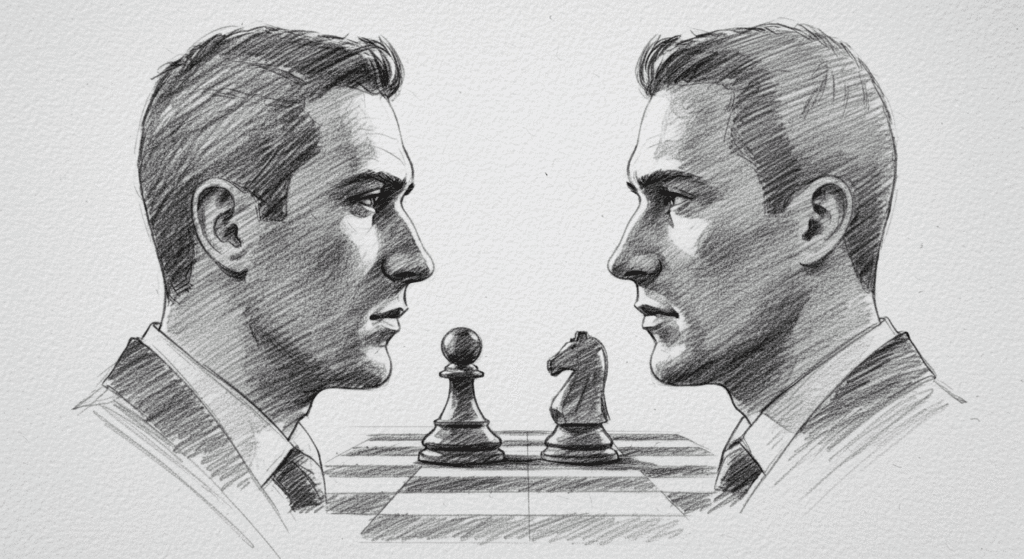
Consider the scene that plays out in chess clubs and online platforms every day. Two people sit across from each other, silent, concentrating. Each is trying to destroy the other’s position. Each is calculating threats, looking for weaknesses, planning attacks. And yet, after the game ends, they often shake hands with genuine warmth. They discuss what happened with mutual respect. Sometimes they become friends. The battlefield becomes a bridge.
This transformation happens because chess demands something unusual from its players. To win, you must become your opponent.
The Strange Theater Inside Your Head
Chess creates a peculiar mental space. When a player stares at the board, two parallel realities exist in their mind. In one reality, they imagine their own plans unfolding perfectly. The pieces flow into ideal positions. Threats multiply. Victory appears inevitable. But experienced players know this fantasy means nothing.
The second reality matters more. In this version, the player tries to inhabit their opponent’s mind. What does the other person see? What are they planning? What do they fear? What have they overlooked? This mental exercise is not optional. A player who only thinks about their own plans will lose to someone who understands what threatens them.
The process mirrors what psychologists call perspective taking, the ability to mentally step into another person’s shoes. But chess makes this abstract concept concrete. The board forces you to practice it, move after move, game after game.
A player learns that their opponent is not stupid. That tempting piece left hanging in the center of the board might be bait. That seemingly passive move might prepare a devastating blow. The other person has plans, just as sophisticated as your own. They have ideas you did not consider. They see possibilities you missed. Respecting their intelligence becomes a survival skill.
The Wisdom Hidden in Defeat
Every chess player, from beginner to grandmaster, loses constantly. The game is perfectly balanced. Against an equal opponent, you will lose about half the time. Against someone better, you will lose more. This steady stream of defeats creates something unexpected. It builds humility.
Picture a player who just lost a game they thought they were winning. The position looked favorable. Then, suddenly, it collapsed. Reviewing the game, they discover their opponent saw something they missed ten moves earlier. A subtle weakness. A long term plan. The defeat feels complete because it was not just bad luck. The other person outthought them.
This experience repeats itself hundreds of times for anyone who plays seriously. Each loss delivers the same message. You are not as clever as you think. Your understanding is incomplete. Someone else found a solution you could not see. The accumulation of these lessons changes how players view disagreements outside the game.
When someone holds a different opinion about politics, relationships, or life choices, the experienced chess player has a template for understanding. Perhaps the other person sees something real. Perhaps their reasoning follows a logic that makes sense from their perspective. Perhaps dismissing them as wrong is like dismissing an opponent’s move as bad, only to discover three moves later that it was brilliant.
Different Minds, Different Worlds
One remarkable aspect of chess is how many ways exist to play it well. Some players build slowly, accumulating small advantages over many moves. Others sacrifice material for quick attacks. Some seek complex positions with many possibilities. Others simplify to endgames where technique matters. All these approaches can succeed.
A player who loves aggressive attacks must learn to face someone who defends patiently. The defender is not playing wrong. They are playing differently. To beat them, the attacker must understand what the defender values, how they think, what makes them comfortable. The same applies in reverse. The defender must learn the attacker’s language.
This mirrors the diversity of human personalities and values. Some people prioritize security. Others chase excitement. Some build carefully toward long term goals. Others seize immediate opportunities. Chess players learn that these differences are not defects. They are strategies, each with strengths and weaknesses.
The concept extends to cultural differences. Chess has champions from dozens of countries, each bringing their own style influenced by how they learned the game. Russian players often show deep theoretical preparation. American players might emphasize practical fighting qualities. Indian players frequently display brilliant calculation. These generalizations are rough and incomplete, but they point to something real. Different environments produce different approaches to the same problems.
Understanding this creates intellectual flexibility. If ten different styles can succeed at chess, perhaps ten different philosophies can lead to good lives. Perhaps the person who solves problems differently is not making mistakes. They are playing a different game, with different goals.
The Map Is Not the Territory
Every chess player builds a mental model of what the position means. They evaluate who is better and why. They form plans based on this evaluation. Then reality intrudes. The opponent makes an unexpected move. The evaluation changes. The plan fails. The model was incomplete.
This cycle teaches a crucial lesson about knowledge. Your understanding of reality is always partial. The board looks one way to you and another way to your opponent. Both of you are working with incomplete information, not about the pieces themselves, but about what the position means and where it leads.
Philosophers might call this epistemic humility, the recognition that your knowledge has limits. Chess gives you dozens of chances each game to experience these limits directly. You thought the position was equal, but you were slowly losing. You thought you had an attack, but your opponent had a stronger defense. You thought a move was safe, but it contained a hidden flaw.
Players learn to hold their evaluations lightly. They might think they are winning, but they add a mental note. They might be wrong. The position is complex. The opponent might see something different. This habit of mind transfers beyond the board.
In arguments about politics, morality, or personal choices, the chess player has practice saying “I think this is right, but I might be missing something.” Not from false modesty, but from genuine experience with the limits of their own perception. The board has humbled them too many times for arrogance.
When Competition Creates Connection
The relationship between chess players is strange and beautiful. They sit down as opponents, each trying to defeat the other. The game is zero sum. One wins, one loses. And yet, they are also partners in a shared experience. Neither can play without the other. The quality of the game depends on both people bringing their full effort.
This creates an unusual form of respect. Your opponent is simultaneously trying to crush you and giving you the gift of challenge. A weak opponent who plays carelessly offers nothing. A strong opponent who fights hard, even if they defeat you, gives you a chance to test yourself, to learn, to improve.
Good players thank their opponents for the game, win or lose. They mean it. The other person gave them their time, their attention, their effort. They created the conditions where growth was possible. This gratitude exists despite the competitive nature of the activity, or perhaps because of it.
The lesson applies to conflict outside chess. Someone who disagrees with you sharply might be offering something valuable. They are testing your ideas. They are forcing you to defend your position, to find its weaknesses, to think more deeply. The disagreement might feel threatening, but it can serve the same function as a tough opponent. It makes you better.
This does not mean all conflict is good or that every disagreement deserves respect. But it suggests a different starting point. Instead of seeing opposition as purely negative, players learn to look for what they might gain from the encounter.
The Patience That Comes From Complexity
Chess positions can be staggeringly complex. A single position might allow dozens of reasonable moves. Each move leads to new positions, each with dozens more possibilities. The tree of variations branches endlessly. Even powerful computers cannot calculate everything.
Players learn to make decisions with imperfect information. They assess probabilities. They trust their intuition. They make their best judgment and accept uncertainty. Sometimes they guess wrong. The position was more complicated than they realized. The move they rejected was actually better than the move they played.
This experience creates patience with complexity in other domains. A player who has struggled with a difficult chess position knows that complicated problems rarely have obvious solutions. Quick judgments often miss important factors. The easy answer is often wrong.
Building Understanding Move by Move
Empathy is not a single skill. It is a collection of mental habits. The ability to imagine other perspectives. The willingness to question your own certainty. The recognition that people have different but valid approaches to problems. The patience to understand before judging. The humility that comes from being wrong repeatedly.
Chess does not directly teach players to care about others’ feelings. It is not primarily about emotional connection. But it builds the cognitive scaffolding that empathy requires. Through thousands of games, players practice seeing through eyes that are not their own. They learn that their initial understanding is often incomplete. They develop respect for different styles of thinking.
The game creates empathy almost as a side effect. Players begin by wanting to win. But to win, they must understand their opponent. To improve, they must learn from their losses. To enjoy the game, they must appreciate the diversity of approaches others bring. The structure of the activity guides them toward these realizations.
The Person Across the Board
In the end, chess players develop a specific way of looking at the person across the board. They see a mind at work. They see someone with their own plans, their own understanding, their own goals. They see someone who might defeat them, who might teach them something, who shares their passion for this strange game.
This way of seeing transfers. The person who disagrees with you is not an obstacle. They are another mind, working through problems in their own way. They might be right about something you missed. They might have experience you lack. They might see consequences you overlooked.
The player who learned empathy through chess did not set out to become more understanding. They wanted to get better at a game. But the game demanded that they step outside themselves. It insisted they recognize other minds as complex and capable. It rewarded them for understanding instead of dismissing. It taught them, slowly and patiently, through countless small defeats and victories, that other perspectives exist and matter.
This is the paradox at the heart of chess. A game about war teaches peace. A competition creates connection. A battle of minds builds bridges between them. The weapons are wooden pieces, and the casualties are pride and certainty. What survives is something better. Understanding that complexity exists. Respect for different approaches. Recognition that the world looks different from different angles. Humility about the limits of your own perspective.
These lessons do not make chess players saints. But they create openings for empathy to grow. And in a world that often divides people into allies and enemies, these openings matter. The chessboard reminds us that even opponents share something. They are both human minds, trying to make sense of a complex position, doing their best with what they know.
The sixty four squares contain more than a game. They contain a laboratory for understanding what it means to face another person and truly try to see what they see.